

The Garmin Fenix 8 AMOLED is the best outdoor GPS watch for most serious hikers, trail runners, and multisport athletes right now. It combines multi-band positioning, full-color maps, physical controls, a bright AMOLED screen, 10 ATM water resistance, and enough battery for a long weekend away from an outlet. At Garmin’s current $999.99 list price for the 43mm and 47mm AMOLED models, it earns that recommendation through its combination of mapping, controls, and training tools. Budget $400.99 less for the Suunto Vertical 2 if those extra Garmin tools will go unused.
This guide covers rugged GPS watches for hiking, trail running, and multisport training. Every main pick offers multi-band positioning, offline navigation, and a case built for outdoor use. Apple’s two-day normal-use rating requires more frequent charging than the dedicated sports watches. Our Best Fitness Tracker guide covers lighter everyday trackers, while the Best Smartwatch guide starts with phone compatibility, apps, calls, and daily convenience.
Manufacturer prices and specifications were checked on October 15, 2026. All prices below are manufacturer list prices, not current Amazon offers. Prices move, colors sell out, and third-party sellers rotate, so use the links to confirm the current total and exact model before buying.
5 Picks for 5 Different Buyers
The five slots answer distinct outdoor questions: the best all-around tool, the best option for iPhone users, the clearest offline maps for the money, the longest battery life, and the best recovery guidance. Each slot reflects a different constraint on the same outdoor brief.
- Best overall: Garmin Fenix 8 AMOLED
- Best for iPhone users: Apple Watch Ultra 4
- Best for offline maps: Suunto Vertical 2
- Best battery life: COROS VERTIX 2S
- Best recovery guidance: Polar Grit X2 Pro
How We Picked
We chose five buyer questions on purpose: all-around outdoor capability, iPhone integration, offline mapping, long-course battery life, and recovery guidance. We did not create separate slots for diving, golf, or everyday smartwatch apps. Those are legitimate needs, but they would turn one focused outdoor guide into three unrelated lists.
We weight navigation and multi-band GPS first, followed by battery at default settings, physical durability, controls that work in rain or with gloves, training and recovery tools, and current price. Manufacturer ratings set the baseline. We checked the manufacturer product pages and exact Amazon device identities, then compared the practical trade-offs. We also account for charging stops and navigation needs on long trips.
The Fenix 8 AMOLED is our default for buyers who need the broadest mix of outdoor and training tools. The other four picks exist because a specific constraint makes that default wrong: you carry an iPhone and want cellular on your wrist, you want the largest offline map screen for the money, you want long daily-use endurance and standard GPS tracking, or you train by Polar’s recovery language. If none of those describes you, buy the Fenix 8 and skip the rest of this guide.
Specs at a Glance
| Slot | Watch | Manufacturer list price | Display | Battery claim | GPS claim | Water rating |
|---|---|---|---|---|---|---|
| Overall | Garmin Fenix 8 AMOLED | $999.99 list (43mm/47mm) | 1.4-inch AMOLED | Up to 16 days | Up to 47 hr GPS-only; 35 hr multi-band/SatIQ | 10 ATM |
| iPhone | Apple Watch Ultra 4 | From $799 at Apple | OLED, 49mm case | Up to 50 hr normal use | Up to 18 hr workout tracking | 100m |
| Offline maps | Suunto Vertical 2 | $599 list | 1.5-inch AMOLED | Up to 20 days | Up to 65 hr multi-band | 100m |
| Battery life | COROS VERTIX 2S | $699 list | 1.4-inch MIP | Up to 36 days with sleep and stress | Up to 118 hr standard GPS; 43 hr dual-frequency | 10 ATM |
| Recovery | Polar Grit X2 Pro | $999.99 list | 1.39-inch AMOLED | Up to 10 days | Up to 43 hr | WR100 |
Battery ratings use different test conditions. Garmin smartwatch figures assume gesture display; Suunto’s 20 days include daily heart rate and wrist-raise display. COROS’s 36 days include sleep and daily stress; its 118 hours use standard GPS, versus 43 hours in dual-frequency mode. Apple’s 18-hour figure is workout tracking. These are not equivalent multi-band endurance tests.
Best Overall: Garmin Fenix 8 AMOLED

$999.99 list price for 43mm or 47mm AMOLED. Check the current price on Amazon →
The Fenix 8 AMOLED wins the broadest outdoor brief. Its 47mm model pairs a 1.4-inch, 454 x 454 AMOLED display with multi-band GPS, color maps, a flashlight, touchscreen navigation, five buttons, 10 ATM water resistance, and a dive rating to 40 meters. Garmin’s training, routing, safety, and recovery tools also cover more activities than the narrower systems below.
The limitation is cost and complexity. Garmin’s menus reward time spent learning them, and the Fenix 8 is heavier and more expensive than a purpose-built running watch. At $999.99, this is a premium all-around choice. The $599 Suunto Vertical 2 is better value if maps and battery cover your needs.
- Pros: Full maps, multi-band GPS, physical buttons, touchscreen, flashlight, 10 ATM rating, broad training platform.
- Cons: Dense interface, bulky beside a running watch, $999.99 list price.
Who it’s for: Buyers who want one rugged watch for hiking, trail running, skiing, swimming, training, and daily wear.
👉 Also consider: the Suunto Vertical 2 if mapping clarity and price outrank Garmin’s software depth. Deep dives: Fenix 8 AMOLED vs Suunto Vertical 2 and Fenix 8 AMOLED vs COROS VERTIX 2S.
Best for iPhone Users: Apple Watch Ultra 4
From $799 at Apple; band choice can raise the price. Check the current price on Amazon →
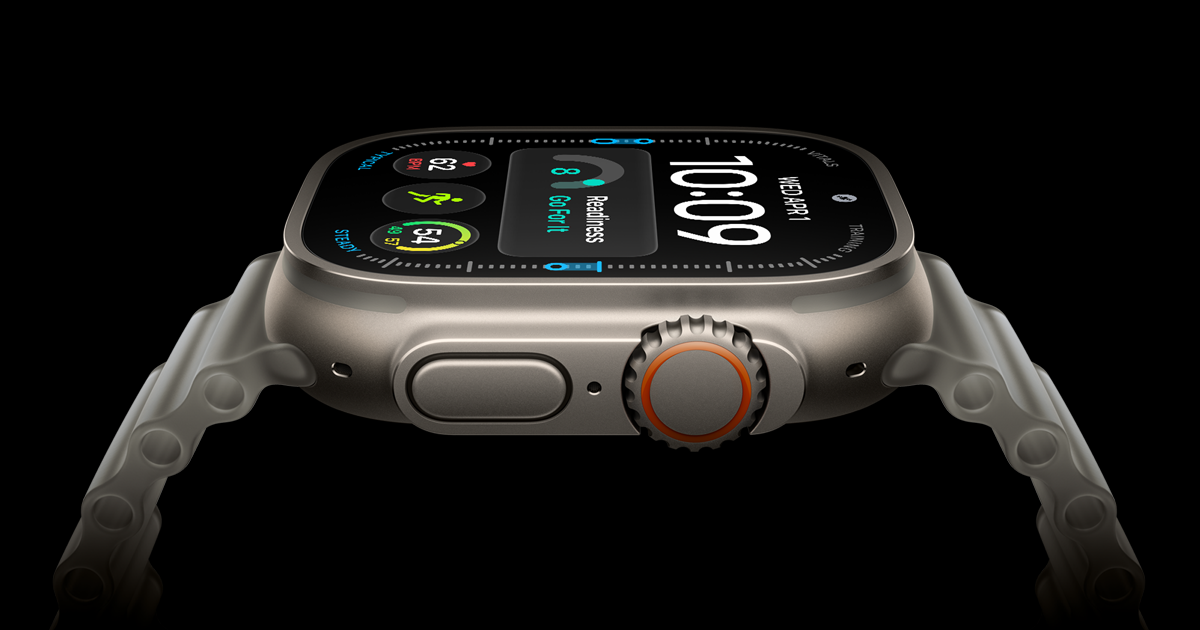
The Ultra 4 pairs a 49mm titanium case, dual-frequency GPS, offline maps, a 100-meter water rating, cellular connectivity, and an OLED display with iPhone apps, calls, and payments. Apple also lists satellite communications, subject to regional availability and service conditions. Download maps and set up communication features before leaving coverage.
Apple rates it for up to 50 hours of normal use and 18 hours of workout tracking. Extended and Max Extended Workout modes reach 25 and 45 hours respectively with different tracking settings. Those ratings need separate consideration from the dedicated watches’ GPS modes. Ultra 4 requires an iPhone 11 or later running iOS 27 or later, and cellular service requires a compatible plan.
- Pros: iPhone integration, dual-frequency GPS, offline maps, cellular and satellite features, 100m rating.
- Cons: Frequent charging on long trips, iPhone only, communication services have coverage and plan restrictions.
Who it’s for: iPhone owners who want an outdoor watch with everyday apps and communication tools.
👉 Also consider: the Suunto Vertical 2 for offline maps at a lower list price. Apple’s Ultra 4 specifications detail the workout modes and service requirements.
Best for Offline Maps: Suunto Vertical 2

$599 list price. Check the current price on Amazon →
The Vertical 2 puts the trail on the best screen in this group for $400.99 less than the $999.99 Fenix 8. Its 1.5-inch, 466 x 466 LTPO AMOLED display leaves more room for topographic detail, while offline maps, route navigation, multi-band GPS, and a built-in flashlight cover the essentials away from cell service. Suunto rates it for 20 days in daily use and 65 hours in its highest-accuracy GPS mode.
The trade-off is ecosystem depth. Suunto’s interface is easier to approach, but Garmin offers more activity profiles, Connect IQ apps, and training detail. The steel Vertical 2 also weighs 87 grams, which is noticeable during sleep and long runs. Choose it because mapping, screen size, and battery are the priorities, not because it tries to match Garmin feature for feature.
- Pros: Large AMOLED map display, offline maps, 65-hour GPS claim, flashlight, competitive $599 list price.
- Cons: Heavy in steel, fewer apps and training layers than Garmin, no NFC payments.
Who it’s for: Hikers and trail runners who want readable offline maps and long GPS endurance without crossing into four figures.
👉 Also consider: the COROS VERTIX 2S if battery life outranks AMOLED map clarity. Deep dive: Suunto Vertical 2 vs COROS VERTIX 2S.
Best Battery Life: COROS VERTIX 2S

$699 list price. Check the current price and availability on Amazon →
The VERTIX 2S earns this slot with up to 36 days of daily use including sleep and stress tracking, or 40 days with sleep tracking alone. Standard GPS runs for up to 118 hours; dual-frequency mode is rated for 43 hours. Its 50.3mm titanium-bezel case, sapphire glass, 10 ATM rating, multi-band positioning, offline maps, and 32GB of storage turn that endurance into a credible expedition tool rather than a battery stunt. Its $699 list price is $100 below Garmin’s current $799.99 Enduro 3 list price. Choose a GPS mode that covers your planned time on course with a safety margin.
The MIP display is the compromise. It reads well in sunlight and helps the battery, but it lacks the color, contrast, and indoor clarity of the AMOLED screens from Garmin, Suunto, Apple, and Polar. Its 50mm case is large, and band choice changes the weight. COROS’s current product page marks it out of stock, so verify the seller and exact device before ordering from Amazon.
- Pros: 36-day daily-use claim with sleep and stress, 118-hour standard GPS claim, titanium and sapphire construction, 10 ATM rating, offline maps.
- Cons: Dimmer MIP display indoors, 50.3mm case, no payments, inconsistent Amazon availability.
Who it’s for: Ultrarunners and expedition users who want three-digit GPS endurance without paying Garmin Enduro money.
👉 Also consider: the Suunto Vertical 2 for a brighter map screen and easier everyday interface. Deep dives: Fenix 8 AMOLED vs VERTIX 2S.
Best Recovery Guidance: Polar Grit X2 Pro

$999.99 list price. Check the current price on Amazon →
The Grit X2 Pro is our specialist choice for athletes who want Polar’s recovery-testing workflow in a rugged watch. Polar combines Nightly Recharge, Sleep Plus Stages, orthostatic testing, Recovery Pro, training load, and FuelWise guidance with dual-frequency GPS and offline topographic maps. The 1.39-inch AMOLED, sapphire glass, stainless-steel case, WR100 rating, and MIL-STD-810H testing keep that recovery focus inside a legitimate outdoor body.
At $999.99, it costs the same as the Fenix 8 and $400.99 more than the Suunto Vertical 2. There is no price advantage. Polar rates it for 10 days of smartwatch use and 43 hours in performance training mode. Choose it if Nightly Recharge, Recovery Pro, and regular orthostatic tests fit how you train; the Fenix remains our default for broader outdoor use.
- Pros: Detailed sleep and recovery guidance, dual-frequency GPS, offline maps, AMOLED, sapphire glass, WR100 rating.
- Cons: $999.99 list price, 10-day smartwatch rating, fewer everyday smart features than Apple or Garmin.
Who it’s for: Polar athletes who want outdoor navigation and structured recovery guidance in the same watch.
👉 Also consider: the Suunto Vertical 2 if a larger map screen and a 20-day battery claim outrank Polar’s recovery language. Deep dive: COROS VERTIX 2S vs Polar Grit X2 Pro.
Who Should Skip This List: Garmin Fenix 8 Pro

$1,099.99 list for 47mm AMOLED; $1,199.99 for 51mm AMOLED. Check the current price on Amazon →
The Fenix 8 Pro suits buyers who need off-grid communications. Its satellite messaging and LTE features require an inReach plan and can justify the price for guides, remote crews, and solo adventurers who routinely travel beyond phone coverage. Most buyers will get the same core Garmin training, mapping, flashlight, 10 ATM construction, and AMOLED experience from the cheaper Fenix 8.
The battery case is also weaker than the name suggests. The 47mm model is rated for 15 days in smartwatch mode and 44 hours of GPS-only use, close to the standard Fenix 8 and behind the COROS on both figures. Pay for the Pro only when its connection hardware changes your safety plan. Everyone else should keep the difference.
Go deeper: Garmin Fenix 8 Pro vs Fenix 8 and Fenix 8 AMOLED vs Fenix 8 Pro.
What We Didn’t Include
- Garmin Instinct 3: It is the better lower-cost rugged choice, especially in Solar form, but breadcrumb navigation does not replace the full-color offline maps required for this roster.
- Amazfit T-Rex 3 Pro: Consider it if its feature set better fits your budget; it is outside these five slot selections.
Our Best Premium Marathon Training Watches guide is the narrower sub-guide for road runners spending more than $500. It favors training fit and wrist comfort over expedition battery and rugged construction.
FAQ
What is the best outdoor GPS watch in 2026?
The Garmin Fenix 8 AMOLED is the best outdoor GPS watch for most serious users at Garmin’s $999.99 list price for the 43mm and 47mm AMOLED models. It combines full maps, multi-band GPS, physical controls, a touchscreen, a flashlight, 10 ATM water resistance, and a deep training platform.
Which outdoor watch has the best battery life?
The COROS VERTIX 2S has the best battery life in this guide, with up to 36 days including sleep and daily stress tracking, 40 days with sleep tracking alone, and 118 hours in standard GPS mode. Dual-frequency GPS is rated for 43 hours. The $799.99 Enduro 3 costs $100 more and offers up to 120 hours of GPS-only use without solar.
Which GPS watch is best for hiking maps?
The Suunto Vertical 2 is our offline-maps pick. Its 1.5-inch AMOLED gives offline topographic maps more room than the other screens here, and its $599 list price undercuts the premium Garmins.
Is the Apple Watch Ultra 4 good for hiking and ultrarunning?
It suits day hikes and races within its battery budget. Apple rates Ultra 4 for 18 hours of workout tracking, 25 hours in Extended Workout mode, and 45 hours in Max Extended Workout mode. Check each mode’s tracking settings and leave a charging margin for long events.
Do outdoor GPS watches work without a phone?
All five picks can record routes and navigate offline without carrying a phone. Phone-free calls, messages, and emergency communication are different: Apple Watch Ultra 4 offers cellular and satellite features, while Fenix 8 Pro offers satellite and LTE through an inReach plan. Availability, setup, and service conditions vary.
Is multi-band GPS worth paying for?
Multi-band GPS earns its keep in canyons, forests, mountains, and dense cities where reflected or blocked signals can distort a route. On open roads and short walks, a good single-band receiver can still be accurate enough.
Last reviewed: November 2026 · Next review: January 2027
Methodology
Price and specification sources checked October 15, 2026: Fenix 8 47mm, Fenix 8 43mm, Ultra 4, Vertical 2, VERTIX 2S, Grit X2 Pro, Fenix 8 Pro, and Enduro 3.
We re-review this guide every 3 months. Picks use verified manufacturer specifications, the FTT wearables database, current catalog availability, live Amazon targets, and published head-to-head comparisons. Fitness Tech Trends may earn a commission if you buy through an Amazon link above, at no extra cost to you. Prices move and sellers change, so verify the exact model, seller, and current total before purchase.
