

Quick Ranking
Short version: buy the Garmin Forerunner 265. At a street price near $343, it is the cleanest Garmin runner’s watch in 2026: AMOLED, multi-band GPS, and the full Garmin training brain — Training Readiness, PacePro, and Race Widget predictions — without the maps tax of the 965. The 2026 story for Garmin runners is not the 970 or 570. It is the discount-era flagships, and the 265 leads it.
- Garmin Forerunner 265 — Best Overall — Check Price
- Garmin Forerunner 255 — Best Value — Check Price
- Garmin Forerunner 965 — Best Premium — Check Price
- Garmin Forerunner 955 — Best for Trail / Multi-sport Runners — Check Price
- Garmin Fenix 7 Sapphire Solar — Best Endurance Pick — Check Price
Anti-pick: Garmin Forerunner 165. Lovely entry watch, wrong tool if you take running seriously enough to be reading this.
Most “best Garmin for runners” lists in 2026 are quietly out of date. They still rank the latest releases — the Forerunner 970 at $749, the 570 at $549 — as if MSRP is what you actually pay. It is not. The 2026 reality is that Garmin’s previous-generation flagships are sitting at 20% to 44% off, and they are still better runner’s watches than the entry tier. That is the entire shape of this list.
Prices below were verified on May 4, 2026. Prices move — always re-check before you buy — but the discount-era thesis is not a one-week deal. Garmin is clearing out 7-series and previous-gen Forerunners as the 8/9-series moves in.
Last reviewed: August 2026 · Next review: August 2026
How We Ranked
This is a Garmin-only roundup for runners — people whose week includes pace work, structured training, and at least one long run. Every pick was judged as a running tool first, smartwatch second.
- GPS trust: Multi-band GPS (L1+L5) is non-negotiable for serious pace work. Single-band gets demoted, full stop.
- Training intelligence: Training Readiness, PacePro, Race Widget, structured workouts. The watch should help you train better, not just record it.
- Battery in GPS mode: Twenty hours is the floor. Below that, you lose the “forgot to charge it” safety margin on race week.
- Price-per-feature in 2026, not at launch: A 2024 flagship at -30% is judged on its 2026 street price, not its 2024 sticker.
- Reader fit: “Best Overall” and “Best Value” are different shoppers with different priorities. Same with the trail runner who needs maps.
Quick Specs Snapshot
| Watch | Street | GPS Battery | GPS Type | Display | Maps |
|---|---|---|---|---|---|
| Forerunner 265 | $343 | 20 hours | Multi-band | 1.3-inch AMOLED | No |
| Forerunner 255 | $237 | 30 hours | Multi-band | 1.3-inch MIP | No |
| Forerunner 965 | $504 | 31 hours | Multi-band | 1.4-inch AMOLED | Full topo |
| Forerunner 955 | $459 | 42 hours | Multi-band | 1.3-inch MIP | Full topo |
| Fenix 7 Sapphire Solar | $449 | 73 hours | Multi-band | 1.3-inch MIP | Full topo |
The Best Garmin Watches for Runners in 2026
#1 Garmin Forerunner 265 — $343
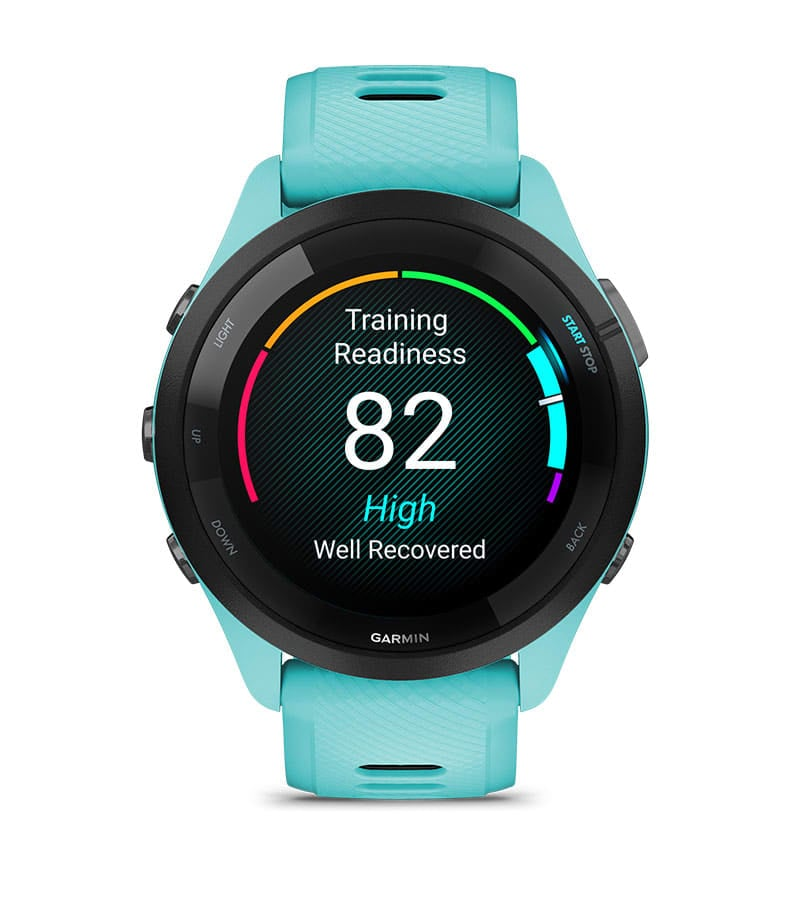
Verdict: The cleanest answer for the Garmin runner in 2026. The 265 was a $449 watch when it launched. In May 2026 it streets near $343 — a 23% cut on the very watch most marathoners spent two years recommending at full price. You get multi-band GPS, an AMOLED screen, and Garmin’s real training stack: Training Readiness (a daily score blending HRV, sleep, and load), PacePro (race-pace strategies that adjust for elevation), and Race Widget predictions that recalibrate as your training progresses. The new 570 above it adds a microphone, a bigger screen, and a $200 price increase. Most runners will not feel the difference. They will feel the $200.
Pros:
- Training Readiness, PacePro, and Race Widget — Garmin’s three best running-specific tools, all here.
- Multi-band GPS plus a 20-hour GPS battery makes it race-day safe for any marathon distance.
- 1.3-inch AMOLED display: bright, sharp, the upgrade most buyers actually feel daily.
- 23% off list. Same hardware that earned its reputation, fewer dollars to earn it.
Cons:
- No maps. If your training routes need turn-by-turn or topo, jump to the 965.
- Battery is fine, not class-leading. The 955 and Fenix 7 Sapphire Solar trounce it on long days.
Best for: Road and track-focused runners who want the full Garmin training brain without paying flagship-tier prices.
For the AMOLED-vs-MIP decision that defines slots #1 and #2, start with Forerunner 265 vs Forerunner 255.
#2 Garmin Forerunner 255 — $237

Verdict: The runner’s value play, and the watch you keep noticing on elite wrists at major marathons. The 255 ships with what serious runners actually need: multi-band GPS, 30-hour GPS battery, full structured-workout support, daily training-load and recovery analysis, and a 1.3-inch MIP screen that is genuinely easier to read in direct sun than any AMOLED. At $237 — a 32% cut from its $349.99 launch price — it is the most spec-honest watch in this entire roundup. The reason it sits at #2 instead of #1 is simple: the 265 is the same training computer with AMOLED added, and at $343 the AMOLED tax is now $106 instead of $100. Worth it for daily wear, not worth it for pure pace work.
Pros:
- Multi-band GPS at $237 is the most absurd value in running watches right now.
- 30-hour GPS battery covers every long run a marathoner will throw at it.
- Same training stack as the 265 — daily suggested workouts, training-load analysis, race-pace strategies.
- MIP transflective screen wins outright in bright outdoor sun.
Cons:
- No Training Readiness or PacePro — Garmin gates those behind the 265.
- MIP screen looks dated next to AMOLED if you wear it as a daily smartwatch.
- No music storage on the base 255 (the 255 Music model is a separate SKU).
Best for: Runners who care about pace data and battery, not screen glamor — and want to keep $100+ for shoes.
If the price gap is what is paralyzing you, Forerunner 265 vs Forerunner 255 is the cleanest breakdown of what the extra $106 actually buys.
#3 Garmin Forerunner 965 — $504
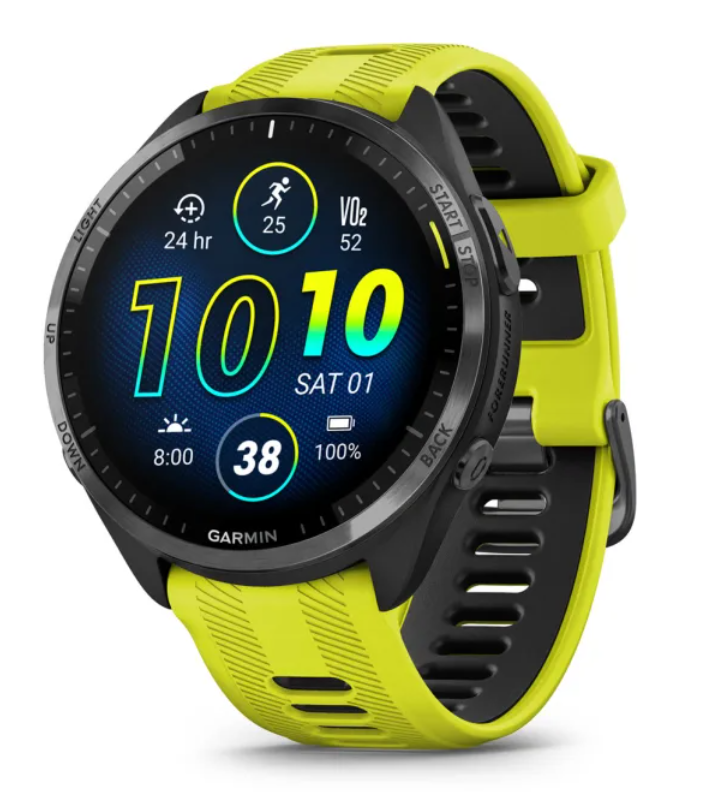
Verdict: The Forerunner flagship for runners, with maps. The 965 keeps everything that earned the 265 its slot and adds the upgrades that road runners stop being able to ignore once their long runs creep past 18 miles: full topographic maps with turn-by-turn navigation, ClimbPro for elevation pacing, a 1.4-inch AMOLED, and a 31-hour GPS battery. It launched at $599.99; in May 2026 it streets near $504. That is a 16% cut — not the headline discount on this list, but enough to keep the price-per-feature math honest against the new 970, which adds a microphone and an ECG sensor for an extra $245. If you have ever cursed your watch at mile 22 because you took a wrong turn in an unfamiliar marathon, the maps alone justify the upgrade from a 265.
Pros:
- Full topographic maps + turn-by-turn navigation — the feature road runners do not realize they need until race day.
- 1.4-inch AMOLED is the largest, sharpest screen in the Forerunner line.
- 31-hour GPS battery handles ultra-distance training without flinching.
- Same Training Readiness, PacePro, and Race Widget tooling as the 265.
Cons:
- $504 is real money for features (maps, bigger battery) that pure track-and-road runners may never use.
- Bigger and slightly heavier than the 265 — not a deal-breaker, but noticeable on small wrists.
- The 970 above it is the “true” current-gen flagship if you want LTE messaging or ECG.
Best for: Marathoners and ultra-curious road runners who want maps and the bigger AMOLED, without paying $749 for the 970.
Want to see how the 965 stacks up against the rugged adventure-watch alternative? Forerunner 965 vs Fenix 7 is the head-to-head between slots #3 and #5. Coverage of the recent 965 price cut backs up the discount-era thesis.
#4 Garmin Forerunner 955 — $459
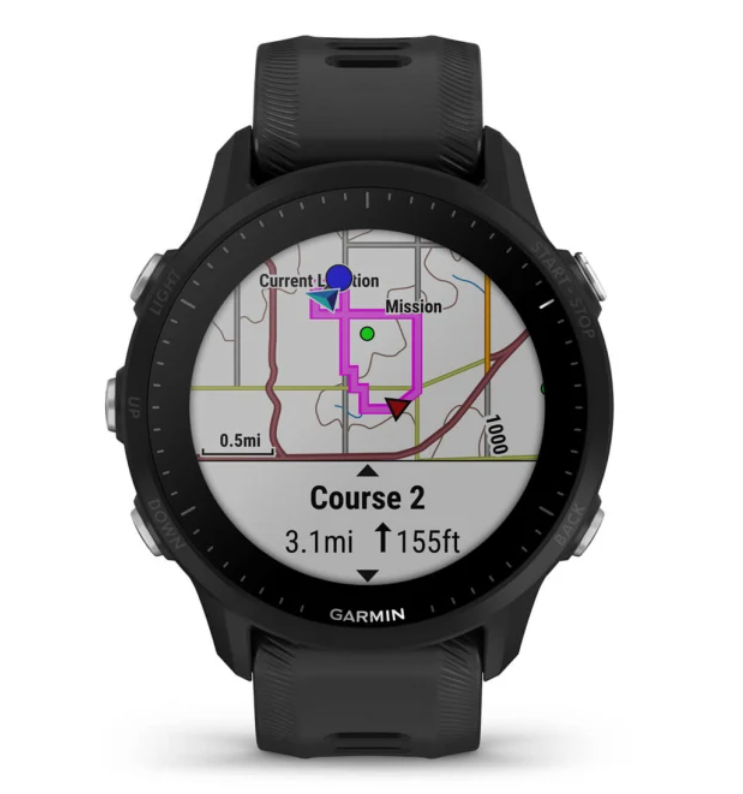
Verdict: The runner’s endurance pick. The 955 keeps the same training stack as the 965 but trades AMOLED for a 1.3-inch MIP display and stretches the GPS battery to 42 hours — double the 265’s. You also get full topo maps and ClimbPro at this price. At $459 — an 8% cut from a $499.99 list, the smallest discount on this list — the 955 is no longer the screaming deal it was at $335 last spring. It is, however, the watch I would still recommend to anyone whose long runs include trails, elevation, or unsupported routes where you need both maps and battery you do not have to think about. The MIP screen is also genuinely easier to read in midday sun than any AMOLED, which matters during summer training.
Pros:
- 42-hour GPS battery is the highest in the Forerunner line — trail and ultra training without battery anxiety.
- Full topographic maps, ClimbPro, and route navigation at sub-$500.
- MIP screen excels in bright outdoor sun — the right call for long-day road runners and trail crossover.
- Same Training Readiness and PacePro stack as the 265 and 965.
Cons:
- The 8% discount is real but modest. The 965 above it has only narrowed the gap.
- MIP screen looks dated next to the 265’s AMOLED for daily smartwatch use.
- No microphone, no ECG — this is a training tool, not a do-everything watch.
Best for: Marathoners whose training crosses into trails, ultras, or long unsupported routes — and who want maps and battery over screen glamor.
For the natural cross-shop with the rugged adventure pick, Forerunner 955 vs Fenix 7 covers the “save $200 or go full rugged” decision better than any spec sheet.
#5 Garmin Fenix 7 Sapphire Solar — $449
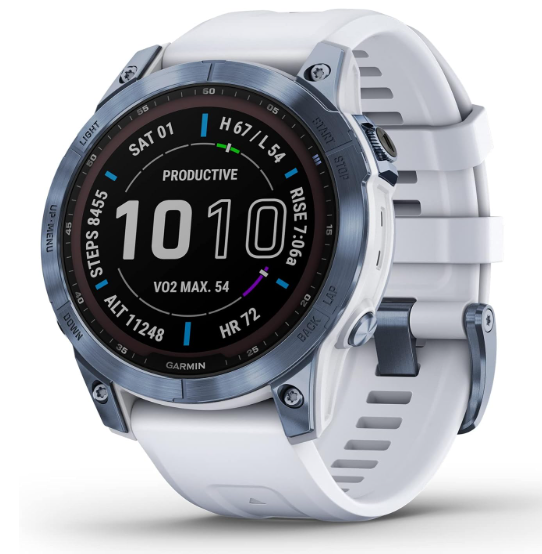
Verdict: The headline discount of this entire list. The Fenix 7 Sapphire Solar launched at $799.99 in 2022 as the premium adventure flagship. In May 2026 it streets near $449 — a 44% cut on a watch with sapphire crystal, titanium bezel, solar charging, 73-hour GPS battery in standard mode, and full topographic maps. For runners whose training overlaps with mountain trails, ultra distances, or all-day unsupported sessions, this is the watch that rewires the math. Yes, it is an adventure watch first and a runner’s watch second — the running-specific software is a generation behind the 965 (no Race Widget, an older Training Readiness implementation). But the 73-hour GPS battery and the bombproof build make it the tool for runners whose limiting factor is not pace data, but staying out longer than any AMOLED Forerunner can survive.
Pros:
- 44% off list — a $799 watch for $449. Not a flash sale; an entire generation clearing as the Fenix 8 ramps.
- 73-hour GPS battery in standard mode — outright unmatched in this roundup.
- Sapphire crystal + titanium bezel + solar charging — built for environments that destroy plastic Forerunners.
- Full topo maps, ClimbPro, and SatIQ multi-band GPS.
Cons:
- MIP screen, not AMOLED — great in sun, dim in low light.
- Heavier and chunkier than any Forerunner; not a small-wrist watch.
- Running-specific software trails the 965 by a generation.
Best for: Runners whose training profile is trail, ultra, or all-day backcountry — where battery, durability, and maps outrank AMOLED and the latest Race Widget tweaks.
If you are weighing this against the Forerunner 965, Forerunner 965 vs Fenix 7 is the most honest version of that argument we have published.
Who Should Skip This List
Garmin Forerunner 165 is the anti-pick for serious runners. Not because it is a bad watch — it is genuinely fine as a first running watch, and we recommend it elsewhere on the site for exactly that reader. But it is the wrong tool for someone reading a Garmin runner’s buying guide. The 165 ships with single-band GPS, no Training Readiness, no PacePro, and a 19-hour GPS battery. At $199 — only $38 cheaper than the Forerunner 255 — the value math collapses the moment you compare them on the things runners actually use.
Cons (for serious runners specifically):
- Single-band GPS in 2026 is hard to defend at this price; the 255 is right there with multi-band for $38 more.
- No Training Readiness, no PacePro, no Race Widget — Garmin gates the runner-grade tooling above the 265.
- 19-hour GPS battery is the lowest on this page — thin margin for marathons and a non-starter for ultras.
If you are buying your first running watch and the 165 still sounds right, that is a different roundup — Best First Running Watch Under $250 (2026) covers exactly that reader. The 165 is the centerpiece pick there, and rightly so.
On Our Radar (But Not In The Ranking)
Three Garmins we looked at closely and passed on for now. Here is what each would need to do to break in.
- Garmin Forerunner 970 ($749 list) — The actual 2026 flagship. AMOLED, multi-band GPS, ECG, microphone for voice notes, and the latest Training Readiness implementation. The hardware is real. The price is also real: $749 buys both the 965 and the 255 in this list with $8 to spare. Until the 970 either drops 20% or the 965 sells out, the 965 is the smarter Forerunner-flagship buy.
- Garmin Forerunner 570 ($549 list) — The mid-tier 2025 release. Adds a microphone and a slightly bigger AMOLED to the 265 formula. At $549 vs the 265’s $343, the upgrade math is brutal. Worth a second look if it dips under $450; right now, the 265 is the same training computer for $200 less.
- Garmin Fenix 8 AMOLED ($1,099 list) — Gorgeous, current-gen, capable of swallowing any training plan you have. But buying a $1,000+ watch for marathon prep when the Fenix 7 Sapphire Solar is $449 is the kind of decision a Garmin shareholder makes, not a runner.
FAQ
What is the best Garmin watch for runners in 2026?
The Forerunner 265. At a street price near $343 it is the cleanest combination of multi-band GPS, AMOLED, and Garmin’s full training brain — Training Readiness, PacePro, Race Widget — without paying for maps or for the latest 970’s incremental upgrades.
Is the Forerunner 265 still the right pick over the new Forerunner 570?
For most runners, yes. The 570 adds a microphone, a slightly larger AMOLED, and the latest Training Readiness implementation, but it lists at $549 versus the 265’s $343. That $200 gap buys a lot of running shoes; the 265 has the same multi-band GPS, AMOLED, PacePro, and Race Widget. Wait for the 570 to drop below $450 before reconsidering.
Should I buy the Forerunner 965 or the Forerunner 970?
The 965, in 2026. The 970 lists at $749 and adds an ECG sensor, LTE messaging, and a microphone. The 965 has the same multi-band GPS, full topo maps, and Training Readiness for $245 less. If you do not need ECG or voice notes, the 965 is the smarter buy until the 970 lands a real discount.
Is the Fenix 7 Sapphire Solar a good runner’s watch?
Yes — if your training overlaps with trails, ultras, or all-day unsupported routes. The 73-hour GPS battery, sapphire crystal, and titanium bezel make it the right tool for runners whose limiting factor is endurance, not pace data. Pure road marathoners get more running-specific value from the 965 at a similar price.
How long does GPS battery need to last for a marathon?
Plan for at least 8 hours of continuous GPS to give yourself a real safety margin: 4–5 hours of race time plus a charge buffer if you forgot to top up. Every pick on this list clears that bar with significant headroom; even the anti-pick Forerunner 165 makes it on paper, but with thinner margin than a serious runner should accept.
Do I really need multi-band GPS?
For tempo work in cities with tall buildings, races in major-city marathons, or trails with tree cover, yes — multi-band (L1+L5) gives you noticeably tighter pace data. For pure suburban-loop training, single-band is workable. But every Garmin in this main ranking has multi-band, and the only one that does not (the anti-pick 165) is also the one we tell serious runners to skip.
Why is the Forerunner 255 ranked above the Forerunner 165 if they are similarly priced?
Multi-band GPS, 30 hours of GPS battery (vs 19), and full daily training-load and recovery analysis. The 255 ships with what serious runners actually use; the 165 ships with the entry-level subset. At a $38 price gap, the 255 wins on every spec a runner ranks first.
Final Verdict
If you want one answer and do not enjoy overthinking, buy the Garmin Forerunner 265. If you want the smartest cheap answer, buy the Garmin Forerunner 255. Everything else on this list is a niche branch off those two choices.
The 965 is the “I want maps and the bigger AMOLED” pick. The 955 is the trail and ultra pick if AMOLED does not matter. The Fenix 7 Sapphire Solar is the “I am out for 12 hours and I need a watch built for it” pick — and at $449, the discount-era headline of the entire list. But the top of the board is still the 265 first, the 255 second, and that is the ranking I would defend without hedging.
Prices in this guide were verified May 4, 2026 and move regularly. Affiliate links above pay FTT a small commission at no cost to you; that is how we keep the lights on. Re-check pricing before you buy.
