
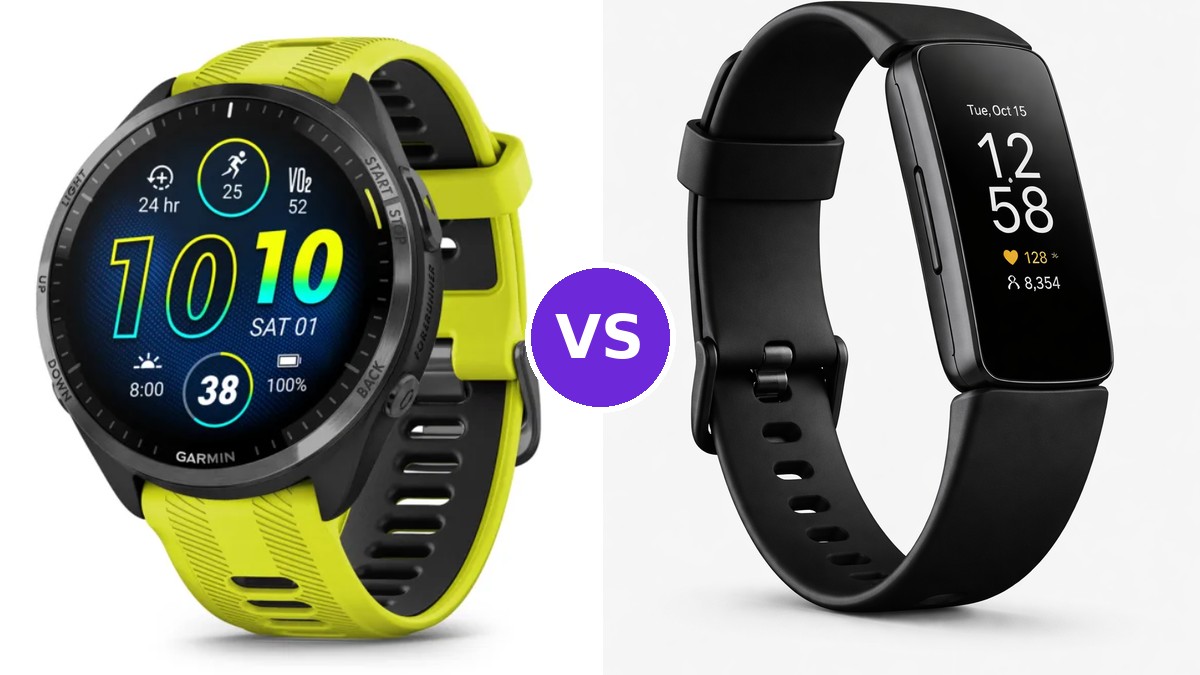
At a Glance: The Verdict
| Garmin Forerunner 965 | Garmin Fenix 7 |
|---|---|
|
Best For: Road runners and triathletes who want the best display At just 53g with a stunning 1.4″ AMOLED screen and multi-band GPS, the Forerunner 965 is the lighter, sharper, more affordable choice for serious endurance athletes who train primarily on roads and tracks. |
Best For: Backcountry adventurers and ultramarathon runners Built tougher with 10 ATM water resistance and a massive 57 hours of GPS battery life, the Fenix 7 is the rugged multisport tank designed for athletes who push deep into the wilderness and need their watch to outlast them. |
Quick Buy Path
Check today’s pricing before you go deeper.
If these are already your two finalists, compare current pricing now, then keep reading for the full verdict.
Introduction
The Garmin Forerunner 965 and Garmin Fenix 7 represent two of Garmin’s most capable multisport watches, but they’re built for different athletes. The Forerunner 965 brings a gorgeous AMOLED display and featherweight build to performance-focused runners and triathletes, while the Fenix 7 doubles down on ruggedness and marathon GPS battery life for outdoor adventurers. Choosing between them comes down to where you train, how long you train, and what you value on your wrist.
Key Differences
- Display technology: The Forerunner 965 uses a vibrant 454 x 454 AMOLED screen, while the Fenix 7 uses a transflective MIP display (260 x 260) that’s easier to read in direct sunlight but far less vivid.
- Weight: The Forerunner 965 weighs just 53g — a full 26g lighter than the 79g Fenix 7. That’s a noticeable difference during long runs.
- GPS battery life: The Fenix 7 delivers 57 hours of GPS tracking compared to the Forerunner 965’s 31 hours — nearly double the endurance for ultra-distance events.
- Water resistance: The Fenix 7 is rated to 10 ATM (100m), twice the Forerunner 965’s 5 ATM (50m) rating.
- GPS accuracy: The Forerunner 965 features multi-band GPS for superior positioning in urban canyons and dense tree cover, while the Fenix 7 standard edition uses single-band GPS.
- Storage: The Forerunner 965 packs 32GB of storage versus the Fenix 7’s 16GB, allowing for more offline maps and music.
- Price: The Forerunner 965 launched at $599, while the Fenix 7 debuted at $699 — a $100 difference favoring the newer watch.
Deep Dive Comparison
Design & Comfort
The Forerunner 965 is the clear comfort winner. At 53g with a fiber-reinforced polymer case and titanium bezel, it sits lightly on the wrist and almost disappears during a run. The Fenix 7, weighing 79g with its metal rear cover, feels noticeably more substantial. That extra heft signals durability — and the Fenix 7 delivers on that promise — but it’s a trade-off that matters during high-tempo workouts.
Both watches share a 47mm case diameter, but the Forerunner 965’s slim profile gives it a more modern, sporty look. The Fenix 7 wears its rugged heritage proudly with five buttons and a beefier build that can take hits against rocks and gear. If your watch takes a beating on the trail, the Fenix 7 is built for it. If you want something that transitions smoothly from a tempo run to a dinner table, the Forerunner 965 has the edge.
Battery Life
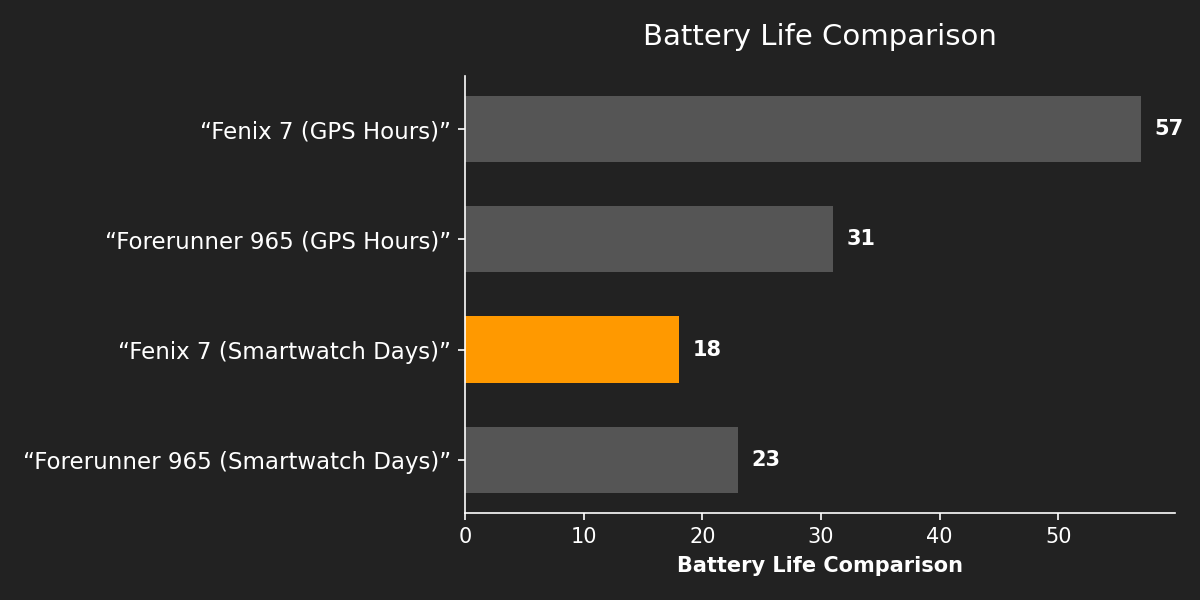
Battery life is where these two watches diverge dramatically. The Fenix 7 is an absolute powerhouse in GPS mode, delivering up to 57 hours of continuous tracking — enough for most ultramarathons and multi-day hikes without a charge. The Forerunner 965’s 31 hours of GPS life is still excellent by any standard, but it’s nearly half what the Fenix 7 offers.
In smartwatch mode, the story flips. The Forerunner 965 lasts approximately 23 days on a single charge compared to about 18 days for the Fenix 7. The AMOLED display on the Forerunner 965 is managed efficiently enough that daily use actually exceeds the MIP-equipped Fenix 7 — a testament to Garmin’s power optimization.
Health & Fitness Features
Both watches share Garmin’s deep health and training ecosystem, including wrist-based heart rate, Pulse Ox monitoring, Body Battery energy tracking, Training Readiness scores, and advanced sleep tracking. You won’t miss any core health features regardless of which you choose.
The Forerunner 965 gains a meaningful edge with its multi-band GPS. By receiving signals from multiple satellite frequencies simultaneously, it delivers more accurate route tracking in challenging environments — think city streets lined with tall buildings or dense forest canopy. The Fenix 7’s single-band GPS is reliable in open terrain but can struggle with accuracy in those trickier conditions.
Both watches support a full suite of multisport profiles including running, cycling, swimming, hiking, skiing, golf, and dozens more. Triathlon mode with automatic transitions is available on both. The Forerunner 965 leans more heavily into structured running metrics like race predictor and daily suggested workouts, while the Fenix 7 offers more outdoor-specific tools like expedition mode and extended trail navigation features.
Smart Features
Smart feature parity is high between these two watches. Both support Garmin Pay (NFC contactless payments), smart notifications, Connect IQ app and watch face downloads, and music playback with Spotify, Amazon Music, and Deezer support. Neither watch has a built-in microphone or speaker, so you can’t take calls from your wrist.
The Forerunner 965’s AMOLED display makes interacting with notifications, maps, and music controls a dramatically better experience. Colors pop, text is crisp, and the touchscreen is responsive. The Fenix 7 also has a touchscreen, but its MIP display is designed for sunlight readability at the expense of indoor vibrancy. With 32GB of storage versus 16GB, the Forerunner 965 also holds twice as many offline playlists and maps.
Price & Value
The Garmin Forerunner 965 launched at $599, while the Fenix 7 debuted at $699. Given that the Forerunner 965 is the newer watch with a superior display, multi-band GPS, and more storage, it offers stronger value per dollar for most athletes. Street prices for both have dropped since launch, with the Fenix 7 often found in the $500–$550 range and the Forerunner 965 between $500–$575.
If rugged construction and extreme GPS battery life are your top priorities, the Fenix 7 justifies its price. But for the majority of runners and triathletes, the Forerunner 965 delivers more modern technology at a lower price point.
Technical Specs
| Spec | Forerunner 965 | Fenix 7 |
|---|---|---|
| Case Size | 47.2mm | 47mm |
| Weight | 53g | 79g |
| Display | 1.4″ AMOLED (454 x 454) | 1.3″ MIP (260 x 260) |
| Water Rating | 5 ATM | 10 ATM |
| GPS | Multi-band | Single-band |
| Battery (Smartwatch) | ~23 days | ~18 days |
| Battery (GPS) | 31 hours | 57 hours |
| Storage | 32GB | 16GB |
| NFC Payments | Yes (Garmin Pay) | Yes (Garmin Pay) |
| Sensors | HR, Pulse Ox, Altimeter, Compass, Gyroscope, Accelerometer, Thermometer, Ambient Light | HR, Pulse Ox, Altimeter, Barometer, Compass, Gyroscope, Accelerometer, Thermometer |
| Launch Price | $599 | $699 |
The Verdict
Buy the Garmin Forerunner 965 if you are a road runner, triathlete, or gym-to-pavement athlete who values a brilliant display, lightweight comfort, and top-tier GPS accuracy. It’s the better watch for daily training, race day, and everyday smart features — and it costs $100 less at retail. The AMOLED screen alone makes checking mid-run stats and navigating maps a genuinely better experience.
Buy the Garmin Fenix 7 if you spend your weekends on mountain trails, run ultras, or need a watch that can survive serious abuse. Its 57-hour GPS battery means you can run a 100-miler without worrying about power. Its 10 ATM water rating handles deep dives and whitewater. And its tank-like build won’t flinch when you’re scrambling over rocks. For backcountry athletes, the Fenix 7 remains the more capable tool.
For most fitness enthusiasts, the Forerunner 965 is the smarter buy. It’s lighter, cheaper, sharper, and more accurate where it matters most. But if endurance and ruggedness are non-negotiable, the Fenix 7 earns its place on your wrist.
🏆 Ready to Decide?
Check the latest deals to see which one fits your budget.
*We earn a commission if you make a purchase.
Specs and features may change. Always verify details on the manufacturer’s official site before purchasing.
