
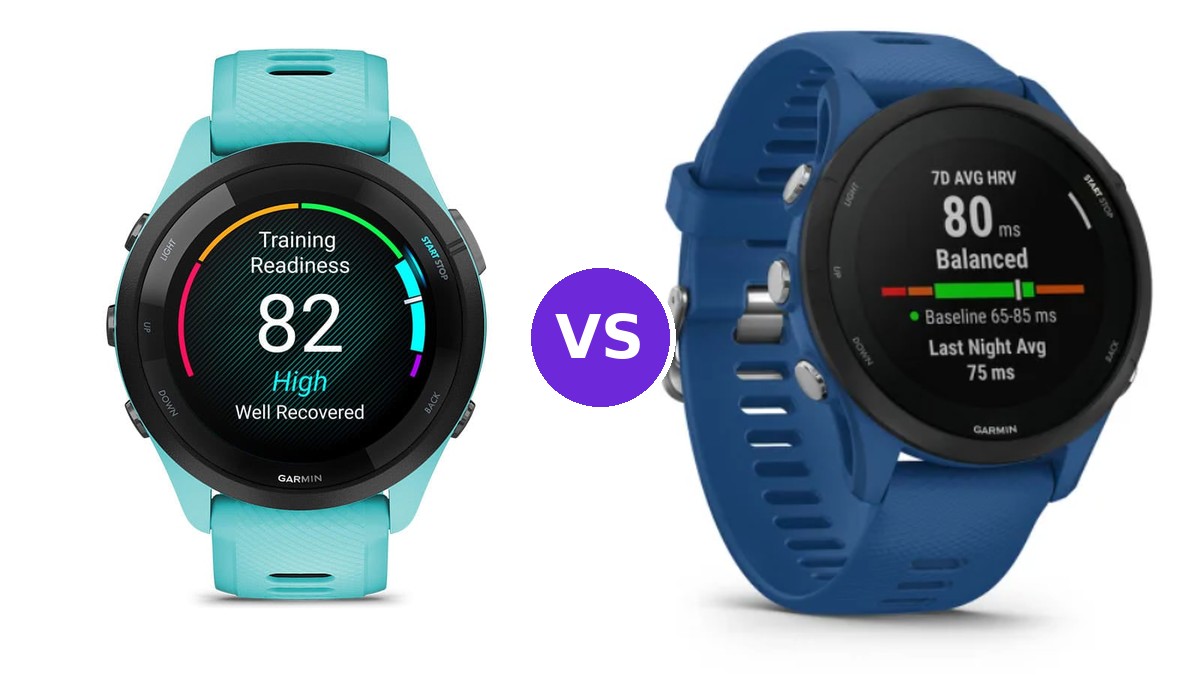
At a Glance: The Verdict
| Garmin Forerunner 265 | Forerunner 255 |
|---|---|
|
Best For: New buyers who want the best mid-range Forerunner experience The Forerunner 265 is the clear successor — a stunning AMOLED display, Wi-Fi connectivity, and sharper training insights make it the default pick for anyone buying fresh. At ~$350, it’s worth every dollar over the 255. |
Best For: Budget-conscious runners who prioritize battery life over display Still a rock-solid GPS running watch with longer battery life and a sunlight-friendly MIP screen. At ~$237 — roughly $110 less than the 265 — it’s a genuine bargain if you can live without AMOLED and Wi-Fi. |
Quick Buy Path
Check today’s pricing before you go deeper.
If these are already your two finalists, compare current pricing now, then keep reading for the full verdict.
If you are deciding between the Garmin Forerunner 265 and the Garmin Forerunner 255, the real question is not whether Garmin improved the watch. It did. The real question is whether an AMOLED screen, Wi-Fi, touchscreen controls, and a slightly slicker training experience are worth roughly $110 more than a discounted 255 that still nails the fundamentals.
That is what makes this comparison rank-worthy for real buyers: both watches deliver multi-band GPS, strong battery life, Garmin’s serious training stack, and reliable everyday run tracking. The 265 feels more modern. The 255 still does almost all of the actual coaching work.
The short answer: buy the 265 if you are shopping fresh and want the best all-around experience. Buy the 255 if price matters more than screen quality. If you already own a 255, upgrading is a luxury move, not an urgent one.
Key Differences
- Display technology: The 265 upgrades to a vibrant AMOLED touchscreen (416 × 416), while the 255 uses a transflective MIP display (260 × 260). This is the single biggest generational leap — colors pop, data is easier to read mid-run, and the interface feels modern.
- Wi-Fi connectivity: The 265 adds Wi-Fi for faster syncing, software updates, and downloading music playlists without your phone nearby. The 255 relies on Bluetooth only, meaning you need your phone nearby to sync.
- Touchscreen input: The 265 supports both touchscreen and five-button navigation. The 255 is buttons-only.
- Storage: The 265 doubles onboard storage to 8 GB (vs. 4 GB on the 255), giving you room for more offline music and a larger app/music library.
- Battery life: The 255 wins here — its power-sipping MIP display delivers up to 14 days in smartwatch mode and 30 hours with GPS, compared to 13 days and 20 hours on the 265.
- Weight: The 265 is slightly lighter at 47 g versus 49 g — a negligible difference in practice.
- Training features: The 265 introduced Morning Report, enhanced Training Readiness scoring, and improved race predictor algorithms that weren’t available at the 255’s launch (though some have since been backported via firmware).
Deep Dive Comparison
Design & Comfort
Both watches share the same fiber-reinforced polymer case and classic Forerunner silhouette. The 265 is marginally larger (46.1 mm vs. 45.6 mm) but 2 grams lighter — a wash on the wrist. The real design difference is skin-deep: the 265’s AMOLED panel with a rich always-on display option makes the 255’s grayscale MIP screen look dated by comparison. If you’ve ever used an AMOLED Garmin, it’s hard to go back.
Both are comfortable for all-day wear and sleep tracking. The 22 mm quick-release bands are interchangeable between models, so strap preference isn’t a factor.
Battery Life
This is the one category where the older model holds a clear advantage. The 255’s MIP display sips power, delivering roughly 14 days of smartwatch use and a full 30 hours of continuous GPS tracking. The 265’s AMOLED screen is hungry by comparison — you’ll get around 13 days of daily wear and 20 hours with GPS active.
For most runners logging 5–10 hours of GPS per week, both watches will last comfortably between charges. But ultrarunners or multi-day adventure racers will appreciate the 255’s extra 10 hours of GPS headroom.

Health & Fitness Features
The core training engine is much closer than the price gap suggests. Both watches offer multi-band GPS with SatIQ, wrist-based heart rate, Pulse Ox, HRV Status, VO2 Max, Training Status, Training Load, recovery guidance, suggested workouts, Garmin Coach, and deep race-tracking support. In plain English: neither watch leaves a serious runner under-equipped.
Where the 265 wins is how that data feels day to day. Morning Report is easier to absorb, Training Readiness feels more front-and-center, and the brighter screen makes pre-run prompts, sleep summaries, and recovery nudges more likely to get used instead of ignored. That matters, because the best training features are the ones you actually notice and act on.
The 255, though, is not some stripped-down budget watch. It still gives you the core Garmin training stack that makes the brand compelling in the first place. If your priority is run tracking, structured workouts, and dependable race prep rather than a nicer interface, the 255 still covers the mission exceptionally well.
Smart Features
Both watches support Garmin Pay (NFC payments), Connect IQ apps, and smartphone notifications. Music storage and playback are available on both — though the 265’s 8 GB gives you roughly double the offline library capacity compared to the 255’s 4 GB.
The 265’s Wi-Fi connectivity is a genuine quality-of-life upgrade. Software updates download automatically, music playlists refresh over Wi-Fi, and syncing feels less dependent on having your phone nearby. On the 255, every sync requires a Bluetooth connection to your phone — not a dealbreaker, but noticeably less seamless.
The 265’s touchscreen also makes navigating menus, scrolling through widgets, and zooming on maps significantly faster than the 255’s button-only interface.
Price & Value
This is the section that decides the article. The Forerunner 265 launched at $449.99 and now usually sells around $345 to $350. The Forerunner 255 launched at $349.99 and often sits near $237. That means Garmin’s newer watch is not just better, it is about 45% more expensive than the discounted 255.
For that extra money, you get a dramatically nicer screen, Wi-Fi syncing, touchscreen controls, more storage, and a more premium everyday experience. For a first-time buyer who plans to wear the watch every day, that is usually enough to justify the jump. The 265 feels like the watch Garmin wanted the 255 to be.
The 255 becomes compelling when you frame the purchase differently: not “which watch is best?” but “how much performance am I actually giving up to save about $110?” The honest answer is not much. You lose polish, convenience, and visual appeal. You do not lose the core reasons most runners buy a Forerunner in the first place.
Should You Upgrade from the Forerunner 255?
If you already own the Forerunner 255, this is where the answer gets stricter. The Forerunner 265 is better, but it is not better in a way that automatically changes your training outcomes.
- Upgrade now if you actively dislike the 255’s MIP screen, want a touchscreen, care about Wi-Fi syncing, or wear the watch all day and want something that feels more premium every time you look at it.
- Keep the 255 if your current watch still works well, you mostly care about GPS accuracy and training metrics, or you would rather spend the difference on race entries, shoes, or a chest strap.
- Buy the 255 instead of the 265 if you are a value-first runner who wants Garmin coaching depth under $250 and does not need the prettier display.
That is the cleanest way to think about it: the 265 is the better purchase for new buyers, while the 255 remains the smarter hold for existing owners unless the screen and convenience upgrades are exactly what has been bothering you.
Technical Specs
| Spec | Forerunner 265 | Forerunner 255 |
|---|---|---|
| Release Date | March 2023 | June 2022 |
| Display | 1.3″ AMOLED, 416 × 416 | 1.3″ MIP, 260 × 260 |
| Case Size | 46.1 mm | 45.6 mm |
| Weight | 47 g | 49 g |
| Water Rating | 5 ATM | 5 ATM |
| Battery (Smartwatch) | Up to 13 days | Up to 14 days |
| Battery (GPS) | Up to 20 hours | Up to 30 hours |
| GPS | Multi-band with SatIQ | Multi-band with SatIQ |
| Connectivity | Bluetooth, ANT+, Wi-Fi | Bluetooth, ANT+ |
| Storage | 8 GB | 4 GB |
| Touchscreen | Yes (+ buttons) | No (buttons only) |
| NFC Payments | Garmin Pay | Garmin Pay |
| Launch Price | $449.99 | $349.99 |
| Current Street Price | ~$350 | ~$237 |
FAQ
Is the Forerunner 265 actually more accurate than the Forerunner 255?
Not in a way most runners will notice. Both watches support multi-band GPS with SatIQ and use Garmin’s mature training platform. The 265 feels better to use, but the 255 is still excellent at the core job of tracking runs and guiding training.
Is the AMOLED display worth paying extra for?
Usually yes if you are buying new and plan to wear the watch every day. The AMOLED screen is brighter, easier to read indoors, and makes the whole watch feel more current. It is less essential if you mainly care about workouts and prefer maximum battery efficiency.
Does the Forerunner 255 still make sense in 2026?
Yes. At around $237, it is one of the best running-watch values Garmin has. You still get serious training tools, music support, Garmin Pay, and strong GPS accuracy without paying mid-$300s for the newer model.
Which one is better for marathon training?
Both are strong marathon watches. The 265 is better if you want the nicer daily experience and richer on-watch presentation. The 255 is better if you care more about stretching your budget and getting longer GPS battery life for the money.
Both watches make our 2026 ranking. The 265 is our #1 Best Overall pick and the 255 is #2 Best Value in Best Garmin Watch for Runners (2026) — alongside three more discounted Garmin runners ranked head-to-head.
The Verdict
Buying new? Get the Forerunner 265. It’s the better watch in almost every way that matters for daily use — the AMOLED display alone transforms the experience, and Wi-Fi syncing plus the touchscreen make it feel like a modern device rather than a niche GPS tool. At ~$350, it’s priced right where the 255 launched, which makes it excellent value for what you get.
On a tight budget? The Forerunner 255 at ~$237 is a steal. You’re getting multi-band GPS, advanced training metrics, music storage, and Garmin Pay for well under $250. The MIP display is perfectly readable outdoors (arguably better than AMOLED in direct sunlight), and the extra battery life is a genuine advantage for longer efforts. If you’re a newer runner who doesn’t need the flashiest screen, the 255 delivers 90% of the training capability at 68% of the price.
Already own a Forerunner 255? The upgrade to the 265 is nice-to-have, not need-to-have. Your watch still tracks runs with the same GPS accuracy and core training data. Unless the MIP screen genuinely frustrates you or you badly want Wi-Fi syncing, your money is better spent on shoes, race entries, or waiting for the next generation.
🏆 Ready to Decide?
Check the latest deals to see which one fits your budget.
*We earn a commission if you make a purchase.
Specs and features may change. Always verify details on the manufacturer’s official site before purchasing.
