
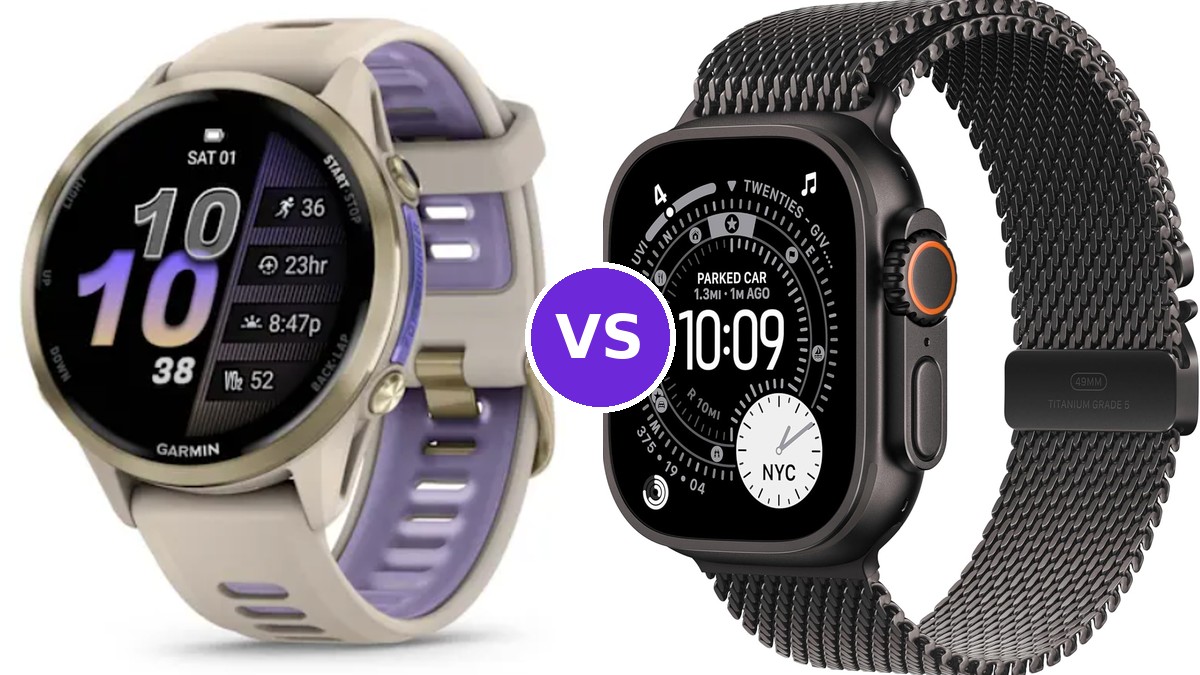
At a Glance: The Verdict
| Garmin Forerunner 970 | Apple Watch Ultra 3 |
|---|---|
|
Best For: Serious runners and endurance athletes who need marathon-level battery and deep training metrics The Forerunner 970 is Garmin’s flagship running watch, packing a titanium build, 15-day smartwatch battery, AMOLED display, and the brand’s full training ecosystem — all for $50 less than its rival. |
Best For: iPhone users who want a rugged all-in-one smartwatch with cellular and dive-ready durability The Apple Watch Ultra 3 pairs a massive 1.98-inch display with LTE connectivity, 100-meter water resistance, and tight Apple ecosystem integration — ideal if your watch doubles as your phone on the trail. |
Quick Buy Path
Check today’s pricing before you go deeper.
If these are already your two finalists, compare current pricing now, then keep reading for the full verdict.
The Garmin Forerunner 970 and Apple Watch Ultra 3 represent the top tier of their respective ecosystems — one built for athletes who live by their training data, the other for adventurers who refuse to carry a second device. Both feature titanium cases, advanced health sensors, and premium price tags, but they take fundamentally different approaches to what a high-end sport watch should do.
Key Differences
- Battery life is the headline: The Forerunner 970 lasts up to 15 days in smartwatch mode versus roughly 42 hours for the Ultra 3 — a 9x difference that changes how you plan multi-day trips.
- Cellular connectivity: The Ultra 3 includes built-in LTE so you can leave your phone behind entirely. The Forerunner 970 has no cellular option.
- Water depth rating: Apple rates the Ultra 3 to 100 meters with a built-in depth gauge and water temperature sensor, making it a legitimate recreational dive computer. The Forerunner 970 is rated to 5 ATM (about 50 meters) and lacks dive features.
- Training ecosystem: Garmin Connect delivers training load, recovery time, VO2 max trends, race predictor, and daily suggested workouts out of the box. Apple’s training metrics are improving but still lag behind in depth.
- Display size: The Ultra 3’s 1.98-inch screen dwarfs the Forerunner 970’s 1.4-inch panel, making mid-run glances easier — though the Garmin is noticeably lighter at 56g vs. 61.6g.
- Storage: The Ultra 3 doubles the Forerunner’s storage at 64GB vs. 32GB, useful for offline music libraries.
- Ecosystem lock-in: The Ultra 3 requires an iPhone. The Forerunner 970 works with both Android and iOS.
Deep Dive Comparison
Design & Comfort
Both watches use titanium cases and sapphire-grade crystal lenses, so durability is a wash on paper. In practice, the Forerunner 970 wears smaller (47mm vs. 49mm) and lighter (56g vs. 61.6g), which makes a real difference on long runs where every gram bouncing on your wrist adds up. The Ultra 3’s flat-sided, tool-watch aesthetic and signature orange Action Button give it a more rugged look, while the Forerunner follows Garmin’s rounder sport-watch design language.
The Ultra 3’s larger footprint also means a larger display — 1.98 inches of Always-On Retina OLED versus 1.4 inches of AMOLED. Both screens are bright and readable outdoors, but the Ultra 3 is simply easier to read at a glance, especially when you’re soaked in sweat or wearing gloves. The Forerunner 970 counters with a built-in LED flashlight, a feature trail runners will appreciate on predawn starts.
Battery Life
This is where the two watches diverge most dramatically. The Forerunner 970 delivers up to 15 days in smartwatch mode and 26 hours of continuous GPS tracking. The Apple Watch Ultra 3 manages roughly 42 hours (under two days) in regular use and around 20 hours with GPS active. For ultramarathons, multi-day hikes, or simply not wanting to think about charging, Garmin wins by a wide margin.
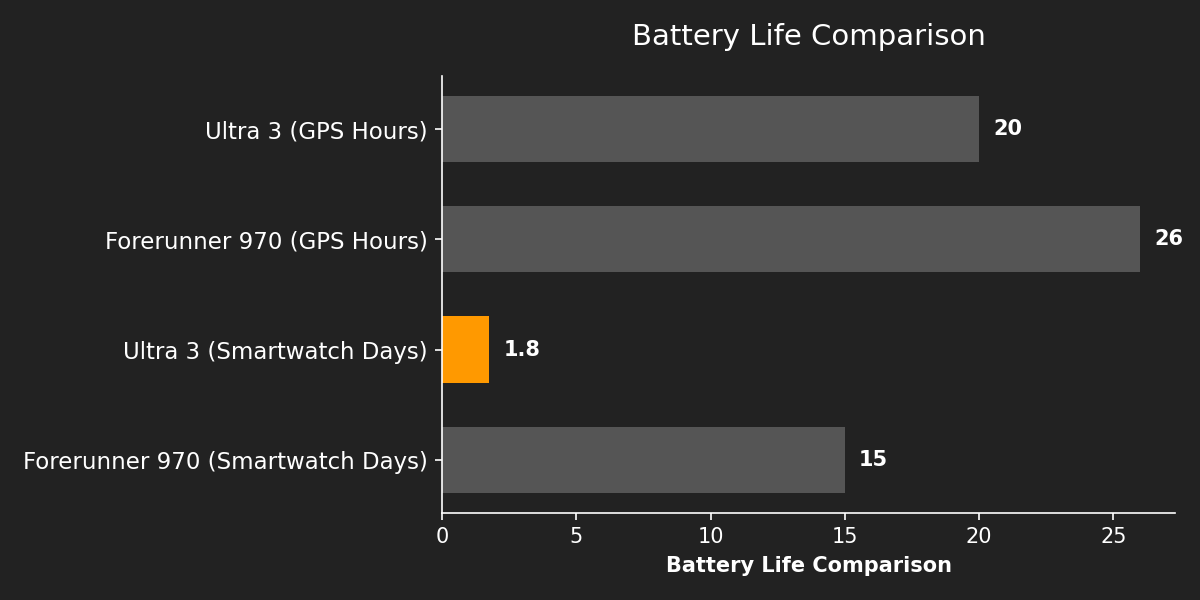
If you run for 60–90 minutes a few times a week and charge nightly anyway, the Ultra 3’s battery is perfectly adequate. But if you race ultras, go off-grid for days, or simply hate chargers, the Forerunner 970 is in a different league.
Health & Fitness Features
Both watches pack optical heart rate, SpO2 monitoring, skin/wrist temperature tracking, ECG, compass, altimeter, and multi-band GPS. The core sensor suites are competitive, but they diverge in how that data is used.
The Forerunner 970 leverages Garmin’s mature training ecosystem: Training Readiness scores, HRV status, race predictions, daily suggested workouts, and advanced running dynamics when paired with compatible accessories. It speaks the language of structured training plans and periodization. For runners following a marathon program, this depth is hard to match.
The Ultra 3 adds a depth gauge and water temperature sensor — genuine dive-computer functionality that the Forerunner lacks entirely. Apple’s health features also lean more toward everyday wellness: crash detection, fall detection, atrial fibrillation history logging, and tighter integration with Apple Health records. The double-tap gesture and Smart Stack make casual health checks frictionless.
For GPS accuracy, both use dual-frequency satellite reception and perform well in urban canyons and dense tree cover. Real-world accuracy differences between the two are marginal for most runners.
Smart Features
The Apple Watch Ultra 3 is the clear winner for smartwatch functionality. LTE connectivity means calls, texts, streaming music, and Siri all work without your phone. The App Store ecosystem is enormous, and features like Apple Pay, turn-by-turn navigation, and real-time translation are polished and reliable.
The Forerunner 970 supports Garmin Pay (NFC), offline music storage (Spotify, Amazon Music, Deezer), smart notifications, and basic call handling via mic/speaker. It’s competent but not comparable to the full smartphone-on-your-wrist experience the Ultra 3 provides. On the other hand, the Forerunner works equally well with Android and iOS, while the Ultra 3 is iPhone-only.
Price & Value
The Garmin Forerunner 970 launched at $749, while the Apple Watch Ultra 3 debuted at $799. That $50 gap is minor at this price tier, so the decision should hinge on feature fit rather than cost. The Forerunner 970 offers more value per dollar for dedicated athletes thanks to its vastly superior battery life and deeper training tools. The Ultra 3 justifies its premium through LTE, dive capability, and unmatched smartwatch polish.
Technical Specs
| Spec | Garmin Forerunner 970 | Apple Watch Ultra 3 |
|---|---|---|
| Price | $749 | $799 |
| Case Size | 47mm | 49mm |
| Weight | 56g | 61.6g |
| Case Material | Titanium / Sapphire Crystal | Grade 5 Titanium |
| Display | 1.4″ AMOLED (454×454) | 1.98″ LTPO3 OLED (422×514) |
| Water Rating | 5 ATM | 100m (ISO 22810) |
| Battery (Smartwatch) | Up to 15 days | Up to 42 hours |
| Battery (GPS) | Up to 26 hours | Up to 20 hours |
| GPS | Multi-band | Dual-frequency (L1+L5) |
| Cellular | No | LTE |
| Storage | 32GB | 64GB |
| Key Sensors | HR, ECG, SpO2, Temp, LED Flashlight | HR, ECG, SpO2, Temp, Depth Gauge |
| NFC Payments | Garmin Pay | Apple Pay |
| Phone Compatibility | Android & iOS | iPhone only |
The Verdict
Buy the Garmin Forerunner 970 if you are a dedicated runner or endurance athlete who prioritizes training analytics, multi-day battery life, and cross-platform compatibility. It is the better watch for marathon training blocks, ultra-distance events, and anyone who views their watch primarily as a performance tool. The 15-day battery and Garmin’s training ecosystem are unmatched at any price.
Buy the Apple Watch Ultra 3 if you are an iPhone user who wants one device that handles calls, texts, music streaming, dive tracking, and fitness — all without carrying your phone. Its LTE connectivity, 100-meter water resistance, and enormous display make it the most capable all-around adventure smartwatch available. Just plan on charging it every night or two.
For most serious runners and triathletes, the Forerunner 970 is the stronger pick. For everyone else who wants a rugged, do-everything smartwatch that stays connected anywhere, the Ultra 3 earns its premium.
🏆 Ready to Decide?
Check the latest deals to see which one fits your budget.
*We earn a commission if you make a purchase.
Specs and features may change. Always verify details on the manufacturer’s official site before purchasing.
