

At a Glance: The Verdict
| Garmin Fenix 8 AMOLED | Apple Watch Ultra 3 |
|---|---|
|
Best For: Endurance athletes and outdoor adventurers who need multi-day battery life The Fenix 8 AMOLED delivers up to 16 days of smartwatch battery, 47 hours of GPS tracking, dive-rated water resistance, and Garmin’s deep training analytics ecosystem. It’s the watch you strap on for an ultramarathon or a week-long backcountry trip and never worry about charging. |
Best For: iPhone users who want a premium all-rounder with cellular connectivity The Apple Watch Ultra 3 pairs a stunning 1.98-inch Retina display with built-in LTE, advanced health sensors, and tight integration across the Apple ecosystem. It’s the smartest watch on the market — if your phone is an iPhone. |
Quick Buy Path
Check today’s pricing before you go deeper.
If these are already your two finalists, compare current pricing now, then keep reading for the full verdict.
The Garmin Fenix 8 AMOLED and Apple Watch Ultra 3 sit at the top of their respective ecosystems, but they serve fundamentally different masters. One is built around endurance and the outdoors; the other around connectivity and daily smart features. Choosing between them comes down to what you actually need on your wrist — and which phone is in your pocket.
Key Differences
- Battery life is the biggest gap: The Fenix 8 AMOLED lasts up to 16 days in smartwatch mode and 47 hours with GPS. The Ultra 3 tops out around 42 hours in smartwatch mode and roughly 20 hours in a low-power outdoor workout.
- Cellular connectivity: The Apple Watch Ultra 3 has built-in LTE, so you can leave your phone behind and still take calls, stream music, and get notifications. The Fenix 8 has no cellular option.
- Ecosystem lock-in: The Ultra 3 requires an iPhone. The Fenix 8 works with both Android and iOS, though the full Garmin Connect experience is available on both platforms.
- Display size: Apple’s 1.98-inch screen dwarfs Garmin’s 1.4-inch panel. For reading maps, messages, or workout data mid-run, the Ultra 3 is noticeably easier to glance at.
- Water rating: Both watches handle swimming and water sports, but Garmin rates the Fenix 8 to 10 ATM with a dedicated dive mode and depth sensor. The Ultra 3 is rated to 100 meters (ISO 22810) with its own depth gauge.
- Training depth: Garmin’s platform offers Training Readiness, Training Load, HRV Status, stamina tracking, and multi-sport modes that Apple’s workout app still can’t match in granularity.
- Price: The Fenix 8 AMOLED launches at $999, while the Ultra 3 starts at $799 — a $200 difference that favors Apple.
Deep Dive Comparison
Design & Comfort
The Fenix 8 AMOLED uses a fiber-reinforced polymer case with a titanium rear cover, coming in at 73g (titanium) or 80g (stainless steel) for the 47mm size. It’s a traditional round watch face that looks at home on a trail or in a meeting. Garmin’s QuickFit band system makes swapping straps effortless.
The Apple Watch Ultra 3 goes all-in on Grade 5 titanium for the full case, weighing in at 61.6g despite being physically larger at 49mm. The flat sapphire front crystal and customizable Action Button give it a distinct tool-watch identity. Both watches are built tough, but the Ultra 3’s full titanium construction gives it a more premium feel in hand.
Battery Life
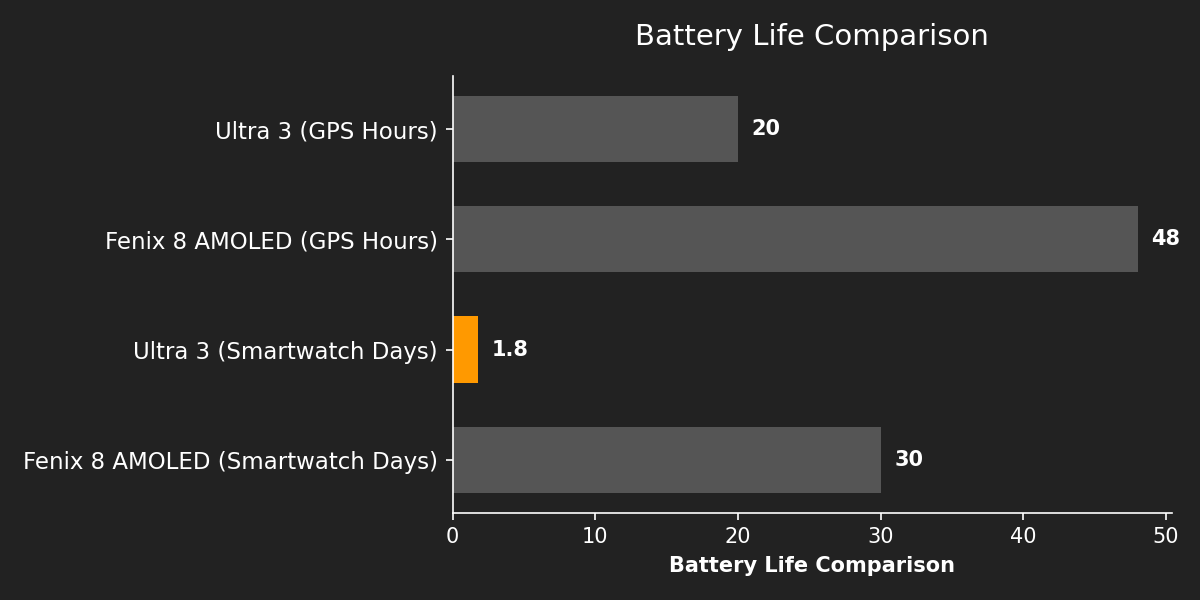
This is where the comparison gets lopsided. The Fenix 8 AMOLED delivers up to 16 days of general smartwatch use (with gesture/tap-to-wake; 7 days with always-on display) and up to 47 hours of continuous GPS tracking. The Apple Watch Ultra 3 manages about 42 hours in daily use and up to 20 hours in an outdoor workout with GPS.
For day hikes, gym sessions, or daily runs, the Ultra 3’s battery is perfectly adequate — you’ll charge every other day. But for multi-day backpacking trips, ultramarathons, or expedition-style adventures, the Fenix 8’s battery advantage is not just a convenience — it’s a necessity.
Health & Fitness Features
Both watches pack optical heart rate monitors, SpO2 sensors, temperature sensors, altimeters, compasses, and depth gauges. On paper, the sensor suites look similar. In practice, the software layer is where they diverge.
Garmin’s ecosystem goes deep on training science. The Fenix 8 provides Training Readiness scores, Training Load analysis, HRV Status, stamina tracking, race predictions, PacePro pacing strategies, and recovery advisors — all tuned for athletes who structure their training. It also supports multi-band GPS for more accurate positioning in challenging terrain like canyons and dense forests.
Apple counters with its electrical heart sensor for ECG readings, crash detection, and the most polished health dashboard in the business through the Health app. The Ultra 3 also features Apple’s Precision dual-frequency GPS (L1 + L5), which delivers competitive accuracy. For general health monitoring and casual fitness tracking, Apple’s interface is more approachable and better integrated with your medical data.
Smart Features
The Apple Watch Ultra 3 dominates in smart functionality. Built-in LTE means you can leave your phone at home and still make calls, receive texts, stream Apple Music, and use Siri. The App Store offers thousands of third-party watch apps. Apple Pay works seamlessly, and the integration with iMessage, FaceTime, and the broader Apple ecosystem is unmatched.
The Fenix 8 AMOLED supports Garmin Pay (NFC payments), music storage (32GB onboard), smart notifications, and a growing Connect IQ app store. It has a speaker and microphone for on-wrist calls when paired via Bluetooth. But without cellular, you always need your phone nearby for connectivity features. Garmin’s smart features are functional but utilitarian — they get the job done without the polish Apple delivers.
Price & Value
The Apple Watch Ultra 3 starts at $799, while the Garmin Fenix 8 AMOLED launches at $999 — making the Garmin the more expensive option by $200. However, the value calculation depends on your use case. If you need multi-day battery life and deep training analytics, the Fenix 8 justifies the premium. If you want the most capable smartwatch with cellular connectivity and don’t need week-long battery, the Ultra 3 delivers more daily utility for less money.
It’s also worth noting that the Apple Watch Ultra 3 offers 64GB of storage compared to Garmin’s 32GB, and Apple’s trade-in and upgrade ecosystem makes the total cost of ownership more flexible over time.
Technical Specs
| Spec | Garmin Fenix 8 AMOLED | Apple Watch Ultra 3 |
|---|---|---|
| Case Size | 47mm | 49mm |
| Weight | 73–80g | 61.6g |
| Case Material | Fiber-reinforced polymer / titanium back | Grade 5 Titanium |
| Display | 1.4″ AMOLED (454 x 454) | 1.98″ LTPO3 OLED (422 x 514) |
| Water Rating | 10 ATM (Dive-rated) | 100m (ISO 22810) |
| Battery (Smartwatch) | Up to 16 days | Up to 42 hours |
| Battery (GPS) | Up to 47 hours | Up to 20 hours |
| GPS | Multi-band | Precision Dual-frequency (L1 + L5) |
| Connectivity | Bluetooth, ANT+, Wi-Fi | LTE, Wi-Fi 4, Bluetooth 5.3 |
| Storage | 32GB | 64GB |
| NFC Payments | Yes (Garmin Pay) | Yes (Apple Pay) |
| Price | $999 | $799 |
Which One Fits Your Use Case?
Specs tell half the story. The other half is what you actually do with your wrist. Here is how each watch performs in the scenarios most buyers care about.
Ultrarunning & Multi-Day Events
The Fenix 8 AMOLED is built for this. Forty-seven hours of continuous GPS covers a 100-mile race with headroom, and UltraTrac mode extends that further when you’re not actively navigating. Pacing tools like PacePro, stamina tracking, and customizable data screens let you build a race plan that adapts to the course. The Ultra 3 can complete an ultramarathon in Low Power mode, but you will think about battery instead of the race.
Marathon & Half-Marathon Training
Both watches handle structured training well, but they coach differently. Garmin’s Training Readiness, HRV Status, and race predictors give you a daily “should I push or back off?” signal that Apple’s Fitness app still doesn’t replicate. Apple’s new Workout Buddy (AI coaching in watchOS) is catching up on motivational cues, and the Fitness+ subscription adds structured running programs — but the Fenix is still the data nerd’s choice.
Triathlon & Multi-Sport
The Fenix 8 supports dedicated triathlon mode with one-button transitions between swim, bike, and run — and it records each leg separately with accurate open-water swim metrics. The Ultra 3 can stitch together a multi-sport workout through third-party apps (HealthFit, WorkOutDoors), but it is not a native feature out of the box.
Hiking & Backcountry
Both watches have a built-in compass, altimeter, and barometer. The Fenix ships with full-color TopoActive maps of your region pre-loaded, plus Up Ahead, ClimbPro, and turn-by-turn course guidance. The Ultra 3 uses the Compass app with waypoint backtracking and offline Apple Maps cached for your area — capable, but not the dedicated hiking tool Garmin has spent a decade refining.
Diving & Watersports
The Fenix 8 includes a dedicated dive mode for recreational single-gas diving down to 40 meters, with a depth sensor and surface interval tracking. The Ultra 3 supports recreational diving via the Oceanic+ app to 40 meters as well, and free diving to 130 feet. For serious divers who want a log that travels with them, the Oceanic+ subscription is required on Apple; Garmin includes the feature free.
Daily Health & Casual Fitness
If you walk, do the occasional run, go to the gym, and care about sleep, HRV, and notifications, the Ultra 3 is the more comfortable daily driver. The larger display, faster app ecosystem, and tight iPhone integration make it less friction for casual wear. The Fenix 8 is overkill — you’re paying for training depth you won’t use.
Strength Training & Gym Workouts
The Ultra 3 auto-detects rest periods and logs sets and reps through third-party apps like Gymshark or Strong. Garmin’s strength tracking is more manual — you tag exercises and it counts reps via wrist motion with decent accuracy. For heavy lifters using barbells, both watches suffer the same limitation: wrist-based rep counting is imperfect.
GPS Accuracy & Navigation
Both watches use dual-frequency (L1 + L5) GNSS, which is the current gold standard for wrist-based positioning. In open terrain, they’re effectively tied — expect sub-3-meter accuracy on roads and open trails. The difference shows up in challenging environments: dense canopy, urban canyons, and tight switchbacks.
Independent testing communities (DC Rainmaker, Fellrnr, the5krunner) have repeatedly found Garmin’s multi-band GPS slightly more consistent under tree cover, while Apple’s Precision Dual-Frequency GPS holds up better in cities. For most runners, neither will meaningfully throw off a pace or distance reading.
Where they diverge sharply is on-wrist navigation. The Fenix 8 renders full topographic maps with elevation shading, points of interest, and the ability to create routes on the watch itself. It also supports “Round Trip Routing” — enter a distance and the watch builds a loop back to your starting point. The Ultra 3 shows a compass heading and a breadcrumb trail with Apple Maps cached tiles, but it doesn’t render topographic lines or let you build routes on the device.
Sleep, Recovery & Stress Tracking
Garmin’s Body Battery is a single-number energy gauge that blends sleep quality, stress, heart rate variability, and activity. It’s intuitive — wake up at 80, end the day at 20, and you know you overdid it. The Fenix 8 also provides detailed sleep staging (light, deep, REM, awake) and a Sleep Score with actionable feedback.
Apple’s sleep tracking in watchOS covers the same stages and ties into the iPhone Health app’s trends view, which is genuinely good-looking data. It added Sleep Apnea Notifications in late 2024 — a real clinical feature — and Vitals tracking that surfaces anomalies in heart rate, breathing, and temperature overnight. For medical-grade ambient monitoring, Apple has pulled ahead.
For active recovery feedback (“should I train hard today?”), Garmin wins. For passive health monitoring (“is something wrong?”), Apple wins.
Activity Modes & Workout Variety
The Fenix 8 ships with 90+ preloaded sport profiles, including niche activities like ski touring, open-water swimming, windsurfing, and obstacle course racing. Each mode has its own data fields and auto-lap rules. You can also create fully custom profiles.
The Apple Watch Ultra 3 covers the mainstream activities — running, cycling, swimming, hiking, HIIT, strength, yoga — and opens everything else up through the App Store. If you climb, GymShark logs workouts; if you SUP, Paddle Logger tracks strokes. The ceiling is higher on Apple, but the out-of-the-box depth is higher on Garmin.
Longevity & Software Support
Apple typically supports each Watch for 5–6 years of major watchOS updates, and the Ultra 3’s faster S10 chip suggests it will receive the full window. Garmin doesn’t version its firmware the same way, but active Fenix models from five years ago still receive feature drops (new activity types, metric updates, interface refinements). Both watches should remain useful well past 2030.
Replacement bands are cheap and abundant for both. Apple’s Ultra-specific titanium Milanese Loop and Trail Loop run $99–$199 from Apple, with endless third-party alternatives. Garmin’s QuickFit system uses a 26mm band on the 47mm Fenix, with silicone, leather, and titanium options from $30–$300.
What About Coros, Polar, or the Fenix 8 Pro?
A few alternatives worth knowing about before you commit:
- Garmin Fenix 8 Pro: The cellular-equipped Fenix, launched in late 2025. It closes the LTE gap with Apple but at a higher price — worth considering if you want Garmin’s training depth plus phone-free connectivity.
- Coros Vertix 2S: Longer battery than the Fenix (60+ hours GPS) at a lower price, but with a less polished app ecosystem and no dive mode.
- Polar Grit X2 Pro: Elegant training load model, strong sleep analytics, but smaller app ecosystem and weaker maps than Garmin.
- Apple Watch Series 10: If cellular and daily smartwatch features matter but you don’t need the Ultra 3’s rugged build or battery, the Series 10 is $400+ cheaper.
Frequently Asked Questions
Can the Apple Watch Ultra 3 work with Android?
No. The Ultra 3 requires an iPhone running the latest iOS for setup and ongoing use. If you carry an Android phone, the Garmin Fenix 8 AMOLED is your only option between these two.
Does the Garmin Fenix 8 AMOLED have cellular?
No. The standard Fenix 8 is Bluetooth/Wi-Fi only. For cellular on a Fenix, you need the Fenix 8 Pro, which adds LTE at a higher price point.
Which watch has better heart rate accuracy during exercise?
Both use modern optical sensors with multi-LED arrays and perform similarly at steady-state efforts. For interval work or heavy strength training — where optical sensors struggle broadly — a chest strap like the Polar H10 or Garmin HRM-Pro Plus outperforms either watch. Both the Fenix 8 and Ultra 3 pair seamlessly with external heart rate straps over Bluetooth.
Can you swim with both watches?
Yes. Both support pool and open-water swim tracking with stroke detection, SWOLF scores, and lap counting. The Fenix 8 adds a dedicated dive mode; the Ultra 3 requires the Oceanic+ app (subscription) for dive logging.
How long does each watch take to charge fully?
The Fenix 8 charges from 0–100% in about 90 minutes via Garmin’s proprietary magnetic cable. The Ultra 3 charges from 0–80% in roughly 60 minutes with Apple’s fast-charging puck, hitting 100% in about 80 minutes.
Can I use the Fenix 8 AMOLED to reply to iMessages?
You can receive and read iMessages on the Fenix, but you can’t reply with a full keyboard. Quick replies (canned responses) work, and voice-to-text works if you pair via Bluetooth. For full iMessage interactivity, the Ultra 3 is the only choice.
Which watch is better for sleep tracking?
They’re close. Garmin’s Sleep Score and Body Battery give you a daily “energy budget” that’s more actionable for training. Apple’s sleep data is visually cleaner and integrates medical features like Sleep Apnea Notifications. For athletes, Garmin edges it; for general health, Apple edges it.
Does the Apple Watch Ultra 3 have topographic maps?
Not natively. Apple Maps supports offline downloads with terrain shading, and the watch can display cached tiles, but it does not render true topographic contour lines like the Fenix 8. Third-party apps like WorkOutDoors bring richer offline mapping to the Ultra 3 for a one-time purchase.
Is the $200 price gap justified?
Only if you need what Garmin does best — multi-day battery, deep training analytics, offline topo navigation, or triathlon mode. If any of those describe you, the premium is easy to justify. If your life is meetings, gym sessions, and weekend hikes, the Ultra 3 is the better value.
What accessories should I budget for?
Plan on $30–$100 for an additional band, $50–$80 for a protective screen film or bumper case if you’re hard on gear, and optionally a chest strap ($90–$130) for precise HR during intervals. Both watches ship with a charging cable and one band; everything else is aftermarket.
The Verdict
Buy the Garmin Fenix 8 AMOLED if you’re a serious endurance athlete, trail runner, hiker, or outdoor enthusiast who prioritizes multi-day battery life and deep training metrics above all else. If your training plan involves structured workouts, multi-sport events, or adventures where a charger isn’t an option for days at a time, the Fenix 8 is the clear choice. It also works with both Android and iPhone, so you’re never locked into one ecosystem.
Buy the Apple Watch Ultra 3 if you’re an iPhone user who wants the most capable smartwatch available — one that handles fitness tracking, daily health monitoring, phone calls, messaging, and music streaming without needing your phone nearby. The Ultra 3 offers a larger display, lighter weight, built-in LTE, and a lower price. For most people who exercise regularly but don’t need week-long battery or Garmin-level training science, it’s the better daily companion.
The bottom line: The Fenix 8 AMOLED is the better fitness tool. The Apple Watch Ultra 3 is the better smart device. Neither choice is wrong — it depends on whether your wrist needs a training computer or a life computer.
🏆 Ready to Decide?
Check the latest deals to see which one fits your budget.
*We earn a commission if you make a purchase.
Specs and features may change. Always verify details on the manufacturer’s official site before purchasing.
