
At a Glance: The Verdict
| Garmin Forerunner 970 | Apple Watch Series 11 |
|---|---|
|
Best For: Serious runners and endurance athletes who need elite GPS accuracy and multi-day battery life The Forerunner 970 is Garmin’s flagship running watch — titanium build, multi-band GPS, ECG, and up to 15 days of battery in smartwatch mode. It’s built for athletes who train hard and want data they can trust without charging every night. |
Best For: iPhone users who want a polished smartwatch with solid fitness tracking and seamless app integration The Apple Watch Series 11 delivers a gorgeous nearly 2-inch display, LTE connectivity, and deep iPhone integration. It handles notifications, calls, payments, and health monitoring in a lighter package — but you’ll be charging it every night. |
Quick Buy Path
Check today’s pricing before you go deeper.
If these are already your two finalists, compare current pricing now, then keep reading for the full verdict.
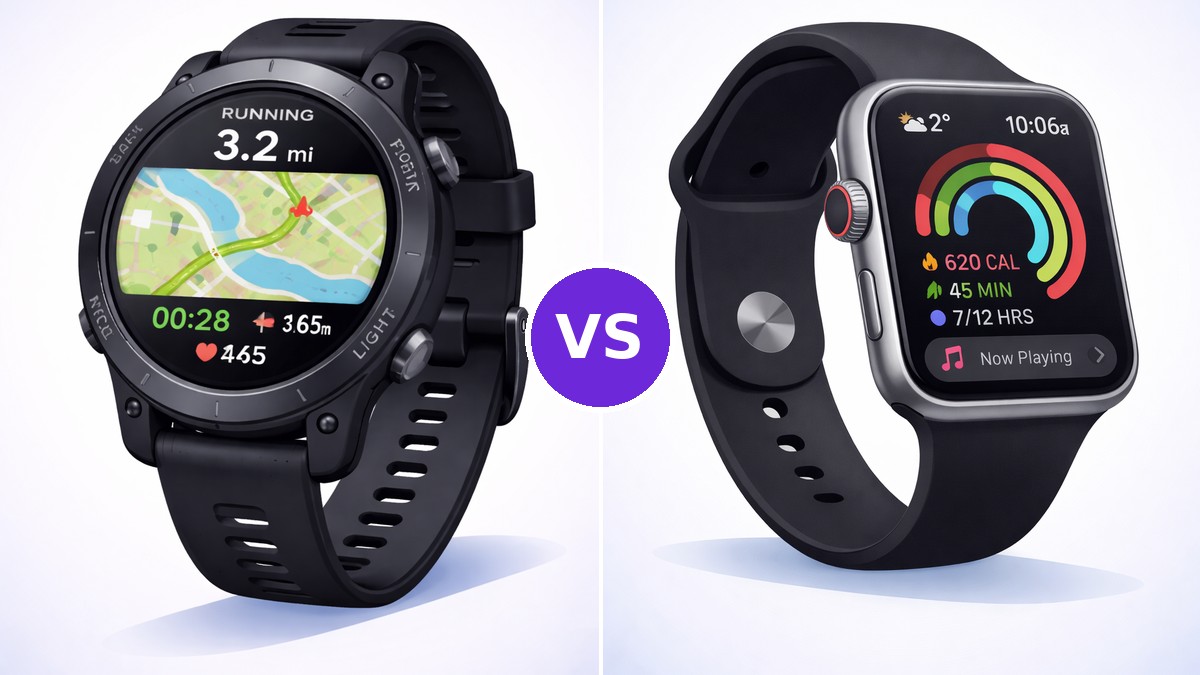
The Garmin Forerunner 970 and Apple Watch Series 11 represent two fundamentally different philosophies in wearable tech. One is an endurance-focused training computer wrapped in titanium; the other is a lifestyle smartwatch with genuinely useful fitness features. Your pick depends on whether training data or daily convenience matters more to you.
Key Differences
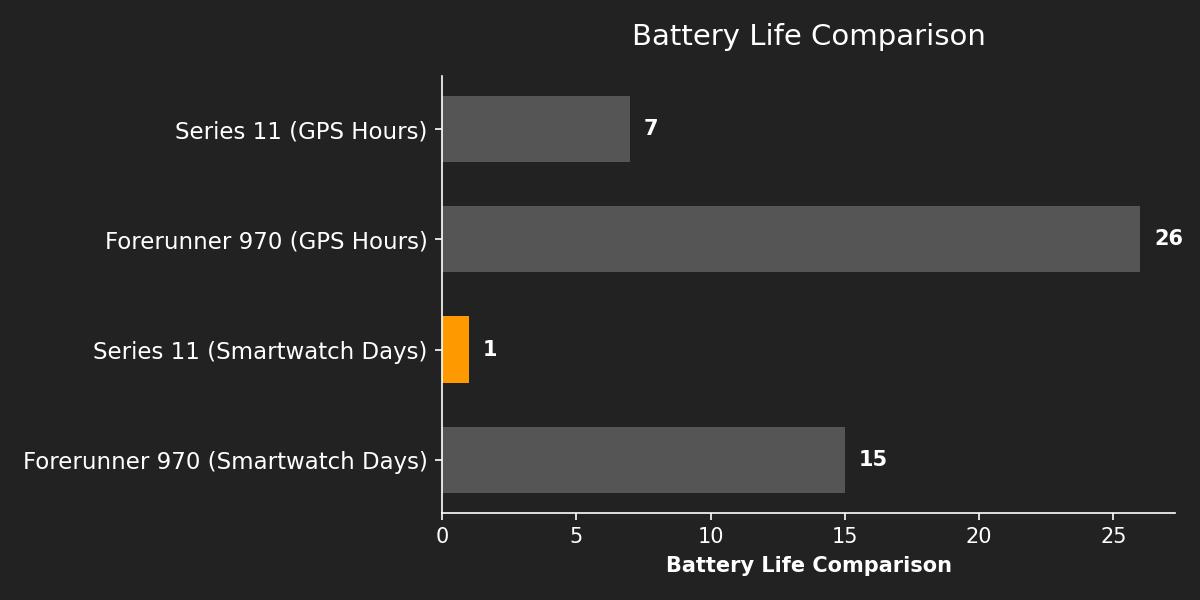
- Battery life is the biggest gap: The Forerunner 970 delivers up to 15 days in smartwatch mode and 26 hours of continuous GPS. The Apple Watch Series 11 lasts about 1 day and tops out at 7 hours of GPS tracking.
- GPS accuracy: Garmin uses multi-band GNSS for superior positioning in urban canyons, dense forests, and mountain trails. Apple relies on single-band GPS, which is adequate for most runs but less precise in challenging environments.
- Smartwatch ecosystem: The Apple Watch has LTE for standalone calls and texts, a massive App Store, and tight integration with iPhone features like iMessage and Apple Music streaming. Garmin’s smart features are functional but limited by comparison.
- Build quality: The Forerunner 970 uses a titanium case with sapphire crystal. The Series 11 uses aluminum — lighter, but less rugged.
- Price: The Garmin costs $750; the Apple Watch starts at $429. That’s a $320 difference.
- Compatibility: The Apple Watch requires an iPhone. The Forerunner 970 works with both iOS and Android.
Deep Dive Comparison
Design & Comfort
The Forerunner 970 wears like a purpose-built instrument. At 56g with a titanium case and sapphire crystal lens, it’s surprisingly light for a premium Garmin and virtually scratch-proof. The 47mm case is on the larger side but sits comfortably on most wrists thanks to Garmin’s curved caseback design. It looks like a sports watch — no getting around that.
The Apple Watch Series 11 takes a different approach. At just 37.8g in the 46mm aluminum case, it’s noticeably lighter. The LTPO3 OLED display stretches to nearly 2 inches with slim bezels, making it one of the best-looking smartwatches on the market. It transitions from a gym session to a dinner meeting without looking out of place. The tradeoff: aluminum won’t survive the same abuse that titanium shrugs off.
Battery Life
This is where the Forerunner 970 dominates. With up to 360 hours (15 days) in smartwatch mode and 26 hours of continuous GPS tracking, you can run an ultramarathon, recover for a week, and still have battery left. For multi-day hiking trips or heavy training blocks, this kind of endurance is a genuine competitive advantage.
The Apple Watch Series 11 delivers roughly 24 hours of general use and about 7 hours of GPS tracking. That’s enough for a marathon but not much more. You’ll be charging nightly — a routine most Apple Watch owners accept, but one that serious endurance athletes find unacceptable.
Health & Fitness Features
Both watches pack serious health sensors, but they emphasize different things. The Forerunner 970 includes optical heart rate, ECG, SpO2, and skin temperature monitoring. It also brings Garmin’s deep training analytics — Training Status, Training Load, Recovery Time, VO2 Max estimates, race predictions, and PacePro pacing strategies. The multi-band GPS delivers consistently accurate tracks, even under tree cover or between tall buildings.
The Apple Watch Series 11 matches on core health metrics with its electrical heart sensor (ECG), blood oxygen, and temperature sensing. It adds a depth gauge and water temperature sensor, which are useful for swimmers and divers. Apple’s health ecosystem — including the Health app, trend analysis, and doctor-sharing features — is more polished for people who want health insights without a sports science degree. However, its single-band GPS is measurably less accurate in difficult signal environments, and its training analytics are shallower than Garmin’s.
For pure running and endurance training, the Forerunner 970 is the stronger tool. For general health monitoring and casual fitness tracking, the Apple Watch is more approachable.
Smart Features
The Apple Watch Series 11 wins this category decisively. LTE connectivity lets you leave your phone at home and still take calls, stream music, get directions, and reply to messages. The App Store offers thousands of watch apps. Apple Pay works everywhere contactless is accepted. Siri integration, Find My, and handoff features make it feel like a natural extension of your iPhone.
The Forerunner 970 supports Garmin Pay (NFC), music storage (32GB — enough for thousands of songs), Bluetooth calling through a connected phone, and basic notification mirroring. It also includes a built-in LED flashlight, which is genuinely useful for early morning or late evening runs. But you won’t be replying to texts from your wrist or installing third-party apps. Garmin’s Connect IQ platform has a limited selection of watch faces and widgets — functional, but not comparable to Apple’s ecosystem.
Price & Value
The Forerunner 970 launches at $749, which is premium pricing even for Garmin. You’re paying for titanium construction, sapphire crystal, multi-band GPS, and the deepest training analytics available in a running watch. If you train seriously and use even half of Garmin’s features, the investment pays for itself in data quality alone.
The Apple Watch Series 11 starts at $429 for the GPS-only aluminum model. Adding LTE increases the price, and you’ll pay a monthly carrier fee on top of that. Even fully loaded, it’s significantly cheaper than the Forerunner 970. For the average person who wants fitness tracking, health monitoring, and a capable smartwatch, it delivers strong value.
Technical Specs
| Spec | Garmin Forerunner 970 | Apple Watch Series 11 |
|---|---|---|
| Price | $750 | $429 |
| Case Size | 47 mm | 46 mm |
| Weight | 56 g | 37.8 g |
| Case Material | Titanium / Sapphire Crystal | Aluminum |
| Display | 1.4″ AMOLED (454 × 454) | 1.96″ LTPO3 OLED (416 × 496) |
| Water Rating | 5 ATM | 50 m |
| Battery (Smartwatch) | Up to 15 days | Up to 24 hours |
| Battery (GPS) | Up to 26 hours | Up to 7 hours |
| GPS | Multi-band GNSS | Single-band |
| Connectivity | Bluetooth, ANT+, Wi-Fi, NFC | LTE, Wi-Fi 4, Bluetooth 5.3, UWB, NFC |
| Storage | 32 GB | 64 GB |
| Key Sensors | HR, ECG, SpO2, Skin Temp, LED Flashlight | HR, ECG, SpO2, Temp, Depth Gauge, Water Temp |
| NFC Payments | Garmin Pay | Apple Pay |
The Verdict
Buy the Garmin Forerunner 970 if you’re a dedicated runner, triathlete, or endurance athlete who prioritizes GPS accuracy, training analytics, and multi-day battery life. You want a watch that survives ultramarathons, tracks every metric your coach cares about, and doesn’t need charging before your next long run. You’re willing to pay a premium for titanium durability and the best GPS in the business, and you don’t need LTE or a deep app ecosystem on your wrist.
Buy the Apple Watch Series 11 if you use an iPhone and want one device that handles fitness tracking, health monitoring, phone calls, music streaming, and daily notifications seamlessly. You run or work out regularly but don’t need elite-level training data. You prefer charging nightly over wearing a bulkier sports watch, and you value the convenience of LTE independence and a massive app library. At $429, it’s also significantly easier on the wallet.
🏆 Ready to Decide?
Check the latest deals to see which one fits your budget.
*We earn a commission if you make a purchase.
Specs and features may change. Always verify details on the manufacturer’s official site before purchasing.
