

At a Glance: The Verdict
| Fitbit Charge 6 | Inspire 3 |
|---|---|
|
If you are deciding between the Fitbit Charge 6 and Fitbit Inspire 3, the choice is simpler than Fitbit’s lineup makes it look. Buy the Charge 6 if you want built-in GPS, Google Wallet, and better workout tools. Buy the Inspire 3 if you want the cheapest good Fitbit for steps, sleep, heart rate tracking, and long battery life. This guide compares the two side by side so you can pick the right tracker fast. Quick Answer Which Fitbit should most people buy?
The Charge 6 is Fitbit’s most advanced tracker, packing built-in GPS, ECG, EDA stress sensing, and Google Wallet into a slim band. It’s the right pick if you want real-time pace data without carrying your phone and advanced health metrics at a mid-range price. |
Best For: Budget-friendly everyday wellness tracking with outstanding battery life The Inspire 3 is Fitbit’s lightest, most affordable tracker: ideal if you want step counting, sleep tracking, and heart rate monitoring without the bells and whistles. It lasts up to 10 days on a charge and practically disappears on your wrist. |
Quick Buy Path
Check today’s pricing before you go deeper.
If these are already your two finalists, compare current pricing now, then keep reading for the full verdict.
If you are deciding between the Fitbit Charge 6 and the Fitbit Inspire 3, the real question is not which one is better on paper. The Charge 6 is better on paper. The real question is whether built-in GPS, Google Wallet, ECG, and a bigger screen are worth paying about $60 more than the simpler Inspire 3.
That is why this comparison matters. A lot of people are not choosing between a “good Fitbit” and a “bad Fitbit.” They are choosing between paying more for workout tools they might actually use or saving money and getting almost everything they need for steps, sleep, heart rate, and everyday wellness.
The short answer: buy the Charge 6 if you want phone-free exercise tracking or expect to use the extra features regularly. Buy the Inspire 3 if you mainly want a slim, low-maintenance tracker for health basics and better battery life.
Why These Two Fitbits Sell So Well
The Charge 6 and Inspire 3 are popular for opposite reasons. The Charge 6 is the Fitbit people buy when they want the most capability without jumping to a full smartwatch. The Inspire 3 is the Fitbit people buy when they want something simple, light, and affordable that still covers the health basics well.
That is why this comparison matters. Most shoppers are really deciding whether built-in GPS, contactless payments, and advanced sensors are worth paying extra for. If the answer is no, the Inspire 3 is usually the smarter buy. If the answer is yes, the Charge 6 earns its higher price.
Fitbit Inspire 3 vs Charge 6: The Key Differences
- GPS: The Charge 6 has built-in GPS for phone-free run tracking. The Inspire 3 has no GPS at all: it relies on Connected GPS through your phone’s signal.
- Health sensors: The Charge 6 adds ECG for heart rhythm assessment and EDA for stress monitoring. The Inspire 3 covers the basics (heart rate, SpO2, and skin temperature) but skips the advanced electrical sensors.
- Contactless payments: The Charge 6 supports Google Wallet via NFC. The Inspire 3 does not have NFC.
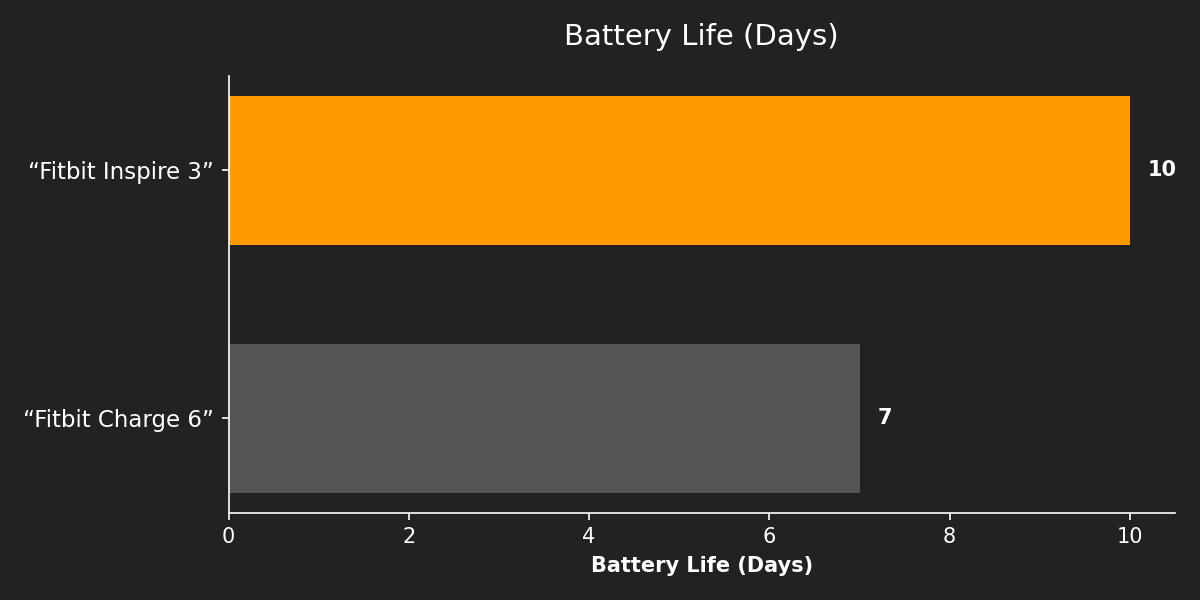
- Battery life: The Inspire 3 lasts up to 10 days versus 7 days on the Charge 6 (and GPS usage drops the Charge 6 to about 5 hours).
- Display: The Charge 6 has a larger 1.04-inch AMOLED screen compared to the Inspire 3’s 0.76-inch panel.
- Price: The Inspire 3 launched at $99.95: $60 less than the Charge 6’s $159.95 retail price.
Deep Dive Comparison
Design & Comfort
The Inspire 3 is the featherweight here at just 17.7g, nearly half the Charge 6’s 30g. That difference is noticeable during sleep tracking and all-day wear. The Inspire 3’s plastic case keeps costs and weight down, but it doesn’t feel as premium as the Charge 6’s aluminum and glass construction.
The Charge 6 has a wider, more readable display that makes mid-workout glances easier. The Inspire 3’s slimmer profile is more discreet and fits smaller wrists comfortably. Both are rated at 5 ATM for swim-proofing. If comfort is your top priority and you don’t mind a smaller screen, the Inspire 3 wins. If you want something that feels more polished and substantial, the Charge 6 is the better build.
Battery Life
The Inspire 3 takes this category decisively. With up to 10 days of battery life, it can go well over a week before needing a charge. The Charge 6 manages about 7 days in smartwatch mode, which is still solid. But activate GPS tracking and you’ll burn through the battery in roughly 5 hours. If you’re a runner logging 45-minute GPS sessions a few times per week, expect the Charge 6 to last closer to 5 days in practice.
Health & Fitness Features
This is where the Charge 6 earns its premium. It adds ECG for heart rhythm checks, EDA for stress sessions, and built-in GPS for phone-free outdoor tracking. Those are not tiny spec-sheet wins. They change what kind of user the device makes sense for.
Both trackers still cover the health basics well: continuous heart rate, SpO2, sleep staging, skin temperature trends, and Fitbit’s familiar wellness dashboards. If that is all you want, the Inspire 3 does not feel cheap in capability. It feels limited mainly when you start asking it to do more serious workout duty.
The decisive split is this: the Charge 6 is built for people who want their fitness tracker to behave more like a small training tool, while the Inspire 3 is built for people who want health tracking to fade into the background. That is a meaningful difference in day-to-day ownership, not just a longer feature list.
Smart Features
Neither tracker has a microphone or speaker, so forget about taking calls from your wrist. Both handle smartphone notifications (calls, texts, apps) and support Fitbit’s suite of guided workouts and mindfulness content.
The Charge 6 pulls ahead with NFC for Google Wallet: tap to pay at any contactless terminal without reaching for your phone or card. It also supports YouTube Music control and Google Maps navigation, thanks to Fitbit’s tighter Google ecosystem integration since the acquisition. The Inspire 3 lacks all of these smart features, keeping things intentionally simple.
Workout Modes & Exercise Tracking
The Charge 6 supports over 40 exercise modes, including indoor and outdoor running, cycling, swimming, HIIT, weight training, and yoga. Its built-in GPS means outdoor workouts get accurate route maps, elevation data, and real-time pace zones, all without your phone. The Charge 6 also tracks Active Zone Minutes using personalized heart rate zones, giving you a clear picture of workout intensity across cardio, fat burn, and peak zones.
The Inspire 3 covers about 20 exercise modes (the core ones like running, walking, cycling, swimming, and yoga) but it lacks any GPS capability of its own. If you start a run, the Inspire 3 will track your heart rate, duration, and calories, but you won’t get distance or pace data unless your phone is nearby with Connected GPS enabled. For gym-based workouts like weight training or group classes, both trackers perform about the same since GPS isn’t a factor.
One underrated Charge 6 advantage: real-time heart rate zone indicators during exercise. The screen is large enough to display your current zone at a glance, which is harder to read on the Inspire 3’s smaller display. If structured training matters to you (intervals, zone-based runs, progressive overload tracking) the Charge 6 is meaningfully better. If you just want credit for being active, the Inspire 3 gets the job done.
Price & Value
At $99.95 MSRP, the Fitbit Inspire 3 is one of the easiest trackers to recommend to casual users. It routinely drops below $80 on sale, gives you an AMOLED display, strong sleep tracking, long battery life, and a lightweight fit that works for almost anyone. For basic tracking, it is one of the cleanest values in Fitbit’s lineup.
The Charge 6 at $159.95 costs about 60% more, so it needs to do more than be “slightly nicer.” Fortunately, it does. Built-in GPS, Google Wallet, ECG, EDA, a bigger screen, and broader workout usefulness push it into a different class. If you will use even two or three of those upgrades regularly, the premium makes sense.
If you will not use those upgrades, the math flips fast. In that case, the Inspire 3 is not the cheaper compromise. It is the smarter purchase. That is the core buyer filter on this page: pay more for the Charge 6 only if the extra features change how you actually exercise or live.
If your real decision is whether a discounted older premium tracker beats the cheaper band, check out Fitbit Charge 5 vs Inspire 3 instead. That comparison is more directly about budget value than this one.
App Experience & Fitbit Premium
Both trackers use the same Fitbit app for iPhone and Android, so the daily experience of checking stats, reviewing sleep scores, and logging food or water is identical. Fitbit has also pushed more everyday logging tools into the free tier, so food logging, water tracking, and mood logging no longer require a Premium subscription.
Where the Charge 6 pulls ahead in the app is GPS data. After an outdoor workout, you get a detailed route map with pace splits, elevation changes, and heart rate overlaid on the path. The Inspire 3 can only show this data if you had your phone with you during the workout. The Charge 6 also integrates with Google Maps for turn-by-turn navigation and YouTube Music for playlist control, features that show up in the app’s connected services but aren’t available on the Inspire 3.
Fitbit Premium ($9.99/month or $79.99/year) unlocks deeper insights on both devices: Daily Readiness Score, detailed sleep analysis, guided workout programs, and wellness reports. The core Premium experience is the same regardless of which tracker you wear. However, the Charge 6’s ECG and EDA data feed into Premium’s health reports with richer detail that the Inspire 3 can’t provide since it lacks those sensors.
Should You Upgrade to the Charge 6?
If you already know the Inspire 3 would cover your basics, this is the decision checkpoint. The Charge 6 is worth paying more for only when the extras solve a real problem for you.
- Upgrade to the Charge 6 if you want built-in GPS for runs and walks, want to pay from your wrist with Google Wallet, or want Fitbit’s more advanced health sensors in a band-style tracker.
- Stick with the Inspire 3 if you mainly care about steps, sleep, resting heart rate, stress-free wear, and charging as rarely as possible.
- Pick the Inspire 3 over the Charge 6 if your budget is tight and you know GPS, ECG, and contactless pay are features you will admire more than use.
That is the honest answer: the Charge 6 is the better device, but the Inspire 3 is still the better buy for a large chunk of everyday Fitbit shoppers.
Technical Specs
| Spec | Fitbit Charge 6 | Fitbit Inspire 3 |
|---|---|---|
| Launch Price | $159.95 | $99.95 |
| Weight | 30g | 17.69g |
| Display | 1.04″ AMOLED (184 × 276) | 0.76″ AMOLED |
| Case Material | Aluminum, glass, resin | Plastic |
| Water Rating | 5 ATM | 5 ATM |
| Battery Life | Up to 7 days (5 hrs GPS) | Up to 10 days |
| GPS | Built-in (GPS + GLONASS) | Connected GPS only |
| NFC Payments | Yes (Google Wallet) | No |
| Key Sensors | HR, SpO2, ECG, EDA, Skin Temp, Accelerometer | HR, SpO2, Skin Temp, Accelerometer |
| Connectivity | Bluetooth, NFC | Bluetooth |
Who Should Upgrade from an Older Fitbit?
Coming from a Charge 5: The Charge 6 adds Google Wallet, YouTube Music, Google Maps, and improved heart rate accuracy with a redesigned sensor array. The upgrade is modest. If your Charge 5 is working fine, you can wait. But if you want the Google ecosystem features or your Charge 5’s battery is degrading, the Charge 6 is a solid step up.
Coming from an Inspire 2: The Inspire 3 brings an AMOLED color display (the Inspire 2 had a grayscale screen), blood oxygen monitoring, skin temperature tracking, and a slimmer design. This is a more significant upgrade: the color screen and SpO2 alone make it worthwhile if your Inspire 2 is showing its age.
Coming from a Versa 2 or Versa 3: If you liked having a larger screen and app ecosystem, the Charge 6 is the closest replacement in Fitbit’s current lineup since the Versa line has been discontinued. You’ll lose the square smartwatch form factor but gain a lighter, more comfortable band with better battery life. The Inspire 3 will likely feel like a downgrade from a Versa.
Coming from a non-Fitbit tracker: If you’re switching from a Xiaomi Mi Band or Amazfit Band, the Inspire 3 is the natural step up: similar form factor (see our Amazfit Band 7 vs Xiaomi Smart Band 9 comparison) but with better build quality and Fitbit’s more polished app ecosystem. If you’re coming from an Apple Watch or Garmin and want something simpler, the Charge 6 bridges that gap without the smartwatch complexity.
The Verdict
Choose the Fitbit Charge 6 if you want the better all-around fitness tracker. It is the right pick for runners, outdoor walkers, and anyone who wants phone-free GPS, Google Wallet, ECG, and a larger screen that is easier to read during workouts.
Choose the Fitbit Inspire 3 if you want the better budget Fitbit. It handles steps, sleep, heart rate, and all-day comfort extremely well, and the 10-day battery life is a real advantage if you do not want another device that needs frequent charging.
Bottom line: the Charge 6 is the better tracker, but the Inspire 3 is the better value for basic tracking. If you will use GPS or want the extra features, buy the Charge 6. If you mainly want wellness tracking and lower cost, buy the Inspire 3.
Frequently Asked Questions
Fitbit Charge 6 vs Fitbit Inspire 3: what is the difference?
The biggest differences are GPS, advanced health sensors, and price. The Charge 6 has built-in GPS for phone-free outdoor tracking, plus ECG and EDA sensors the Inspire 3 lacks. The Charge 6 also supports Google Wallet contactless payments and has a larger screen. The Inspire 3 is lighter, cheaper ($99 vs $160), and has longer battery life (10 days vs 7 days). Both share the same Fitbit app and core features like heart rate monitoring, sleep tracking, and SpO2.
Should you upgrade to the Fitbit Charge 6 over the Inspire 3?
Usually only if you will use the workout and convenience upgrades. If you run, walk, or cycle outdoors and want accurate distance and pace data without carrying your phone, the Charge 6’s built-in GPS alone can justify the extra cost. Google Wallet, ECG, and the larger screen strengthen the case. But if you mostly care about step counting, sleep tracking, and basic heart rate data, the Inspire 3 covers those jobs for less money and with longer battery life.
Can you swim with the Fitbit Charge 6 and Inspire 3?
Yes. Both are rated at 5 ATM, meaning they’re safe for swimming in pools and shallow open water. They can track swim workouts including laps and duration. However, neither is rated for high-velocity water sports like jet skiing or scuba diving.
Do both trackers require Fitbit Premium?
No. Both work fully without a Premium subscription. You get step tracking, heart rate, sleep staging, SpO2, exercise tracking, and smartphone notifications for free. Fitbit Premium ($9.99/month) adds extras like Daily Readiness Score, detailed sleep insights, guided programs, and wellness reports, but these are optional on both devices.
Which Fitbit tracker has better battery life?
The Inspire 3 wins with up to 10 days of battery life compared to the Charge 6’s 7 days. If you use the Charge 6’s GPS regularly, real-world battery life drops to about 5 days. The Inspire 3’s battery advantage is one of its strongest selling points for users who don’t want to charge frequently.
🏆 Ready to Decide?
Check the latest deals to see which one fits your budget.
*We earn a commission if you make a purchase.
Specs and features may change. Always verify details on the manufacturer’s official site before purchasing.
