
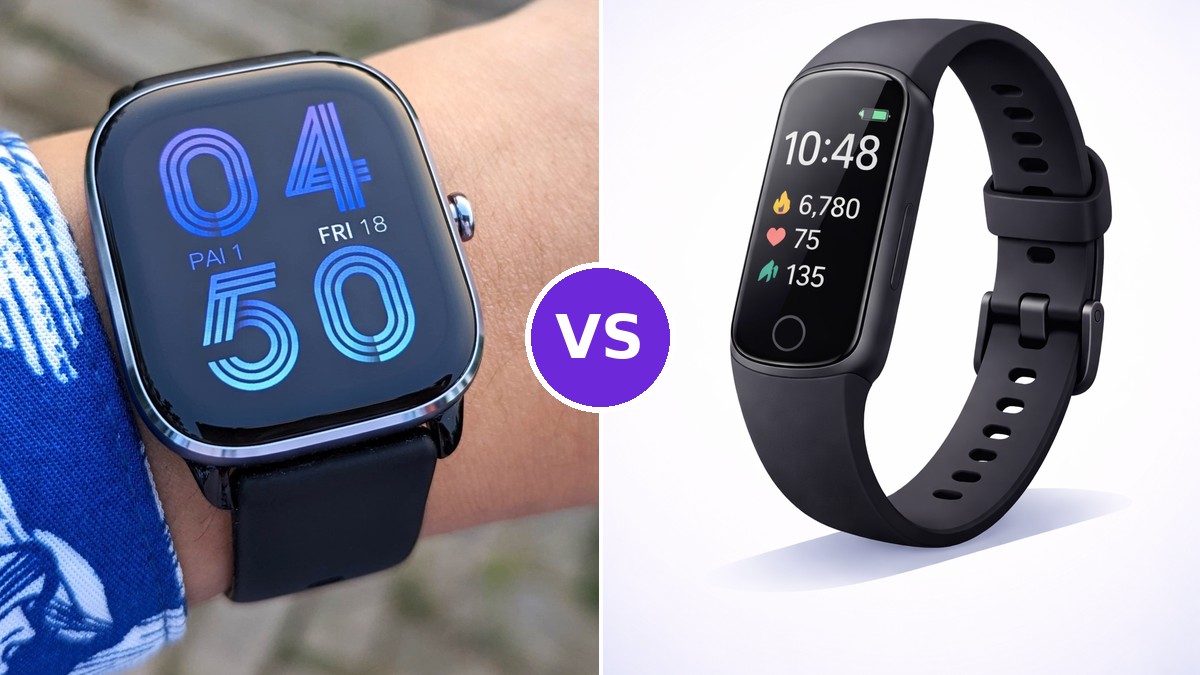
At a Glance: The Verdict
| Amazfit GTS 4 | Fitbit Versa 4 |
|---|---|
|
Best For: Budget-conscious fitness enthusiasts who want longer battery life and multi-band GPS accuracy The Amazfit GTS 4 delivers an impressive 8-day battery, a larger 1.75-inch AMOLED display, and dual-band GPS — all for $30 less than the competition. It’s featherlight at just 27g, making it one of the most comfortable fitness watches you can wear around the clock. |
Best For: Google ecosystem users who want NFC payments and seamless app integration The Fitbit Versa 4 brings contactless payments via Fitbit Pay, deep Google integration (Maps, Wallet), and Fitbit’s proven health tracking platform. If you already use Google services and want a smartwatch that doubles as your wallet, the Versa 4 is hard to beat. |
Quick Buy Path
Check today’s pricing before you go deeper.
If these are already your two finalists, compare current pricing now, then keep reading for the full verdict.
The Amazfit GTS 4 and Fitbit Versa 4 launched within weeks of each other in fall 2022, both targeting the mid-range fitness smartwatch market. They share AMOLED screens, built-in GPS, and microphone/speaker support — but they take very different approaches to battery management, GPS accuracy, and smart features. Here’s how they actually stack up.
Key Differences
- Battery life: The Amazfit GTS 4 lasts up to 8 days on a charge versus 6 days for the Fitbit Versa 4 — a meaningful gap if you hate charging your watch mid-week.
- GPS accuracy: Amazfit uses multi-band GPS (connects to more satellite systems simultaneously), while Fitbit relies on standard GPS + GLONASS. Multi-band typically delivers more accurate route tracking in urban canyons and dense tree cover.
- NFC payments: The Fitbit Versa 4 supports contactless payments through Fitbit Pay/Google Wallet. The Amazfit GTS 4 does not have NFC — you’ll still need your phone or card at checkout.
- Display size: The GTS 4’s 1.75-inch screen is noticeably larger than the Versa 4’s 1.58-inch panel, making it easier to read mid-workout.
- Weight: At 27g, the Amazfit GTS 4 is roughly 10g lighter than the 37.6g Fitbit Versa 4 — a difference you’ll feel during long runs.
- Ecosystem: The Versa 4 integrates tightly with Google services (Maps turn-by-turn, Google Wallet, YouTube Music). The GTS 4 pairs with Amazfit’s Zepp app, which is capable but less connected to third-party services.
Deep Dive Comparison
Design & Comfort
Both watches use aluminum cases and square-ish AMOLED displays, but the similarities end there. The Amazfit GTS 4 is remarkably light at 27g with an aluminum alloy mid-frame and polycarbonate back. Its 42.7mm case houses a larger 1.75-inch screen with a 390 × 450 resolution — sharp enough that text is crisp even at small font sizes. The rectangular shape leans sporty and modern.
The Fitbit Versa 4 weighs in at 37.6g with a full aluminum body and a slightly more compact 40.5mm case. Its 1.58-inch display (336 × 336) is smaller but still perfectly readable. Fitbit’s design language is rounder and more understated — it blends better as an everyday accessory. The physical button on the side is a welcome addition over the Versa 3’s haptic side panel, which many users found frustrating.
Both are rated for 5 ATM / 50 meters of water resistance, so swimming and showering are fair game. If you prioritize comfort during sleep tracking and long workouts, the GTS 4’s 10g weight advantage is noticeable. If you prefer a more polished, jewelry-like look, the Versa 4 edges ahead.
Battery Life
Battery life is one of the clearest differentiators here. The Amazfit GTS 4 claims up to 8 days of typical use and 16 hours of continuous GPS — both figures that hold up reasonably well in real-world testing. The Fitbit Versa 4 manages about 6 days of regular use and roughly 12 hours with GPS active.
For most people, that means the GTS 4 gets you through a full work week and into the weekend without charging, while the Versa 4 needs a top-up around day 5 or 6. If you track GPS-heavy activities like long hikes or marathon training, the GTS 4’s extra 4 hours of GPS runtime adds real peace of mind.

Health & Fitness Features
Both watches cover the essentials: 24/7 heart rate monitoring, SpO2 blood oxygen tracking, sleep analysis, and step/calorie counting. The Amazfit GTS 4 uses its BioTracker 4.0 PPG sensor and adds a gyroscope and geomagnetic sensor for better motion tracking. It supports over 150 sport modes and includes a barometric altimeter for elevation tracking during hikes and stair climbs.
The Fitbit Versa 4 counters with Fitbit’s mature health platform, including a device temperature sensor (useful for menstrual health tracking and illness detection), Daily Readiness Score, and Active Zone Minutes — a feature that automatically tracks time spent in fat-burn, cardio, and peak heart rate zones. Fitbit’s sleep tracking remains among the best in the industry, with detailed sleep stages and a Sleep Score.
Where the GTS 4 pulls ahead is GPS accuracy. Its multi-band positioning system locks onto satellites faster and maintains better accuracy in challenging environments — tall buildings, tree canopy, mountain valleys. The Versa 4’s GPS + GLONASS is adequate for most suburban runs but can drift in tougher conditions.
Fitbit’s advantage is its health ecosystem. Years of data science, a massive user base for benchmarking, and integration with services like your doctor’s office through Fitbit Health Solutions give it depth that Amazfit’s Zepp platform hasn’t matched yet.
Smart Features
This is where the Fitbit Versa 4 justifies its higher price. NFC payments through Google Wallet let you leave your phone and wallet at home on quick runs. Google Maps provides turn-by-turn directions on your wrist. YouTube Music integration means offline playlists without your phone. Amazon Alexa is built in for voice commands.
The Amazfit GTS 4 supports Bluetooth calls (with its mic and speaker), notification mirroring, music control, and Alexa voice assistant. It has 2.3GB of onboard storage for offline music. However, the lack of NFC payments is a genuine gap — once you get used to tapping your watch at a coffee shop, going back to pulling out a card feels like a step backward.
Both watches support phone call handling and notification delivery. The GTS 4 connects via Wi-Fi (2.4GHz) in addition to Bluetooth, which the Versa 4 lacks — useful for faster syncing and downloads when your phone isn’t nearby.
Price & Value
The Amazfit GTS 4 launched at $199, while the Fitbit Versa 4 debuted at $229. That $30 gap has widened over time as both watches have seen discounts, with the GTS 4 frequently dipping below $150 and the Versa 4 hovering around $150–$180.
On pure specs-per-dollar, the Amazfit GTS 4 is hard to beat: longer battery, larger display, multi-band GPS, and lighter weight — all for less money. The Fitbit Versa 4’s premium buys you NFC payments, deeper Google integration, and Fitbit’s superior health platform. Whether that’s worth the extra cost depends entirely on how much you value those features.
Technical Specs
| Spec | Amazfit GTS 4 | Fitbit Versa 4 |
|---|---|---|
| Launch Price | $199 | $229 |
| Case Size | 42.7mm | 40.5mm |
| Weight | 27g | 37.6g |
| Display | 1.75″ AMOLED (390 × 450) | 1.58″ AMOLED (336 × 336) |
| Battery (Typical) | Up to 8 days | Up to 6 days |
| Battery (GPS) | 16 hours | 12 hours |
| GPS | Multi-band | GPS + GLONASS |
| Water Rating | 5 ATM | 50 meters |
| NFC Payments | No | Yes (Google Wallet) |
| Storage | 2.3GB | 4GB |
| Connectivity | Wi-Fi, Bluetooth 5.0, BLE | Bluetooth 5.0, NFC |
| Case Material | Aluminum alloy + PC | Aluminum |
The Verdict
Buy the Amazfit GTS 4 if you want the best value in a mid-range fitness watch. It wins on battery life (8 vs 6 days), GPS accuracy (multi-band), display size (1.75″), weight (27g), and price ($199 vs $229). If your priorities are workout tracking, all-day comfort, and going longer between charges, the GTS 4 delivers more for less.
Buy the Fitbit Versa 4 if you’re invested in the Google ecosystem and want NFC payments on your wrist. Google Wallet, Maps, and YouTube Music integration make this the smarter “smart” watch of the two. Fitbit’s health platform is also more mature — the Daily Readiness Score, temperature tracking, and sleep analysis are best-in-class. If you’ll actually use contactless payments daily, the $30 premium pays for itself in convenience.
The bottom line: The Amazfit GTS 4 is the better fitness watch. The Fitbit Versa 4 is the better smartwatch. Pick the one that matches how you’ll actually use it.
🏆 Ready to Decide?
Check the latest deals to see which one fits your budget.
*We earn a commission if you make a purchase.
Specs and features may change. Always verify details on the manufacturer’s official site before purchasing.
