
At a Glance: The Verdict
| Garmin Forerunner 55 | Garmin Forerunner 165 |
|---|---|
|
Best For: Budget runners who want 14-day battery and don’t care about a fancy screen A stripped-down training watch that nails the basics. At its current street price, it’s one of the cheapest real Garmin GPS watches you can buy. |
Best For: New buyers who want a modern AMOLED screen, Garmin Pay, and music storage The 2024 default. You get a sharp AMOLED display, NFC payments, SpO2, and 4GB of music storage for about $50 more at launch. This is the watch most runners should buy. |
Quick Buy Path
Check today’s pricing before you go deeper.
If these are already your two finalists, compare current pricing now, then keep reading for the full verdict.
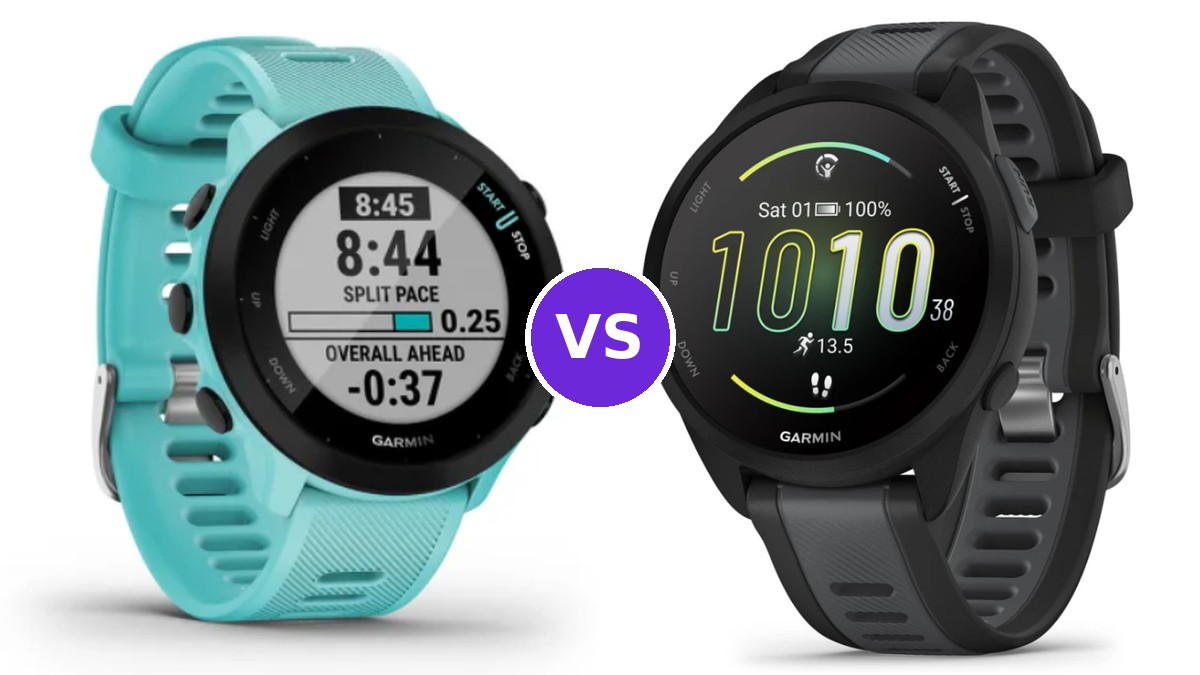
The Forerunner 165 is the 2024 follow-up to the Forerunner 55, and it’s a real generational jump — not a lazy refresh. The 165 is the default pick for new buyers. The real questions are whether 55 owners should upgrade, and whether the aging 55 is still worth buying at its discount price.
Key Differences
- Display: The 165 has a bright 1.2-inch AMOLED (390 x 390). The 55 has a dim 1.04-inch memory-in-pixel screen (208 x 208). It’s not close.
- Payments: The 165 has Garmin Pay via NFC. The 55 does not.
- Music storage: The 165 has 4GB onboard (roughly 500 songs). The 55 has 32MB and stores no music.
- Health sensors: The 165 adds SpO2, barometric altimeter, compass, thermometer, and an ambient light sensor. The 55 has heart rate and an accelerometer and that’s it.
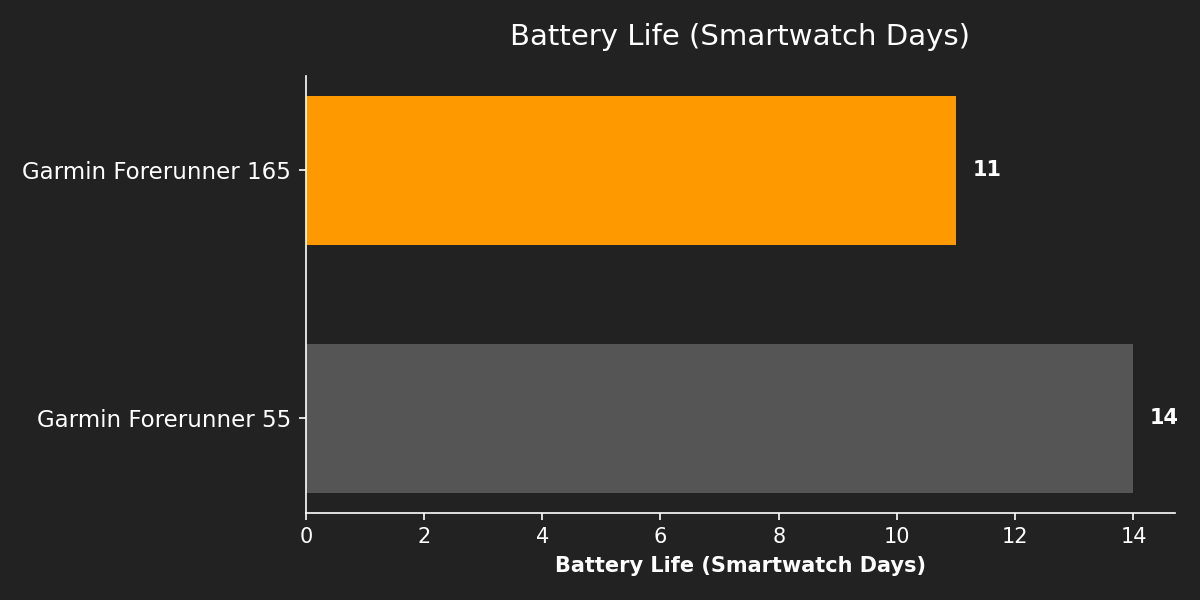
- Battery in smartwatch mode: The 55 wins — 14 days vs 11 days on the 165.
- Launch price: $199.99 for the 55 vs $249.99 for the 165.
Deep Dive Comparison
Design & Comfort
Both watches use a fiber-reinforced polymer case and share the classic small, light Forerunner feel. The 55 is 42mm and 37g. The 165 is slightly larger at 43mm and 39g. You will not notice the 2-gram difference on your wrist. Both have a 5 ATM water rating, which is fine for swimming and showering.
Where the 165 pulls away is the front of the watch. The AMOLED panel is sharper, brighter in sunlight, and easier to read at a glance. The 55’s memory-in-pixel screen is readable outdoors but looks ancient next to the 165 indoors or at night.
Battery Life
This is the one category where the older watch actually wins. The 55 lasts up to 14 days in smartwatch mode vs 11 days on the 165. In GPS mode, they’re basically tied — 20 hours for the 55, 19 hours for the 165. MIP screens sip power, and that’s why the 55 hangs on for an extra three days between charges.
Health & Fitness Features
Both watches use single-band GPS with GLONASS and Galileo support. For most road running, the 165’s GPS performance is a small step forward thanks to newer internals, but don’t expect multi-band accuracy — neither has it.
The 165 pulls ahead on sensors. It adds SpO2 for blood oxygen readings, a barometric altimeter for proper elevation tracking, a compass, a thermometer, and an ambient light sensor for auto screen brightness. The 55 only tracks heart rate and basic motion. If you run trails or want sleep insights with blood oxygen data, the 165 is the clear pick.
Both get Garmin’s core running tools: daily workout suggestions, recovery time, VO2 max estimates, and training status.
Smart Features
The 165 is the first Forerunner under $300 to get Garmin Pay, which means you can tap to pay with your wrist at the grocery store. The 55 can’t do that. The 165 also has 4GB of music storage and supports offline playlists from Spotify, Amazon Music, and Deezer. The 55 has no music support at all — you’ll need to carry your phone for audio on runs.
Both handle phone notifications, weather, and Connect IQ watch faces. Neither has a mic or speaker, so no calls or voice assistant on either.
Price & Value
The 165 launched at $249. The 55 launched at $199 and now routinely sells for less. The $50 launch gap gets you a sharper AMOLED screen, NFC payments, music storage, and a proper sensor stack. That’s a lot of watch for the upgrade price.
The 55’s case only works if you catch it on a real sale. At full price next to the 165, it doesn’t make sense. At a steep discount, it’s a solid starter watch for someone who only cares about logging runs.
Technical Specs Table
| Spec | Garmin Forerunner 55 | Garmin Forerunner 165 |
|---|---|---|
| Release Date | June 2021 | February 2024 |
| Case Size | 42mm | 43mm |
| Weight | 37g | 39g |
| Display | 1.04-inch MIP, 208 x 208 | 1.2-inch AMOLED, 390 x 390 |
| Water Rating | 5 ATM | 5 ATM |
| GPS | Single-band (GPS, GLONASS, Galileo) | Single-band (GPS, GLONASS, Galileo) |
| Battery (Smartwatch) | 14 days | 11 days |
| Battery (GPS) | 20 hours | 19 hours |
| Sensors | HR, Accelerometer | HR, SpO2, Barometric Altimeter, Compass, Thermometer, Ambient Light, Accelerometer |
| NFC Payments | No | Yes |
| Storage | 32MB (no music) | 4GB (music supported) |
| Launch Price | $199 | $249 |
The Verdict
Buy the Forerunner 165 if you’re a new buyer. It’s a full generation ahead. The AMOLED screen, Garmin Pay, music storage, and proper sensor stack are worth the $50 premium for almost everyone. Don’t overthink this one.
Keep your Forerunner 55 if you already own it — unless the AMOLED screen, offline music, or wrist payments genuinely matter to you. The 55 still tracks runs well and holds a charge longer. The 165 is a real upgrade, but it’s not urgent if you mostly use your watch as a run logger.
Buy the Forerunner 55 only at a deep discount — think $120 or less. At full price next to the 165, it doesn’t make sense. At firesale pricing, it’s still a legit entry-level Garmin for someone who just wants a cheap GPS watch with real training tools.
🏆 Ready to Decide?
Check the latest deals to see which one fits your budget.
*We earn a commission if you make a purchase.
Specs and features may change. Always verify details on the manufacturer’s official site before purchasing.
