

At a Glance: The Verdict
| Garmin Forerunner 265 | COROS PACE 4 |
|---|---|
|
Best For: Runners who want a proven training ecosystem with Garmin Coach, NFC payments, and best-in-class software The Forerunner 265 delivers a gorgeous AMOLED display, rock-solid multi-band GPS, and Garmin’s deep training analytics — including Training Readiness, Race Predictor, and morning reports. It costs more, but you get Garmin Pay, music storage, and one of the most polished running watch ecosystems on the market. |
Best For: Budget-conscious runners who prioritize battery life, lightweight design, and raw training data The COROS PACE 4 is a newer, lighter, and significantly cheaper running watch that doubles the Forerunner 265’s GPS battery life. It adds a microphone/speaker, delivers excellent multi-band GPS accuracy, and offers COROS’s powerful EvoLab training metrics. The trade-off: no NFC payments and a smaller app ecosystem. |
Quick Buy Path
Check today’s pricing before you go deeper.
If these are already your two finalists, compare current pricing now, then keep reading for the full verdict.
The Garmin Forerunner 265 has been one of the most popular mid-range running watches since its 2023 launch, but the COROS PACE 4 arrived in late 2025 with aggressive specs at nearly half the price. Both target serious runners with AMOLED displays and multi-band GPS — but they take very different approaches to features, battery life, and value.
Key Differences
- Price gap is massive: The Forerunner 265 launched at $450 vs. the PACE 4 at $249 — a $200 difference for watches targeting the same runner.
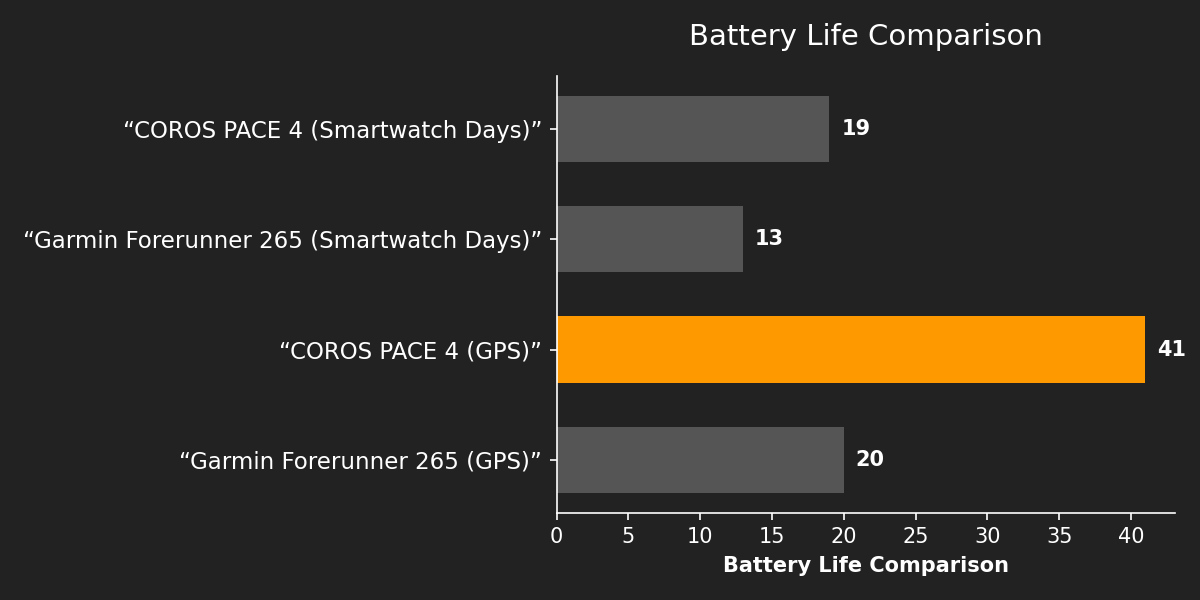
- Battery life isn’t close: The PACE 4 delivers 41 hours of GPS tracking vs. 20 hours on the Forerunner 265. In smartwatch mode, it’s 19 days vs. 13 days.
- Weight: The PACE 4 weighs just 32g compared to the Forerunner 265’s 47g — a 32% reduction that’s noticeable on long runs.
- NFC payments: Only the Forerunner 265 supports Garmin Pay. The PACE 4 has no contactless payment option.
- Mic/Speaker: The PACE 4 includes a built-in microphone and speaker. The Forerunner 265 does not.
- Connectivity: The Forerunner 265 adds ANT+ support on top of Bluetooth and Wi-Fi, making it compatible with a wider range of external sensors.
- Storage: Garmin offers 8GB (enough for ~2,000 songs) vs. COROS’s 4GB.
- Software ecosystem: Garmin Connect is deeper and more mature, with Garmin Coach, Connect IQ apps, and broader third-party integrations.
Deep Dive Comparison
Design & Comfort
Both watches use fiber-reinforced polymer cases with 5 ATM water resistance, but the similarities end at the wrist. The COROS PACE 4 is dramatically lighter at 32g — that’s 15g less than the Forerunner 265’s 47g. For marathon runners logging 20+ miles, that difference adds up. The PACE 4 also has a smaller 43.4mm case compared to the Forerunner 265’s 46.1mm, making it a better fit for slimmer wrists.
The Forerunner 265 has a slightly larger 1.3-inch AMOLED display at 416 x 416 resolution, giving it a small edge in readability over the PACE 4’s 1.2-inch, 390 x 390 screen. Both are sharp and vibrant, but mid-run glances are marginally easier on the Garmin.
Battery Life
This is where the COROS PACE 4 dominates. With 41 hours of GPS battery life, it more than doubles the Forerunner 265’s 20-hour GPS rating. In smartwatch mode, the PACE 4 stretches to 19 days versus the Forerunner 265’s 13 days. For ultra runners or multi-day hikers who want GPS tracking without a charger, the PACE 4 is in a completely different league.
Health & Fitness Features
Both watches pack optical heart rate monitors, SpO2 blood oxygen tracking, barometric altimeters, and full multi-band GPS with access to multiple satellite constellations. Garmin’s implementation includes SatIQ Technology, which intelligently switches between single-band and multi-band GPS to balance accuracy and battery life — a feature COROS doesn’t offer.
On the training side, Garmin brings its deep analytics suite: Training Readiness, Training Status, Training Load, Race Predictor, Morning Report, Body Battery, and HRV Status. COROS counters with its EvoLab platform, offering Running Fitness, Training Load, Base Fitness, and Recovery Timer. Both are excellent for structured training, but Garmin’s ecosystem is more mature and offers Garmin Coach — free adaptive training plans that adjust in real time based on your performance.
The Forerunner 265 also includes Garmin’s Pulse Ox sensor for continuous blood oxygen monitoring and an ambient light sensor — both absent from the PACE 4’s spec sheet.
Smart Features
The Garmin Forerunner 265 has a clear advantage in daily smartwatch utility. Garmin Pay lets you tap to pay at any NFC terminal — perfect for coffee stops mid-run. With 8GB of storage, you can load playlists from Spotify, Amazon Music, or Deezer for phone-free runs. The Connect IQ store adds thousands of watch faces, widgets, and apps.
The COROS PACE 4 takes a more running-focused approach. It skips NFC payments entirely, and while it offers 4GB of storage, music support is more limited. However, the PACE 4 gains a built-in microphone and speaker — useful for voice commands and audio alerts during workouts. Both watches support Bluetooth and Wi-Fi for syncing, but only the Garmin adds ANT+ for connecting to legacy sensors like chest straps and power meters.
Price & Value
This is the COROS PACE 4’s strongest argument. At $249, it undercuts the Forerunner 265’s $450 launch price by $200 — while offering significantly better battery life and a lighter build. The Forerunner 265 has seen street-price discounts since its 2023 launch, but even at $350, it’s still $100 more than the PACE 4.
The question is whether Garmin’s extras — NFC payments, larger app ecosystem, ANT+ compatibility, more storage, and Garmin Coach — justify that premium. For runners who just want accurate GPS, solid training metrics, and great battery life, the PACE 4 delivers more bang for the buck. For those who want a complete smartwatch-meets-running-watch package, the Forerunner 265 earns its price.
Technical Specs
| Spec | Garmin Forerunner 265 | COROS PACE 4 |
|---|---|---|
| Release Date | March 2023 | November 2025 |
| Price | $450 | $249 |
| Weight | 47g | 32g |
| Case Size | 46.1mm | 43.4mm |
| Display | 1.3″ AMOLED (416×416) | 1.2″ AMOLED (390×390) |
| Water Rating | 5 ATM | 5 ATM |
| GPS Battery | 20 hours | 41 hours |
| Smartwatch Battery | 13 days | 19 days |
| GPS Type | Multi-band | Multi-band |
| NFC Payments | Yes (Garmin Pay) | No |
| Mic/Speaker | No | Yes |
| Storage | 8GB | 4GB |
| Connectivity | Bluetooth, ANT+, Wi-Fi | Bluetooth, Wi-Fi |
| Key Sensors | HR, SpO2, Altimeter, Gyro, Compass, Thermometer, Ambient Light | HR, SpO2, Altimeter, Gyro, Compass, Thermometer |
The Verdict
Buy the COROS PACE 4 if you want the best value in a mid-range running watch. At $249, it delivers double the GPS battery life, a lighter build, and all the core training features most runners need. If your priority is logging miles with accurate GPS and solid training metrics — without paying for extras you might not use — the PACE 4 is the smarter buy in 2026.
Buy the Garmin Forerunner 265 if you want the full package. Garmin Pay for phone-free errands, 8GB of music storage for playlist-powered runs, ANT+ for your chest strap or power meter, and Garmin Coach for structured training plans that adapt to your progress. The software ecosystem is deeper, the third-party integrations are broader, and the display is slightly larger. It costs more, but it does more.
The bottom line: The COROS PACE 4 has narrowed the gap dramatically. Two years ago, the Forerunner 265 was the default recommendation for serious runners. Today, unless you specifically need Garmin Pay or ANT+ sensor support, the PACE 4 gives you more of what matters — battery, weight, accuracy — for $200 less.
🏆 Ready to Decide?
Check the latest deals to see which one fits your budget.
*We earn a commission if you make a purchase.
Specs and features may change. Always verify details on the manufacturer’s official site before purchasing.
