

At a Glance: The Verdict
| Garmin Forerunner 165 | Coros Pace 3 |
|---|---|
|
Best For: Runners who want a bright screen, Garmin Pay, and the Garmin Connect ecosystem. A $249 entry-level Forerunner with a sharp AMOLED display, NFC payments, and Garmin’s training tools: the right pick if you want polish and an app ecosystem that just works. |
Best For: Serious runners who care about GPS accuracy and battery life over flash. A 30-gram featherweight with dual-frequency GPS and 38 hours of full-GPS battery for $229. No NFC, no AMOLED: just a tool built for training. |
Quick Buy Path
Check today’s pricing before you go deeper.
If these are already your two finalists, compare current pricing now, then keep reading for the full verdict.
These two are the default answers whenever someone asks for a “good running watch under $250,” and they earn it for very different reasons. The Forerunner 165 leans on Garmin’s polish: a crisp AMOLED, contactless payments, and the deepest coaching ecosystem around. The Pace 3 throws all of that out and focuses on what actually makes a training watch useful: accurate GPS and a battery that outlasts your training block.
Key Differences
- GPS: Pace 3 has multi-band (dual-frequency) GPS. The Forerunner 165 is single-band only: a real gap for tree cover and urban canyons.
- Display: Forerunner 165 uses a 390×390 AMOLED. Pace 3 uses an always-on memory LCD at 240×240: less pretty, but easier on the battery.
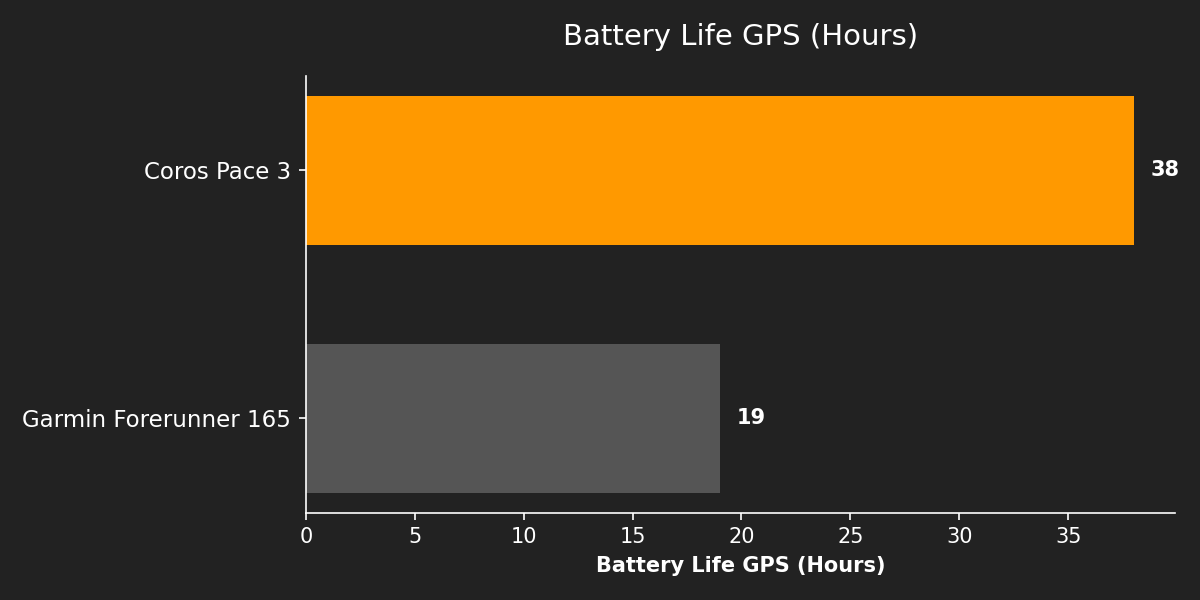
- Battery Life: Pace 3 lasts 38 hours in GPS mode vs 19 for the 165. In smartwatch mode, 360 hours vs 264.
- Payments: Forerunner 165 has Garmin Pay. Pace 3 has none.
- Weight: Pace 3 is 30g. Forerunner 165 is 39g. Noticeable on a long run.
- Price: Pace 3 launched at $229, Forerunner 165 at $249.99.
Deep Dive Comparison
Design & Comfort
Both watches use a fiber-reinforced polymer case and both carry a 5 ATM water rating, so you can swim and shower in either. The Pace 3 is where the engineering gets interesting: 30 grams with the silicone band, which is genuinely close to “forget it’s there” territory on a long run. The Forerunner 165 at 39 grams isn’t heavy by any standard, but it’s 30% more watch on your wrist. Case sizes are nearly identical (43mm vs 41.9mm), so fit is similar. Winner for comfort: Pace 3.
Battery Life
This isn’t close. The Pace 3 runs 38 hours with GPS on: enough for a 100-mile ultra without charging. The Forerunner 165 taps out at 19 hours in GPS, which is fine for a marathon but tight for longer efforts. In smartwatch mode, the Pace 3’s memory LCD gives it 15 days vs Garmin’s 11. The AMOLED on the 165 is the main cost here; pretty screens eat batteries.
Health & Fitness Features
GPS is the headline fight. The Pace 3 has multi-band (L1 + L5) GPS, which is the single best thing you can do for track accuracy in tough conditions: dense trees, downtown skyscrapers, tunnels. The Forerunner 165 is single-band, and in real-world testing it’s where you’ll notice the compromise most.
On training features, Garmin still has a slight edge in polish: daily suggested workouts, Garmin Coach running plans, HRV Status, and Training Readiness are all here. Coros counters with EvoLab, a training-load system that’s genuinely respected by coaches, plus native track mode and built-in running form metrics via the wrist sensor. Heart rate accuracy on both is typical wrist-optical: good for steady state, mediocre for intervals.
Smart Features
The Forerunner 165 wins this outright. It has Garmin Pay via NFC for contactless payments, onboard music with Spotify/Amazon Music/Deezer, and the deeper third-party app store via Connect IQ. The Pace 3 offers music storage (MP3s you transfer manually), but no NFC payments and a much smaller app ecosystem. If you run without your phone and want to buy coffee or stream music through proper services, the 165 is the obvious pick.
Price & Value
Launch prices put these within $21 of each other: $229 for the Pace 3, $249.99 for the Forerunner 165. Both see regular discounts, and at street prices you can often find either for under $200. Dollar for dollar, the Pace 3 gives you more pure running watch. Dual-frequency GPS and 38-hour battery at this price is genuinely absurd. But value depends on what you’ll use: the 165’s payments, AMOLED, and Garmin app depth are worth something if those features fit your life.
Technical Specs
| Spec | Garmin Forerunner 165 | Coros Pace 3 |
|---|---|---|
| Weight | 39 g | 30 g |
| Case Size | 43 mm | 41.9 mm |
| Display | 1.2″ AMOLED, 390×390 | 1.2″ Memory LCD, 240×240 |
| GPS | Single-band | Multi-band (Dual-frequency) |
| Battery (GPS) | 19 hours | 38 hours |
| Battery (Smartwatch) | 11 days | 15 days |
| Water Rating | 5 ATM | 5 ATM |
| NFC Payments | Yes (Garmin Pay) | No |
| Connectivity | Bluetooth, ANT+ | Bluetooth, Wi-Fi |
| Storage | 4 GB | 4 GB |
| Launch Price | $249.99 | $229 |
The Verdict
For most serious runners, the Coros Pace 3 is the better watch. Dual-frequency GPS and double the GPS battery life at a lower price is the kind of value equation that’s hard to argue with. It’s lighter, lasts longer, and tracks more accurately where it counts: on the run.
Buy the Coros Pace 3 if you’re training for races, run in tricky GPS environments (trees, city streets), do long runs or ultras, or just want the most capable pure running tool for your money.
Buy the Garmin Forerunner 165 if you want contactless payments on your wrist, you care about having a vivid AMOLED display, or you’re already deep in the Garmin ecosystem and don’t want to learn a new app. It’s a better lifestyle watch that happens to run well. The Pace 3 is a running watch that happens to tell time.
🏆 Ready to Decide?
Check the latest deals to see which one fits your budget.
*We earn a commission if you make a purchase.
Specs and features may change. Always verify details on the manufacturer’s official site before purchasing.
