
At a Glance: The Verdict
| Fitbit Charge 6 | Whoop 5.0 |
|---|---|
|
Best For: Everyday users who want a screen, GPS, and smart features at a lower price The Fitbit Charge 6 packs an AMOLED display, built-in GPS, NFC payments, and ECG into a $160 tracker. It’s one of the most feature-dense fitness bands available, ideal for people who want glanceable stats and Google ecosystem integration without wearing a full smartwatch. |
Best For: Serious athletes focused on recovery, strain, and 24/7 passive tracking The Whoop 5.0 ditches the screen entirely to focus on what matters most to competitive athletes: recovery scores, strain tracking, and sleep coaching. Its subscription model and screenless design won’t suit everyone, but for data-obsessed performers, it’s hard to beat. |
Quick Buy Path
Check today’s pricing before you go deeper.
If these are already your two finalists, compare current pricing now, then keep reading for the full verdict.
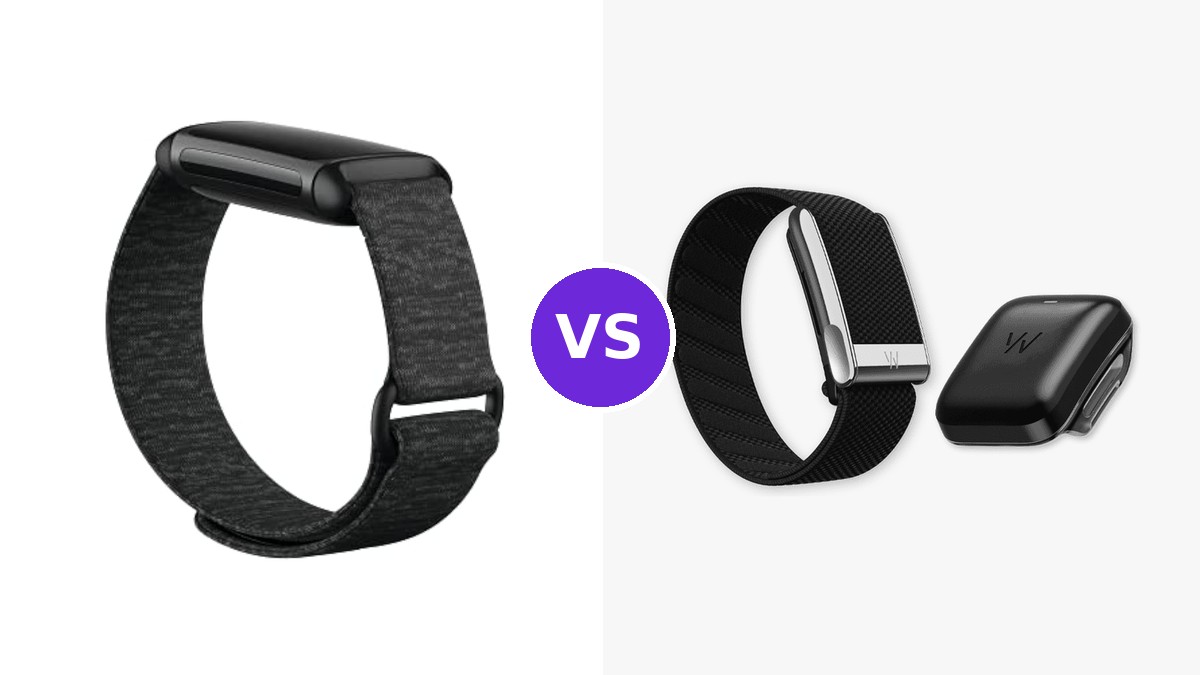
The Fitbit Charge 6 and Whoop 5.0 both sit on your wrist and track your health, but they couldn’t be more different in philosophy. One gives you a bright touchscreen with maps and tap-to-pay; the other gives you nothing to look at — and that’s the point. Choosing between them comes down to whether you want a traditional fitness tracker or a pure performance-recovery tool.
Key Differences
- Display: The Charge 6 has a 1.04-inch AMOLED touchscreen. The Whoop 5.0 has no screen at all — everything lives in the app.
- GPS: The Charge 6 includes built-in GPS with GLONASS for outdoor tracking. The Whoop 5.0 has no GPS and relies entirely on your phone.
- Payments: The Charge 6 supports NFC payments through Google Wallet. The Whoop 5.0 does not.
- Pricing model: The Charge 6 is a one-time purchase at $160. The Whoop 5.0 costs $199 for the hardware plus a mandatory monthly subscription ($30/month or $239/year) to access your own data.
- Recovery focus: Whoop’s entire platform revolves around strain, recovery, and sleep scores. Fitbit offers similar metrics but doesn’t build its experience around them the same way.
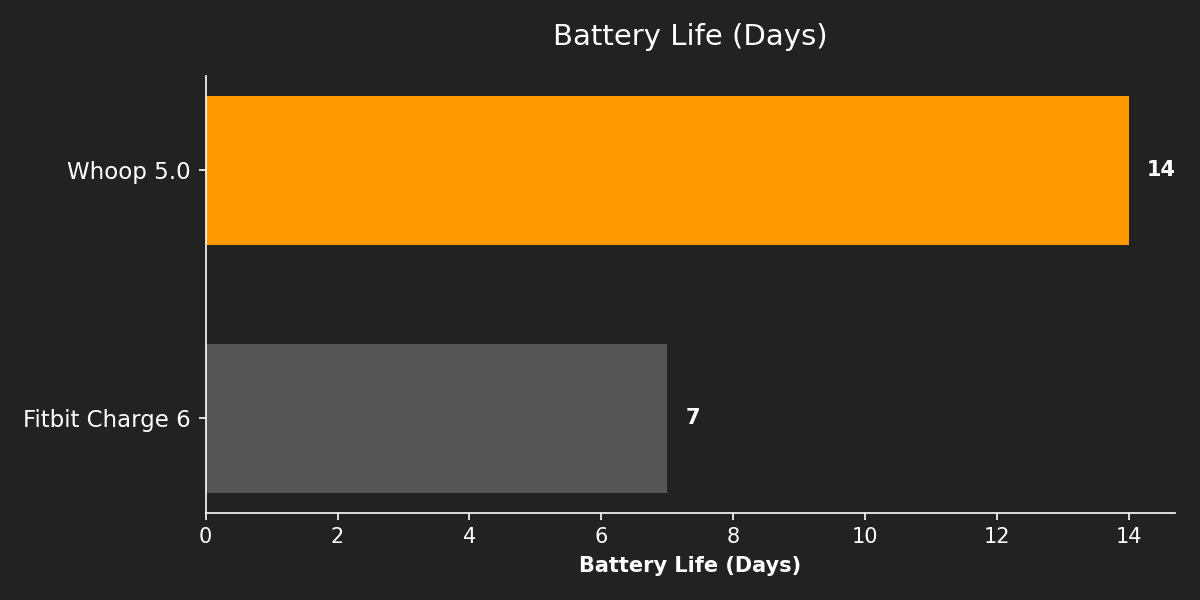
- Battery life: The Whoop 5.0 lasts up to 14 days. The Charge 6 gets about 7 days in smartwatch mode but drops to roughly 5 hours with continuous GPS.
- ECG & EDA: The Charge 6 includes electrical sensors for ECG and EDA (stress) scans. The Whoop 5.0 does not offer these.
Deep Dive Comparison
Design & Comfort
The Fitbit Charge 6 uses an aluminum, glass, and resin build at 30g. It looks and feels like a traditional fitness band — rectangular screen, silicone strap, button on the side. It’s slim enough for all-day wear and doesn’t attract attention in an office setting.
The Whoop 5.0 is slightly lighter at 26.5g with a polymer body. Without a screen, it’s essentially a sensor pod inside a fabric or silicone band. Whoop also sells clothing with built-in sensor pockets so you can wear it on your bicep, shorts, or sports bra instead of your wrist. That flexibility is a real advantage for athletes who find wrist-based trackers uncomfortable during certain lifts or sports.
Both carry water resistance — the Charge 6 at 5 ATM (swim-proof to 50 meters) and the Whoop 5.0 at IP68 (submersible but rated for shorter durations). For lap swimming, the Charge 6 has the edge in formal rating.
Battery Life
Battery is where the Whoop 5.0 dominates. Its 14-day battery life is double the Charge 6’s 7-day claim, and the gap widens further if you use GPS on the Fitbit — continuous GPS drops it to roughly 5 hours. Whoop has no GPS to drain, so its battery stays consistent regardless of activity type.
Whoop also charges via a portable battery pack that slides over the sensor, so you never have to take it off. The Charge 6 uses a proprietary magnetic cable and must be removed to charge.
Health & Fitness Features
Both trackers deliver continuous heart rate monitoring and SpO2 blood oxygen tracking. They each measure skin temperature trends and pack accelerometers for movement detection. On paper, the sensor suites look similar — but the way each device uses that data is fundamentally different.
The Fitbit Charge 6 excels in breadth. You get built-in GPS for pace and route mapping, ECG readings for heart rhythm analysis, EDA scans for stress management, and real-time exercise stats on your wrist. It integrates with Google’s ecosystem and connects to gym equipment. For someone who wants to track a morning run, check heart rhythm irregularities, and log a gym session — all from one band — the Charge 6 covers a lot of ground.
The Whoop 5.0 excels in depth. Its algorithms generate daily Recovery, Strain, and Sleep Performance scores that tell you how hard to push today and whether you’re overtraining. Whoop auto-detects workouts and layers in heart rate variability (HRV), respiratory rate, and resting heart rate trends to build a complete recovery picture. The 5.0 also adds a gyroscope for improved motion tracking. If your priority is optimizing training load and avoiding burnout, Whoop’s analytics are more advanced.
One notable gap: Whoop has no GPS. If you run outdoors and want pace data, you need your phone.
Smart Features
This category is one-sided. The Fitbit Charge 6 offers:
- AMOLED touchscreen with customizable watch faces
- Google Wallet (NFC tap-to-pay)
- Smartphone notifications (calls, texts, apps)
- Google Maps turn-by-turn directions
- YouTube Music controls
The Whoop 5.0 offers none of these. No screen means no notifications, no payments, no maps, and no music controls. Everything happens in the Whoop app on your phone. If you value at-a-glance information throughout the day, the Charge 6 is the clear winner. If you prefer zero distractions and a device that just tracks, Whoop’s stripped-down approach is intentional, not a limitation.
Price & Value
The Fitbit Charge 6 costs $160 with no ongoing fees. Fitbit Premium ($10/month) is optional and adds deeper insights, but the tracker is fully functional without it.
The Whoop 5.0 hardware is $199, but that’s not the full picture. Accessing your data requires a Whoop membership: $30/month, or $239/year, or $399 for 24 months. Over two years, total cost of ownership reaches roughly $560–$920 depending on the plan you choose. That’s a significant commitment for a screenless tracker.
For budget-conscious buyers, the Charge 6 delivers far more hardware per dollar. Whoop’s value proposition hinges on whether its recovery analytics genuinely improve your training — if they do, many athletes consider the subscription worthwhile.
Technical Specs
| Spec | Fitbit Charge 6 | Whoop 5.0 |
|---|---|---|
| Weight | 30g | 26.5g |
| Case Size | 36.73mm | 34.7mm |
| Display | 1.04″ AMOLED (184×276) | None |
| Water Rating | 5 ATM | IP68 |
| Battery (Smartwatch) | Up to 7 days | Up to 14 days |
| GPS | Built-in (GPS + GLONASS) | None |
| NFC Payments | Yes (Google Wallet) | No |
| Key Sensors | HR, SpO2, ECG, EDA, Temp, Accelerometer | HR, SpO2, Temp, Accelerometer, Gyroscope |
| Price | $160 (one-time) | $199 + subscription ($30/mo) |
The Verdict
Buy the Fitbit Charge 6 if you want a traditional fitness tracker that does everything. It has a screen for real-time stats, GPS for outdoor workouts, NFC for payments, and ECG for heart health monitoring — all for a one-time $160. It’s the better choice for general fitness enthusiasts, casual exercisers, and anyone who doesn’t want a monthly subscription just to see their data.
Buy the Whoop 5.0 if you’re a committed athlete whose primary concern is recovery optimization and training load management. Whoop’s strain and recovery algorithms are among the best in the industry, the screenless design eliminates distractions, and the 14-day battery means you can forget about charging for weeks. Just go in with eyes open on the subscription cost — over two years, you’ll spend three to five times what the Charge 6 costs.
For most people, the Fitbit Charge 6 is the smarter buy. It delivers more features at a lower total cost. But if you already know you want Whoop’s recovery-first approach, the 5.0 is the most refined version yet.
🏆 Ready to Decide?
Check the latest deals to see which one fits your budget.
*We earn a commission if you make a purchase.
Specs and features may change. Always verify details on the manufacturer’s official site before purchasing.
