
At a Glance: The Verdict
| Amazfit T-Rex 3 | Fitbit Charge 6 |
|---|---|
|
Best For: Outdoor adventurers who need extreme durability and marathon battery life A rugged GPS watch built for backcountry expeditions, multi-day hikes, and endurance athletes who refuse to carry a charger. Multi-band GPS, 10 ATM water resistance, and up to 25 days of battery make it a legitimate adventure companion at a mid-range price. |
Best For: Everyday fitness trackers who want a slim, affordable band with Google integration A lightweight fitness band with ECG, EDA stress tracking, NFC payments, and deep Google ecosystem ties. It won’t survive a mountaineering trip, but for gym sessions, daily step goals, and contactless payments, it’s hard to beat at $160. |
Quick Buy Path
Check today’s pricing before you go deeper.
If these are already your two finalists, compare current pricing now, then keep reading for the full verdict.
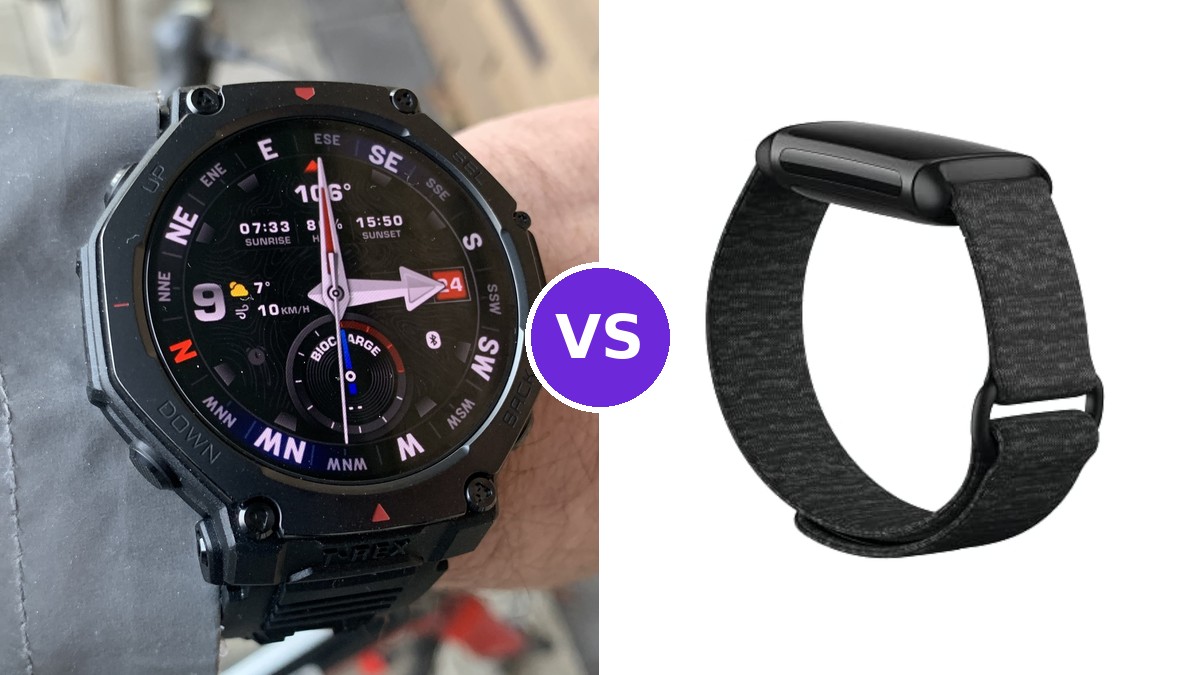
The Amazfit T-Rex 3 and Fitbit Charge 6 sit at opposite ends of the wearable spectrum. One is a tank-like GPS watch designed for extreme environments; the other is a sleek fitness band built for daily wellness tracking and smart convenience. Choosing between them comes down to whether you need rugged outdoor performance or a compact, feature-rich health companion that slides easily under a shirt cuff.
Key Differences
- Form factor: The T-Rex 3 is a full-size 48.5mm watch weighing 68g, while the Charge 6 is a slim band at just 30g — less than half the weight.
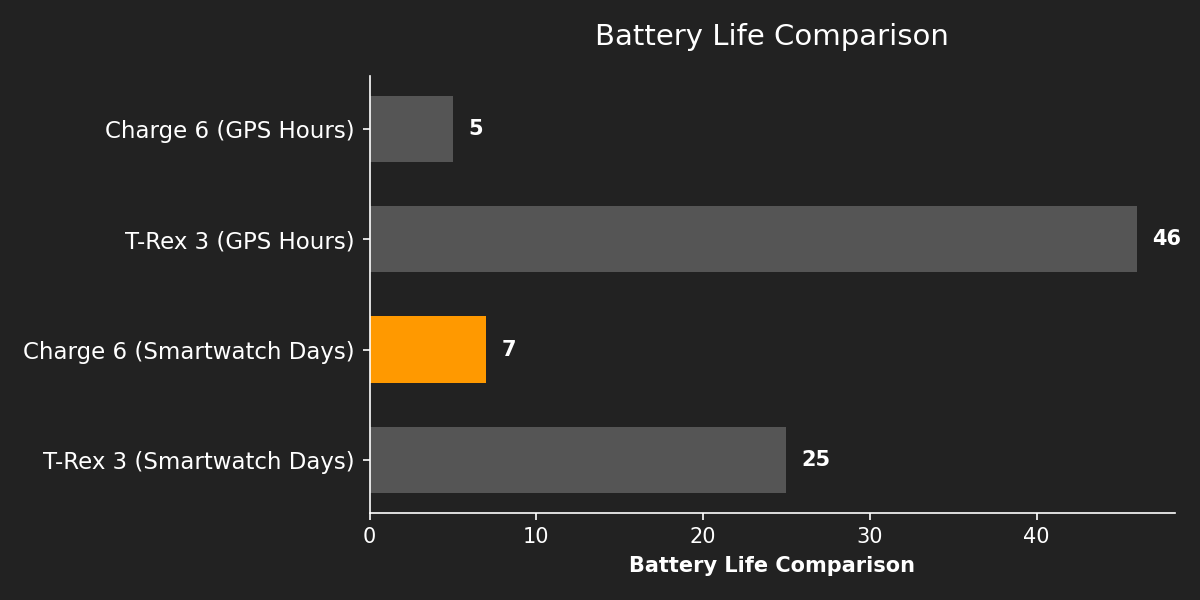
- Battery life: The T-Rex 3 delivers up to 25 days in smartwatch mode and 46 hours of continuous GPS. The Charge 6 lasts about 7 days with GPS use limited to roughly 5 hours.
- GPS capability: The T-Rex 3 features multi-band GPS for superior accuracy in canyons and dense tree cover. The Charge 6 uses standard GPS + GLONASS.
- Health sensors: The Charge 6 includes ECG and EDA (electrodermal activity) sensors that the T-Rex 3 lacks. The T-Rex 3 adds an altimeter and compass instead.
- NFC payments: The Charge 6 supports Google Wallet for contactless payments. The T-Rex 3 does not have NFC.
- Water resistance: The T-Rex 3 is rated to 10 ATM (suitable for swimming and water sports), while the Charge 6 is rated to 5 ATM (pool swimming only).
- Price: The Charge 6 launches at $160 — $120 less than the T-Rex 3 at $280.
Deep Dive Comparison
Design & Comfort
The Amazfit T-Rex 3 makes no apologies for its size. With a 48.5mm stainless steel bezel and nylon fiber body, it’s designed to absorb impacts, resist scratches, and look at home on a summit. The 1.5-inch AMOLED display at 480 x 480 resolution is large and vivid, easy to read at a glance even in direct sunlight. At 68.3g, it wears heavier than most fitness bands but lighter than many competing outdoor watches like the Garmin Instinct series.
The Fitbit Charge 6 takes the opposite approach. At 30g with a compact 36.7mm aluminum-and-resin case, it’s barely noticeable on the wrist. The 1.04-inch AMOLED touchscreen (184 x 276) is smaller but perfectly adequate for notifications, stats, and quick interactions. It’s the kind of wearable you forget you’re wearing, which is exactly the point for all-day, all-night use.
If you want something that disappears on your wrist, the Charge 6 wins. If you want a display you can actually read mid-run without squinting, the T-Rex 3 is the clear pick.
Battery Life
This is where the T-Rex 3 dominates — and it’s not even close. With up to 25 days in standard smartwatch mode and 46 hours of continuous GPS tracking, you can take it on a multi-day backpacking trip without a charger. That GPS endurance is particularly impressive; it means you can track a full ultramarathon or several consecutive days of hiking without running dry.
The Fitbit Charge 6 offers around 7 days of general use, which is respectable for a fitness band. But GPS tracking drains it fast — roughly 5 hours of continuous GPS use. For a weekend warrior doing hour-long runs, that’s fine. For anything longer, you’ll need to charge between activities.
Health & Fitness Features
Both devices cover the essentials — optical heart rate monitoring, SpO2 blood oxygen tracking, and skin temperature sensing. But each adds something the other lacks.
The Fitbit Charge 6 stands out with its ECG sensor for heart rhythm assessment and EDA sensor for stress management. These electrical sensors give it clinical-grade health monitoring capabilities that the T-Rex 3 simply doesn’t offer. If you’re tracking heart health on doctor’s orders or managing stress as part of a wellness routine, the Charge 6 has a meaningful edge. Fitbit’s Daily Readiness Score and deep sleep analysis (backed by years of sleep research) remain best-in-class for a device at this price.
The Amazfit T-Rex 3 counters with outdoor-specific tools: a barometric altimeter for elevation tracking, a compass for navigation, and multi-band GPS that locks onto satellites faster and holds accuracy in challenging terrain like deep valleys, dense forests, and urban canyons. It supports over 170 sport modes and includes a mic and speaker for Bluetooth calls — handy when your phone is buried in a pack.
For gym-and-wellness users, the Charge 6 offers more relevant health data. For trail runners, hikers, and outdoor athletes, the T-Rex 3’s navigation and GPS precision are far more useful.
Smart Features
The Charge 6 integrates deeply with Google’s ecosystem. Google Wallet lets you tap to pay at any NFC terminal — a genuine convenience for quick coffee stops during a run. You also get Google Maps turn-by-turn directions on your wrist and YouTube Music controls. Notifications from your phone come through clearly on the small screen.
The T-Rex 3 skips NFC payments entirely but compensates with onboard storage (2.3GB for music), a built-in microphone and speaker for taking calls directly from the watch, and Wi-Fi connectivity for faster syncing and downloads. It also supports the Zepp app ecosystem with third-party mini apps.
Neither device is a full smartwatch in the Apple Watch or Galaxy Watch sense, but the Charge 6 edges ahead for cashless convenience while the T-Rex 3 wins on standalone functionality (calls, offline music) when your phone isn’t nearby.
Price & Value
The Fitbit Charge 6 launched at $160 and regularly drops below $130 during sales. For that money, you get ECG, EDA, built-in GPS, NFC payments, and the entire Fitbit health platform. It’s one of the best values in fitness tracking, period.
The Amazfit T-Rex 3 launched at $280, which is aggressive for a rugged multi-band GPS watch. Comparable Garmin or Suunto models often cost $350–$500. You’re getting premium outdoor hardware — multi-band GPS, 10 ATM water resistance, 46 hours of GPS battery — at a significant discount versus established outdoor brands.
Both represent strong value within their categories. The question is which category fits your life.
Technical Specs
| Spec | Amazfit T-Rex 3 | Fitbit Charge 6 |
|---|---|---|
| Price | $280 | $160 |
| Weight | 68.3g | 30g |
| Display | 1.5″ AMOLED (480 x 480) | 1.04″ AMOLED (184 x 276) |
| Water Resistance | 10 ATM | 5 ATM |
| Battery (Smartwatch) | Up to 25 days | Up to 7 days |
| Battery (GPS) | Up to 46 hours | Up to 5 hours |
| GPS | Multi-band | GPS + GLONASS |
| NFC Payments | No | Yes (Google Wallet) |
| Key Sensors | HR, SpO2, Altimeter, Compass, Thermometer | HR, SpO2, ECG, EDA, Thermometer |
| Mic & Speaker | Yes | No |
| Connectivity | Bluetooth 5.2, Wi-Fi | Bluetooth, NFC |
The Verdict
Buy the Amazfit T-Rex 3 if you spend time outdoors and need a watch that can keep up. Hikers, trail runners, backcountry skiers, and endurance athletes will appreciate the multi-band GPS accuracy, 46-hour GPS battery, and 10 ATM water resistance. It’s also the right choice if you hate charging your watch — 25 days between charges means it stays on your wrist all month. At $280, it undercuts comparable Garmin outdoor watches by $100 or more.
Buy the Fitbit Charge 6 if you want a lightweight, affordable fitness band for everyday health tracking. The ECG and EDA sensors offer clinical-level health insights you won’t find on the T-Rex 3. Google Wallet payments, Google Maps integration, and a barely-there 30g design make it ideal for gym-goers, commuters, and anyone who wants data without bulk. At $160, it’s the smarter buy for users who exercise mostly in gyms, on roads, or in familiar territory where extreme GPS accuracy isn’t critical.
These two products serve fundamentally different users. The T-Rex 3 is a rugged tool for the wilderness. The Charge 6 is a smart health band for everyday life. Pick the one that matches where you actually spend your time.
🏆 Ready to Decide?
Check the latest deals to see which one fits your budget.
*We earn a commission if you make a purchase.
Specs and features may change. Always verify details on the manufacturer’s official site before purchasing.
