

At a Glance: The Verdict
| Amazfit T-Rex 3 Pro | Garmin Fenix 8 AMOLED |
|---|---|
|
Best For: Budget-conscious adventurers who want rugged build and long battery without breaking the bank The T-Rex 3 Pro delivers flagship-tier hardware (multi-band GPS, AMOLED display, and 25-day battery life) at a fraction of the Fenix’s price. It’s a serious outdoor watch for people who’d rather spend on the trip than the gear. |
Best For: Dedicated athletes and outdoor professionals who need best-in-class navigation, training tools, and ecosystem depth The Fenix 8 AMOLED is Garmin’s crown jewel: dive-rated, packed with 32GB of storage, NFC payments, and the deepest training ecosystem in wearables. If your watch is mission-critical gear, this is the one. |
Quick Buy Path
Check today’s pricing before you go deeper.
If these are already your two finalists, compare current pricing now, then keep reading for the full verdict.
The Amazfit T-Rex 3 Pro and Garmin Fenix 8 AMOLED both target outdoor athletes who demand durability, long battery life, and multi-band GPS, but they sit at wildly different price points. At $280 versus $1,000, the question isn’t just which watch is better; it’s whether the Fenix 8 delivers enough to justify costing more than three times as much.
Key Differences
- Price gap is massive: The T-Rex 3 Pro launches at $280 while the Fenix 8 AMOLED starts at $1,000: a $720 difference.
- Dive capability: The Fenix 8 is dive-rated with a dedicated depth sensor, making it a true dive computer. The T-Rex 3 Pro is water-resistant to 10 ATM but lacks dive functionality.
- Storage: Garmin offers 32GB for maps, music, and apps compared to Amazfit’s 2.3GB: a 14x advantage.
- NFC payments: The Fenix 8 supports Garmin Pay for contactless payments. The T-Rex 3 Pro has no NFC.
- Training ecosystem: Garmin Connect offers Training Readiness, HRV Status, race predictor, and Connect IQ app store. Amazfit’s Zepp app is functional but far less deep.
- Display size: The T-Rex 3 Pro has a larger 1.5-inch AMOLED screen at 480×480 versus the Fenix 8’s 1.35-inch panel at 416×416.
- Connectivity: The Fenix 8 adds ANT+ for direct pairing with chest straps, power meters, and other sports accessories. The T-Rex 3 Pro relies on Bluetooth only.
Deep Dive Comparison
Design & Comfort
Both watches are built to take a beating, but they use different approaches. The T-Rex 3 Pro pairs a stainless steel bezel with a nylon fiber body at 68.3g. The Fenix 8 AMOLED uses fiber-reinforced polymer with a titanium rear cover, coming in slightly lighter at 66g. The difference is negligible on the wrist.
Case sizes are nearly identical: 48.5mm for the T-Rex 3 Pro and 47mm for the Fenix 8. Both are large watches that wear best on medium-to-large wrists. The Fenix 8 has a more refined, premium feel in the hand, with tighter tolerances and more polished button action, details you’d expect given the price difference.
Where the T-Rex 3 Pro gains ground is the display. Its 1.5-inch AMOLED panel at 480×480 is both larger and sharper than the Fenix 8’s 1.35-inch, 416×416 screen. In direct sunlight and during workouts, the larger screen makes data easier to read at a glance.
Battery Life
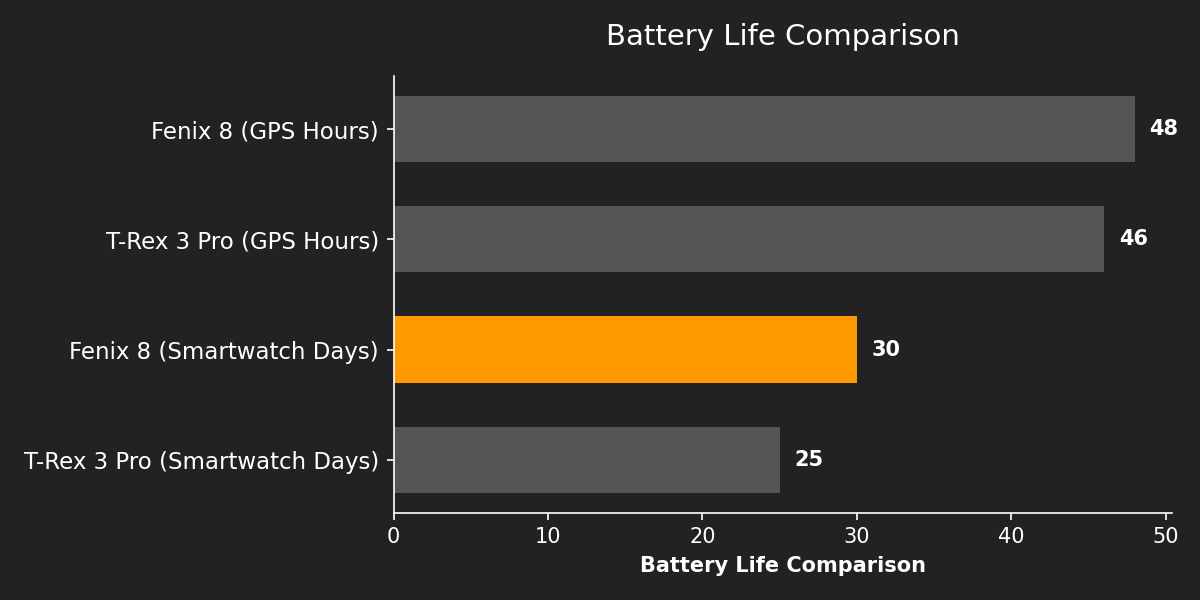
Both watches deliver exceptional battery life for AMOLED-equipped devices. The Fenix 8 edges ahead slightly with 30 days in smartwatch mode versus 25 days for the T-Rex 3 Pro. GPS battery is similarly close: 48 hours for Garmin compared to 46 hours for Amazfit.
In practical use, both will get most athletes through a full week of daily GPS-tracked workouts and 24/7 health monitoring without charging. For multi-day ultramarathons or week-long backpacking trips, the difference is marginal enough that neither has a decisive advantage.
Health & Fitness Features
Both watches share a core sensor suite: optical heart rate, SpO2, altimeter, compass, gyroscope, accelerometer, and thermometer. Both offer multi-band GPS for accurate satellite positioning on trails and in urban canyons.
The Fenix 8 pulls ahead in three key areas. First, the depth sensor enables real dive tracking: not just swim metrics, but actual recreational diving functionality. Second, Garmin’s training ecosystem is unmatched: Training Readiness scores, HRV Status, race predictions, stamina tracking, and the ability to create and follow structured training plans from coaches worldwide through Garmin Connect. Third, ANT+ connectivity allows pairing with premium chest strap heart rate monitors, cycling power meters, and other sports sensors that Bluetooth-only devices cannot access.
The T-Rex 3 Pro holds its own with solid GPS accuracy, over 170 sport modes, and reliable heart rate tracking for daily workouts. The Zepp app provides sleep analysis, PAI (Personal Activity Intelligence), and workout summaries. But it cannot match Garmin’s depth of training analytics: metrics like Training Effect, VO2 Max trend analysis with heat and altitude acclimation, and suggested daily workouts based on training load.
Smart Features
The Fenix 8 wins the smart features category outright. Garmin Pay enables contactless payments at terminals. With 32GB of storage, you can load thousands of songs from Spotify, Amazon Music, or Deezer for offline playback, ideal for phone-free runs. The Connect IQ store adds watch faces, data fields, widgets, and full apps.
The T-Rex 3 Pro offers phone notifications, a microphone and speaker for Bluetooth calls, and basic smart features through the Zepp app. However, 2.3GB of storage limits offline media capabilities, and the lack of NFC means no wrist-based payments. For day-to-day smartwatch use like viewing messages and controlling music playback, both get the job done.
Price & Value
This is where the conversation gets interesting. The Amazfit T-Rex 3 Pro at $280 delivers roughly 80% of the Fenix 8’s hardware capability for 28% of the price. Multi-band GPS, AMOLED display, titanium-grade durability, multi-day battery: it’s all there.
The Garmin Fenix 8 AMOLED at $1,000 charges a premium for its dive rating, 32GB storage, Garmin Pay, ANT+ connectivity, and the Garmin Connect ecosystem. These aren’t superficial features: they represent a fundamentally more capable training and navigation platform. But you’re paying $720 more to access them.
The value calculation depends entirely on how much of Garmin’s ecosystem you’ll actually use. If you follow structured training plans, pair external sensors, load offline maps and music, or dive, the Fenix 8 justifies itself. If you primarily track runs, hikes, and daily health metrics, the T-Rex 3 Pro gives you outstanding performance per dollar.
Technical Specs
| Spec | Amazfit T-Rex 3 Pro | Garmin Fenix 8 AMOLED |
|---|---|---|
| Launch Price | $280 | $1,000 |
| Case Size | 48.5mm | 47mm |
| Weight | 68.3g | 66g |
| Display | 1.5″ AMOLED, 480×480 | 1.35″ AMOLED, 416×416 |
| Water Rating | 10 ATM | 10 ATM (Dive-rated) |
| Battery (Smartwatch) | ~25 days | ~30 days |
| Battery (GPS) | 46 hours | 48 hours |
| GPS | Multi-band | Multi-band |
| NFC Payments | No | Yes (Garmin Pay) |
| Storage | 2.3GB | 32GB |
| Sensors | HR, SpO2, Altimeter, Compass, Gyro, Accel, Temp | HR, SpO2, Altimeter, Compass, Gyro, Accel, Temp, Depth |
| Connectivity | Bluetooth 5.2, Wi-Fi | Bluetooth, ANT+, Wi-Fi |
The Verdict
Buy the Amazfit T-Rex 3 Pro if you want a rugged outdoor watch with excellent battery life and accurate GPS tracking without spending four figures. It’s ideal for recreational hikers, runners, and gym-goers who want reliable data and a sharp AMOLED display at a price that leaves room in the budget for actual adventures. At $280, it’s one of the best values in outdoor wearables.
Buy the Garmin Fenix 8 AMOLED if you’re a serious athlete who relies on structured training plans, needs ANT+ sensor pairing, wants offline maps and music on 32GB of storage, or plans to use it as a dive computer. The Garmin Connect ecosystem, Garmin Pay, and Connect IQ app store create a platform that no competitor currently matches. If these features are part of your daily routine, the $1,000 investment pays for itself in capability.
The bottom line: The T-Rex 3 Pro punches remarkably close to the Fenix 8 on hardware specs while costing 72% less. But the Fenix 8 isn’t just selling hardware. It’s selling an ecosystem, and for athletes who live inside Garmin Connect, nothing else comes close. Choose based on how deep your training needs go, not just what’s on the spec sheet.
🏆 Ready to Decide?
Check the latest deals to see which one fits your budget.
*We earn a commission if you make a purchase.
Specs and features may change. Always verify details on the manufacturer’s official site before purchasing.
