
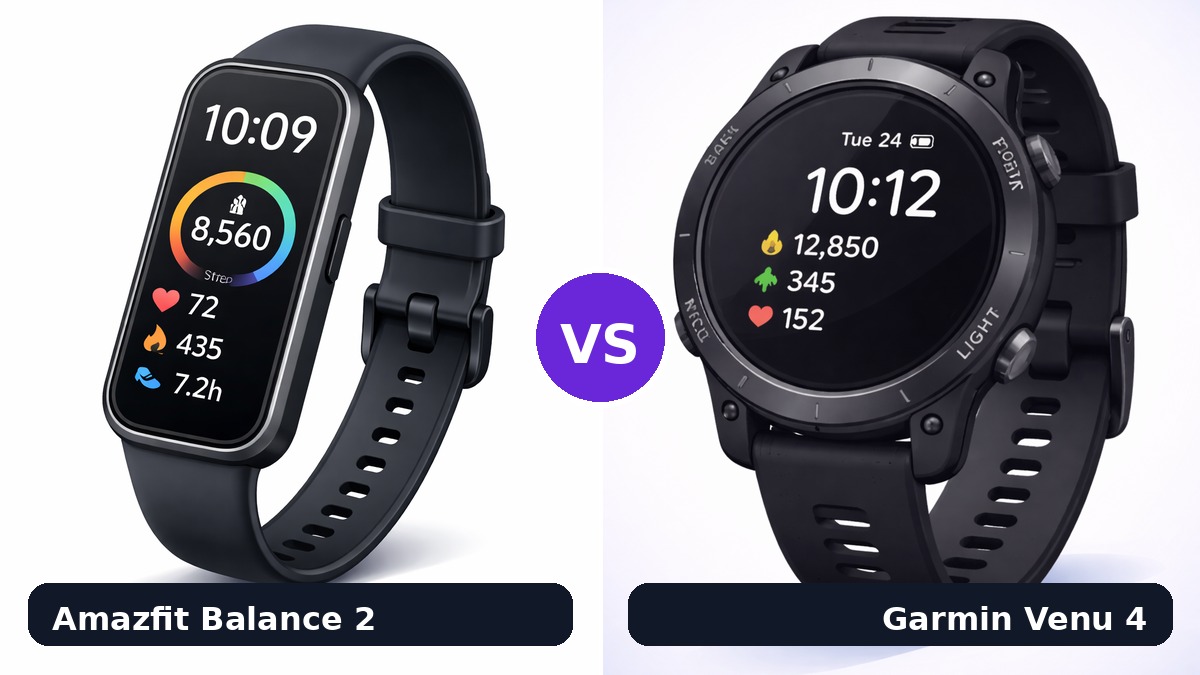
At a Glance: The Verdict
| Amazfit Balance 2 | Garmin Venu 4 |
|---|---|
|
Best For: Budget-conscious buyers who want serious health tracking without the premium price tag The Amazfit Balance 2 delivers 10 ATM dive-rated durability, multi-band GPS, and up to 21 days of battery life — all for under $230. It’s one of the best value propositions in fitness wearables right now. |
Best For: Serious athletes who want Garmin’s proven training ecosystem and deep health analytics The Garmin Venu 4 pairs a stunning AMOLED display with Garmin’s industry-leading fitness platform — including Training Readiness, HRV Status, and 8GB of onboard music storage. You pay more, but the coaching depth is unmatched. |
Quick Buy Path
Check today’s pricing before you go deeper.
If these are already your two finalists, compare current pricing now, then keep reading for the full verdict.
The Amazfit Balance 2 and Garmin Venu 4 both target the lifestyle-fitness crossover market with vibrant AMOLED screens and comprehensive health suites. But at $230 versus $550, the price gap is hard to ignore. The question is whether Garmin’s deeper software ecosystem and training tools justify the $320 premium — or whether Amazfit’s hardware specs tell the full story.
Key Differences
- Price gap is massive: The Amazfit Balance 2 launches at $230 while the Garmin Venu 4 comes in at $550 — nearly 2.4x the cost.
- Battery life favors Amazfit: Up to 21 days in smartwatch mode versus 12 days for the Garmin. The gap widens in GPS mode — 33 hours (Amazfit) vs. 20 hours (Garmin).
- Water resistance favors Amazfit: The Balance 2 is rated at 10 ATM with scuba diving support down to 45 meters. The Garmin Venu 4 tops out at 5 ATM — fine for swimming, but not dive-rated.
- Garmin’s training platform runs deeper: Training Readiness, Race Predictor, HRV Status, and Coach integration are baked into the Venu 4. Amazfit’s Zepp OS has improved, but Garmin Connect remains the gold standard for structured training.
- Storage heavily favors Garmin: 8GB on the Venu 4 versus 2.2GB on the Amazfit — Garmin holds roughly 3.5x more music and apps.
- Garmin has ANT+ connectivity: Critical for pairing with chest straps, power meters, and gym equipment. Amazfit relies solely on Bluetooth.
Deep Dive Comparison
Design & Comfort
Both watches use aluminum alloy in their construction, though Garmin adds stainless steel accents and a fiber-reinforced polymer back. The Amazfit Balance 2 is the lighter watch at just 35g compared to the Garmin’s 56g — a meaningful 21g difference you’ll notice on longer runs. The Balance 2 is also slightly larger at 46mm versus the Venu 4’s 45mm case, but its lighter build means it sits less noticeably on the wrist.
The Balance 2 boasts 10 ATM water resistance with scuba diving support, while the Venu 4 carries 5 ATM — both cover swimming and showering, but only the Amazfit is dive-rated. The Garmin’s build quality has a more premium hand-feel thanks to the stainless steel bezel, but the Amazfit punches above its price class in materials and finish.
Battery Life
This is a category where the Amazfit Balance 2 holds a clear edge. Its 504-hour (21-day) smartwatch battery and 33-hour GPS runtime both outpace the Garmin Venu 4’s 288-hour (12-day) smartwatch mode and 20-hour GPS mode. For weekend warriors and ultramarathon runners alike, those extra hours matter.

Health & Fitness Features
The Amazfit Balance 2 runs Amazfit’s upgraded BioTracker 6.0 PPG sensor with improved heart-rate and SpO2 accuracy. Note that unlike the original Balance, the Balance 2 dropped the BIA body-composition sensor — so body-fat and muscle-mass estimates are no longer available on this model. The Garmin Venu 4 also lacks BIA, so neither watch offers on-wrist body composition.
Garmin fights back with its fifth-generation Elevate optical heart rate sensor, Pulse Ox blood oxygen monitoring, and — most importantly — a much deeper fitness analytics stack. Training Readiness scores, HRV Status tracking, Morning Reports, and Garmin Coach guided workouts give athletes actionable training intelligence that Amazfit can’t match yet. Both watches include a barometric altimeter, compass, gyroscope, and temperature sensor.
GPS performance is comparable — both use multi-band satellite connectivity for accurate outdoor tracking, though Garmin’s track record for GPS accuracy in dense urban environments and under tree cover gives it a slight practical edge.
Smart Features
Both watches support NFC contactless payments, have built-in microphones and speakers for Bluetooth calls, and deliver smartphone notifications. The Garmin Venu 4’s 8GB of onboard storage is a significant advantage for music lovers — you can load hundreds of songs from Spotify, Amazon Music, or Deezer for phone-free listening. The Amazfit’s 2.2GB is more limiting on this front.
Garmin also benefits from ANT+ and Wi-Fi connectivity, while the Amazfit sticks to Bluetooth 5.0 and 2.4GHz Wi-Fi. ANT+ is a niche advantage, but it’s essential for users who pair external sensors like chest-strap heart rate monitors or cycling power meters.
App ecosystems are a draw with a slight Garmin edge — Connect IQ offers a larger selection of third-party watch faces, widgets, and data fields. Zepp OS has grown considerably, but Garmin’s developer community remains more active.
Price & Value
This is where the conversation gets interesting. At $230, the Amazfit Balance 2 is one of the most feature-dense watches in its price range. 10 ATM dive rating, multi-band GPS, AMOLED display, and 21-day battery life — there’s nothing else at this price that checks all those boxes.
The Garmin Venu 4 at $550 is a harder sell on paper, but the premium buys you Garmin’s ecosystem: a best-in-class training platform, more polished software, 8GB storage, ANT+ compatibility, and historically better long-term software support. If you already use Garmin Connect or plan to follow structured training plans, the investment pays dividends over time.
Technical Specs
| Spec | Amazfit Balance 2 | Garmin Venu 4 |
|---|---|---|
| Case Size | 46mm | 45mm |
| Weight | 35g | 56g |
| Display | 1.5″ AMOLED (480×480) | 1.4″ AMOLED (454×454) |
| Water Rating | 10 ATM | 5 ATM |
| Battery (Smartwatch) | Up to 21 days | Up to 12 days |
| Battery (GPS) | Up to 33 hours | Up to 20 hours |
| GPS | Multi-band | Multi-band |
| Storage | 2.2GB | 8GB |
| NFC Payments | Yes | Yes |
| Key Sensors | BioTracker 6.0, Barometer, Gyroscope, Temp | Elevate Gen 5, Pulse Ox, Barometer, Temp |
| Connectivity | Bluetooth 5.2, Wi-Fi | Bluetooth, ANT+, Wi-Fi |
| Price | $230 | $550 |
The Verdict
Buy the Amazfit Balance 2 if you want the best bang for your buck in a fitness smartwatch. At $230, you get 10 ATM water resistance, multi-band GPS, a bright AMOLED screen, and three full weeks of battery life. It’s ideal for casual fitness enthusiasts, gym-goers who want serious hardware at a fair price, or anyone who doesn’t want to spend $500+ on a smartwatch. The value here is genuinely hard to beat.
Buy the Garmin Venu 4 if you’re a committed athlete who needs a serious training platform. Garmin Connect’s Training Readiness, HRV Status, and Coach integrations are tools that genuinely improve performance over time. The 8GB of storage makes it a true phone-free running companion, and ANT+ opens the door to the full ecosystem of external fitness sensors. If you’re already invested in Garmin’s ecosystem — or plan to follow structured training programs — the $550 price tag pays for itself in coaching intelligence.
The bottom line: The Amazfit Balance 2 wins on specs-per-dollar and is the smarter buy for most people. The Garmin Venu 4 wins on software depth and training ecosystem. Your wallet and your training goals should make this decision for you.
🏆 Ready to Decide?
Check the latest deals to see which one fits your budget.
*We earn a commission if you make a purchase.
Specs and features may change. Always verify details on the manufacturer’s official site before purchasing.
