
At a Glance: The Verdict
| Garmin Vivoactive 5 | Fitbit Charge 6 |
|---|---|
|
Best For: Serious fitness enthusiasts who want a full-featured GPS smartwatch The Vivoactive 5 delivers 11 days of battery life, a brilliant AMOLED display, and Garmin’s industry-leading training tools — all in a lightweight 36g package. If you want deep workout analytics and marathon-ready GPS, this is the one. |
Best For: Budget-conscious users who want solid health tracking in a slim band The Charge 6 packs ECG, EDA stress sensing, and Google integration into a compact tracker at nearly half the price. If daily health monitoring matters more than advanced sports features, this is your pick. |
Quick Buy Path
Check today’s pricing before you go deeper.
If these are already your two finalists, compare current pricing now, then keep reading for the full verdict.
Introduction
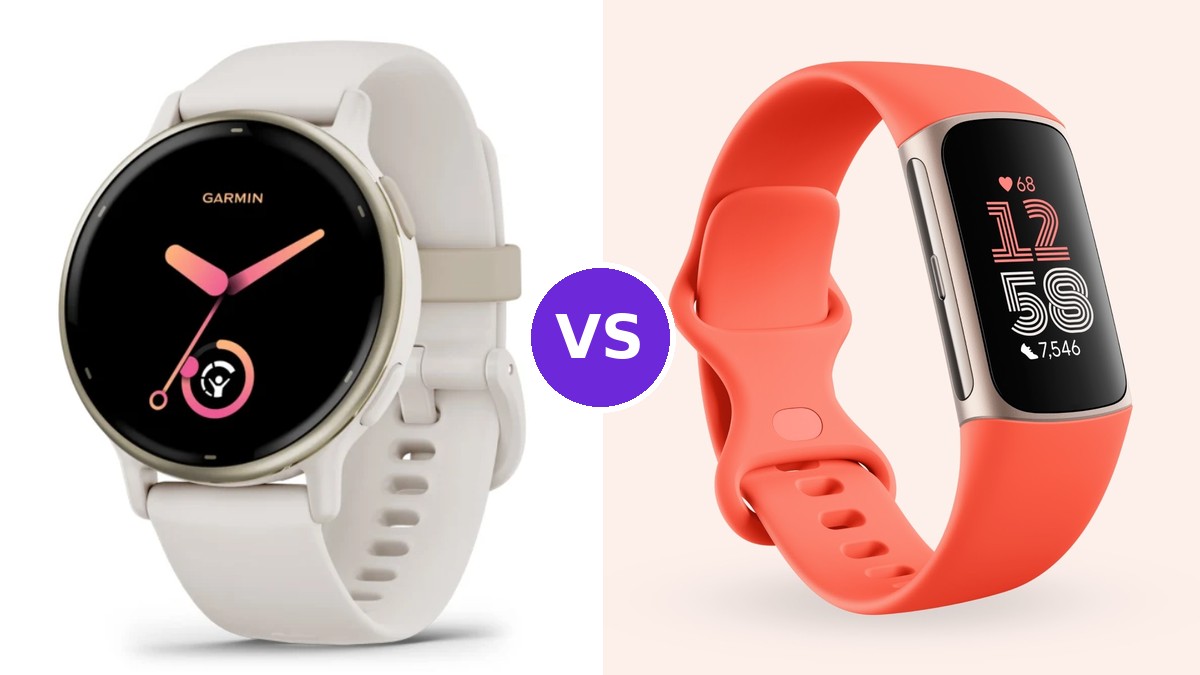
The Garmin Vivoactive 5 and Fitbit Charge 6 both launched in fall 2023, but they target very different users. One is a full-fledged GPS smartwatch built for athletes; the other is a slim fitness band designed for everyday health tracking at a much friendlier price point. Choosing between them comes down to how seriously you train — and how much you’re willing to spend.
Key Differences
- Form factor: The Vivoactive 5 is a round-face smartwatch (42mm); the Charge 6 is a compact rectangular band (36.7mm) — a fundamentally different wearing experience.
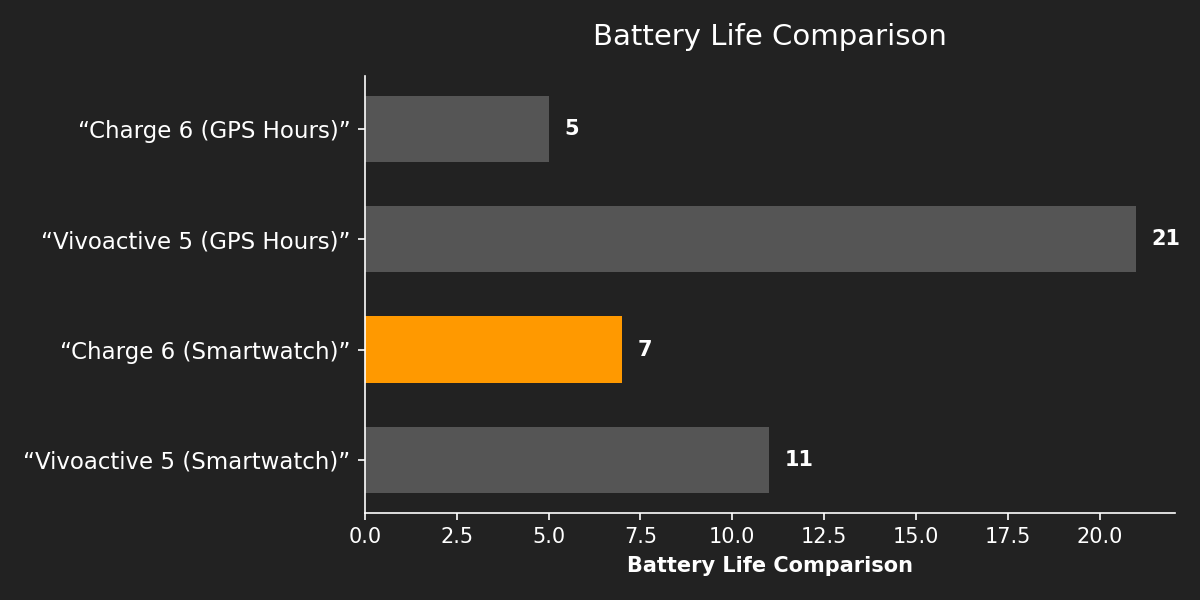
- GPS endurance: Garmin delivers up to 21 hours of GPS tracking versus just 5 hours on the Charge 6 — a massive gap for runners and cyclists.
- Battery life: The Vivoactive 5 lasts up to 11 days in smartwatch mode compared to 7 days on the Charge 6.
- Health sensors: The Charge 6 includes ECG and EDA (electrodermal activity) sensors that the Vivoactive 5 lacks, giving it an edge in clinical-style health monitoring.
- Ecosystem: Garmin runs its own deep fitness platform (Garmin Connect); the Charge 6 ties into Google’s ecosystem (YouTube Music, Google Maps, Google Wallet).
- Price: At $160, the Charge 6 costs nearly half what the $300 Vivoactive 5 does.
- Music storage: The Vivoactive 5 has 4GB of onboard storage for offline playlists; the Charge 6 can control phone music but stores nothing locally.
Deep Dive Comparison
Design & Comfort
The Vivoactive 5 looks and feels like a proper smartwatch. Its 42.2mm fiber-reinforced polymer case houses a sharp 1.2-inch AMOLED display at 390 × 390 resolution. At 36 grams, it’s remarkably light for a full-size watch and comfortable enough to sleep in.
The Charge 6 takes the opposite approach — it’s a slim fitness band with a smaller 1.04-inch AMOLED screen (184 × 276). At 30 grams with an aluminum-and-resin body, it practically disappears on your wrist. If you want something discreet that doesn’t scream “smartwatch,” the Charge 6 wins on subtlety.
Both are water-resistant to 5 ATM (swim-safe), and both use AMOLED panels with vibrant colors and good outdoor readability. But the Vivoactive 5’s larger, higher-resolution screen makes navigating menus and reading workout data significantly easier mid-exercise.
Battery Life
This is where the Vivoactive 5 pulls decisively ahead. Garmin rates it at up to 11 days in smartwatch mode and 21 hours with continuous GPS — numbers that mean you can track a full ultramarathon on a single charge. The Charge 6 manages about 7 days in daily-use mode but drops to just 5 hours with GPS active. For anyone who runs, hikes, or cycles for more than a couple of hours, that’s a serious limitation.
Health & Fitness Features
Both devices cover the basics well — continuous heart rate monitoring, SpO2 blood oxygen tracking, sleep analysis, and step counting. But they diverge sharply beyond the fundamentals.
The Vivoactive 5 brings Garmin’s deep sports toolkit: Body Battery energy tracking, Training Readiness scores, VO2 Max estimates, advanced sleep coaching, and over 30 built-in sport profiles. Its GPS supports GPS, GLONASS, and Galileo satellite systems, and 21 hours of tracking time means you won’t run out mid-activity. It also connects to external ANT+ sensors (chest straps, power meters, cadence sensors) — a must for serious cyclists and runners.
The Charge 6 counters with two sensors the Garmin lacks: an ECG app for heart rhythm assessment and an EDA sensor for stress management. These are genuinely useful for users focused on heart health or anxiety monitoring. It also includes a skin temperature sensor. However, the Charge 6’s GPS tops out at 5 hours, and it offers far fewer sport profiles and no ANT+ connectivity.
Smart Features
The Vivoactive 5 offers Garmin Pay (NFC), Wi-Fi connectivity for syncing, 4GB of music storage (Spotify, Deezer, Amazon Music offline playlists), and smart notifications. It does not have a microphone or speaker, so no voice calls.
The Charge 6 leans into Google’s ecosystem — Google Wallet for NFC payments, YouTube Music controls, and Google Maps turn-by-turn directions pushed from your phone. It also lacks a mic and speaker. Neither device can take calls, but both handle notification mirroring just fine.
The key difference: the Vivoactive 5 can store and play music independently (great for leaving your phone behind on a run), while the Charge 6 needs your phone nearby for music and maps.
Price & Value
At launch, the Garmin Vivoactive 5 retailed for $300 and the Fitbit Charge 6 for $160. That’s nearly a $140 gap. The Charge 6 delivers outstanding value for health-focused users on a budget — ECG, EDA, built-in GPS, and Google integration for well under $200. The Vivoactive 5 justifies its premium with vastly superior battery life, deeper fitness analytics, music storage, and ANT+ support. You’re paying more, but you’re getting a significantly more capable device for athletic training.
Technical Specs
| Spec | Garmin Vivoactive 5 | Fitbit Charge 6 |
|---|---|---|
| Price | $300 | $160 |
| Display | 1.2″ AMOLED (390 × 390) | 1.04″ AMOLED (184 × 276) |
| Weight | 36g | 30g |
| Case Material | Fiber-reinforced polymer | Aluminum, glass, resin |
| Water Rating | 5 ATM | 5 ATM |
| Battery (Smartwatch) | Up to 11 days | Up to 7 days |
| Battery (GPS) | Up to 21 hours | Up to 5 hours |
| GPS | GPS, GLONASS, Galileo | GPS, GLONASS |
| Sensors | HR, SpO2, Compass, Accelerometer | HR, SpO2, ECG, EDA, Temp |
| NFC Payments | Garmin Pay | Google Wallet |
| Music Storage | 4GB | None |
| Connectivity | Bluetooth, ANT+, Wi-Fi | Bluetooth, NFC |
The Verdict
Buy the Garmin Vivoactive 5 if you train regularly and want a device that can keep up. Its 21-hour GPS battery, ANT+ sensor support, offline music, and Garmin’s deep training ecosystem make it the clear choice for runners, cyclists, hikers, and anyone who takes their workouts seriously. The $300 price tag is justified by features no fitness band can match.
Buy the Fitbit Charge 6 if you’re primarily interested in daily health monitoring — heart rate, sleep, stress, and occasional exercise tracking — without spending $300. Its ECG and EDA sensors are genuinely useful for heart health and stress management, the Google integration is seamless, and at $160 it’s one of the best values in fitness tracking. Just know that its 5-hour GPS limit makes it a poor fit for long outdoor workouts.
The bottom line: These aren’t really competitors — they serve different needs at different price points. The Vivoactive 5 is a smartwatch for athletes. The Charge 6 is a health band for everyone else. Pick the category that fits your life.
🏆 Ready to Decide?
Check the latest deals to see which one fits your budget.
*We earn a commission if you make a purchase.
Specs and features may change. Always verify details on the manufacturer’s official site before purchasing.
