
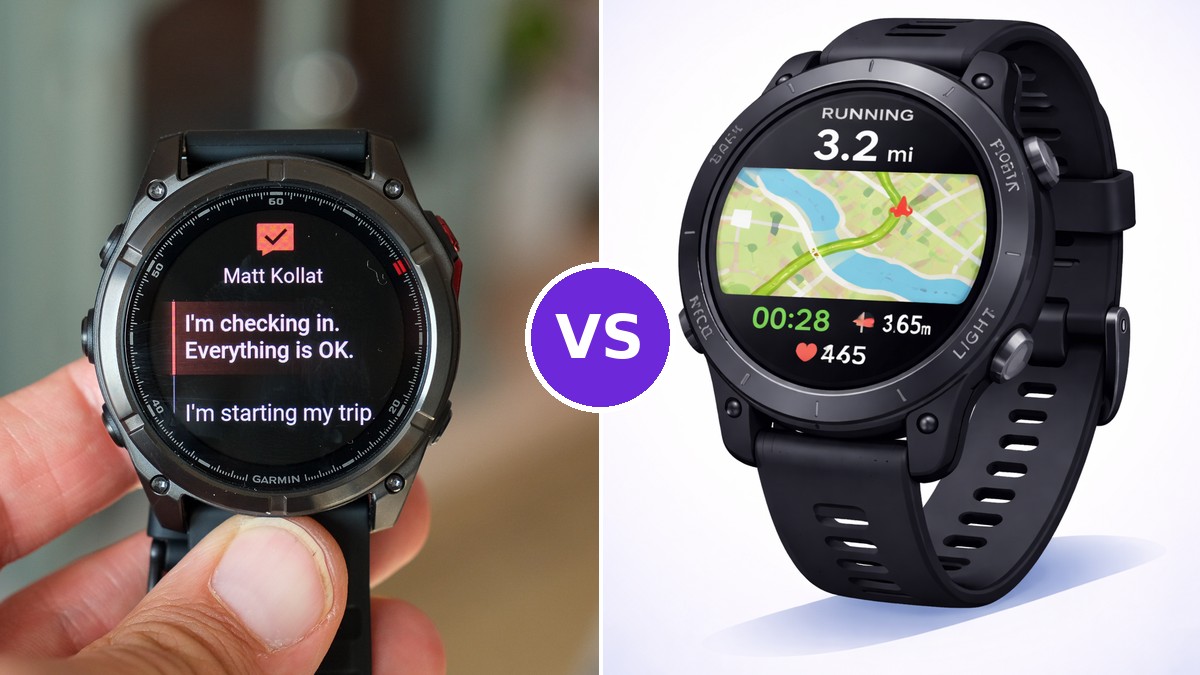
At a Glance: The Verdict
| Garmin Fenix 8 Pro | Garmin Enduro 3 |
|---|---|
|
Best For: Backcountry explorers who want LTE, satellite messaging, and diving in one watch The Fenix 8 Pro packs built-in inReach satellite SOS, LTE connectivity, a stunning AMOLED display, and a 40-meter dive rating into a single wrist-worn package. It’s the Swiss Army knife of adventure watches — at a premium price. |
Best For: Ultra-runners and multi-day adventurers who refuse to carry a charger The Enduro 3 delivers class-leading battery life — up to 90 days in smartwatch mode and 320 hours of GPS — in a lighter, cheaper package. It trades the Fenix 8 Pro’s connectivity extras for raw endurance. |
Garmin’s premium lineup puts buyers in a tough spot: the Fenix 8 Pro loads every possible feature onto your wrist, while the Enduro 3 strips back the extras and focuses on going the distance. Both run Garmin’s full training suite and multi-band GNSS, but the experience of wearing each day-to-day is remarkably different. Here’s how they stack up.
Key Differences
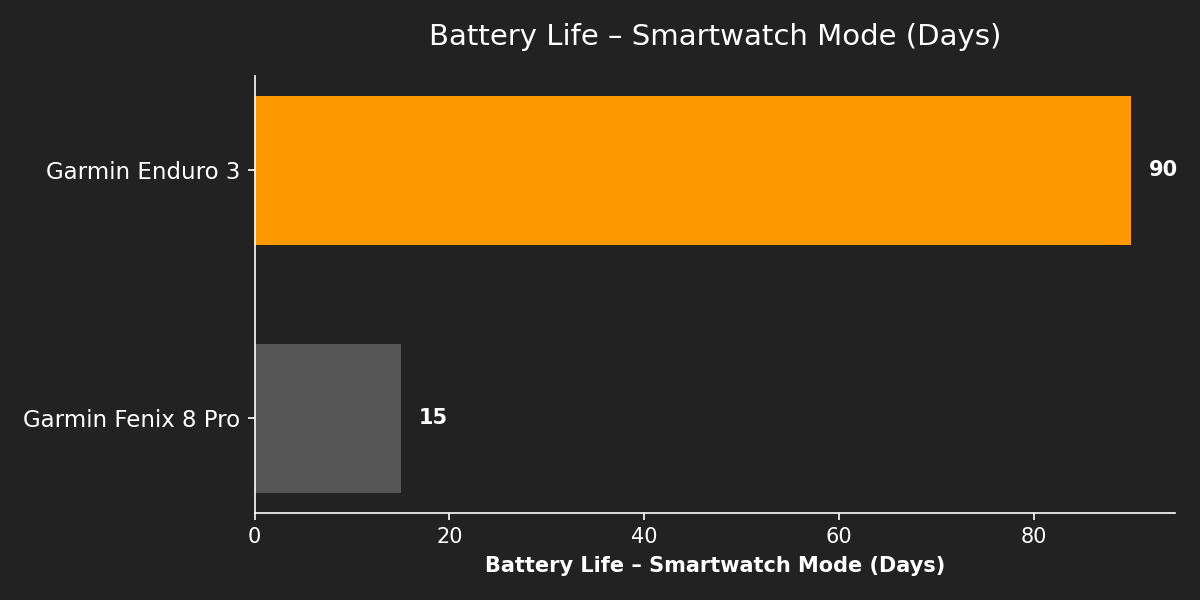
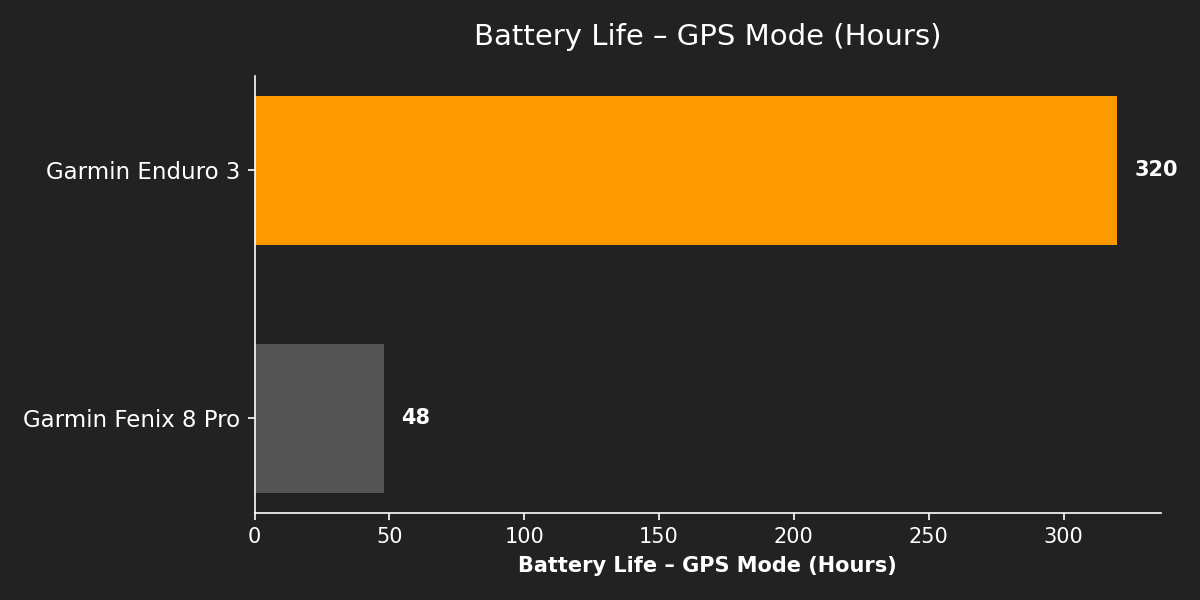
- Battery life gap is massive. The Enduro 3 lasts up to 90 days in smartwatch mode versus 15 days for the Fenix 8 Pro. In GPS mode, the Enduro 3 delivers 320 hours compared to 48 hours on the Fenix 8 Pro.
- LTE and satellite messaging. The Fenix 8 Pro has built-in LTE and Skylo inReach satellite connectivity for SOS and two-way messaging without a phone. The Enduro 3 has no cellular or satellite capability.
- Display technology. The Fenix 8 Pro uses a vibrant AMOLED screen at 454×454 resolution. The Enduro 3 uses a power-efficient MIP (memory-in-pixel) display at 280×280 — less vivid, but easier to read in direct sunlight and far kinder to battery life.
- Dive capability. The Fenix 8 Pro is rated for recreational diving to 40 meters with a built-in depth sensor and inductive buttons that work underwater. The Enduro 3 is swim-proof at 10 ATM but has no dive features.
- Speaker and microphone. The Fenix 8 Pro can take phone calls, play audio prompts, and accept voice commands. The Enduro 3 has neither a speaker nor a microphone.
- Weight and size. The Enduro 3 weighs just 63g in a fixed 51mm case. The Fenix 8 Pro (47mm) weighs 78g and comes in multiple case sizes (43mm, 47mm, 51mm).
- Price. The Enduro 3 launches at $899 versus $1,199 for the Fenix 8 Pro — a $300 difference that widens further if you add an inReach subscription.
Deep Dive Comparison
Design & Comfort
Both watches share a fiber-reinforced polymer case with a titanium bezel and sapphire crystal lens, so durability is a wash. The real difference is on your wrist. The Enduro 3 is 15 grams lighter at 63g despite its larger 51mm case — a noticeable advantage on long runs. However, it only comes in that single 51mm size, which can overwhelm smaller wrists.
The Fenix 8 Pro offers 47mm (and 43mm/51mm variants in the broader Fenix 8 lineup), making it more accessible for a wider range of wrist sizes. It’s thicker and heavier at 78g due to the LTE antenna, dive-rated depth sensor, and speaker hardware. If you’re logging 50-mile training weeks, those extra grams add up. If you’re scuba diving or navigating backcountry with satellite messaging, the extra bulk is the cost of admission.
Battery Life
This is the Enduro 3’s defining advantage and the single biggest factor separating these watches. In smartwatch mode, the Enduro 3 stretches to roughly 90 days — six times the Fenix 8 Pro’s 15-day estimate. Flip on GPS tracking and the gap holds: 320 hours on the Enduro 3 versus 48 hours on the Fenix 8 Pro.
The Enduro 3’s MIP display is the main reason for this dominance. It draws almost no power when showing a static watchface, while the Fenix 8 Pro’s AMOLED panel is constantly lit (or cycling on/off with raise-to-wake). Add LTE check-ins on the Fenix 8 Pro, and real-world battery can drop to 3–4 days with heavy connectivity use.
For thru-hikers, ultra-runners, and expedition athletes, the Enduro 3 is the only option that can realistically go a week or more of daily GPS use without a charge.
Health & Fitness Features
The core training platform is identical: both run Garmin’s latest software with Training Readiness, Training Load, HRV Status, VO2 Max, race predictions, real-time stamina tracking, and full triathlon/multisport support. Both use the Elevate Gen 5 optical heart rate sensor, and both support multi-band GNSS for accurate GPS tracking in challenging terrain.
The Fenix 8 Pro pulls ahead with its built-in depth sensor, making it a legitimate recreational dive computer. It also supports Garmin’s new ECG app (where available) and has better real-time coaching through its speaker — audible turn-by-turn navigation and pace alerts without needing headphones.
The Enduro 3 includes an integrated LED flashlight with red and white modes, useful for early-morning trail runs and overnight sections in ultramarathons. Both watches include a thermometer, barometric altimeter, compass, and SpO2 pulse oximeter for altitude acclimatization.
Smart Features
The Fenix 8 Pro is significantly more capable as a “smart” watch. LTE means you can leave your phone behind and still receive notifications, make calls (via speaker/mic), and stream music over cellular. The built-in Skylo inReach satellite communicator lets you send text messages and trigger SOS from anywhere on Earth — though this requires a separate Garmin inReach subscription ($8–$50/month).
The Enduro 3 covers the basics well: Bluetooth smartphone notifications, Garmin Pay (NFC), Connect IQ app store, and onboard music storage (32GB). But without LTE, satellite, or a speaker, it’s tethered to your phone for any real-time communication.
Both watches support Wi-Fi for syncing and map downloads, ANT+ for external sensors (power meters, chest straps), and Garmin Pay for contactless payments.
Price & Value
At $1,199 MSRP, the Fenix 8 Pro commands a $300 premium over the Enduro 3’s $899 price tag. Street prices have softened both: the Enduro 3 can be found around $799, while the Fenix 8 Pro occasionally dips to $1,099–$1,149. Factor in the mandatory inReach subscription ($96–$600/year) for satellite features, and the total cost of ownership gap widens further.
The Enduro 3 is arguably the better value per dollar: you get Garmin’s full training suite, multi-band GPS, sapphire crystal, and titanium bezel with dramatically better battery life at a lower price. The Fenix 8 Pro justifies its premium only if you’ll actively use LTE, satellite messaging, or diving features.
Technical Specs
| Spec | Garmin Fenix 8 Pro | Garmin Enduro 3 |
|---|---|---|
| Price | $1,199 | $899 |
| Case Size | 47mm | 51mm |
| Weight | 78g | 63g |
| Display | 1.4″ AMOLED, 454×454 | 1.4″ MIP, 280×280 |
| Battery (Smartwatch) | 15 days | 90 days |
| Battery (GPS) | 48 hours | 320 hours |
| Water Rating | 10 ATM (40m dive) | 10 ATM |
| GPS | Multi-band GNSS | Multi-band GNSS |
| Connectivity | BT, Wi-Fi, ANT+, LTE, Satellite | BT, Wi-Fi, ANT+ |
| Speaker/Mic | Yes | No |
| NFC Payments | Yes | Yes |
| Storage | 32GB | 32GB |
| Sensors | HR, SpO2, altimeter, compass, gyro, accel, temp, depth | HR, SpO2, altimeter, barometer, compass, gyro, accel, temp |
The Verdict
Buy the Garmin Enduro 3 if you’re an ultra-runner, thru-hiker, or endurance athlete who needs a watch that can outlast any adventure without a charger. At $899 (often $799 on sale), it delivers 90% of the Fenix 8 Pro’s training capabilities with six times the battery life and less weight on your wrist. It’s also the smarter pick if you already carry a separate satellite communicator like the Garmin inReach Mini 2.
Buy the Garmin Fenix 8 Pro if you want one device to replace your phone, dive computer, and satellite messenger on remote adventures. The built-in LTE, inReach satellite SOS, 40-meter dive rating, and brilliant AMOLED screen justify the $1,199 price tag for athletes who’ll actually use those features. Just budget for the inReach subscription and more frequent charging.
For most people training for marathons, triathlons, or weekend trail runs, the Enduro 3 is the better buy. The Fenix 8 Pro earns its keep only when you’re heading somewhere your phone can’t follow.
🏆 Ready to Decide?
Check the latest deals to see which one fits your budget.
*We earn a commission if you make a purchase.
Specs and features may change. Always verify details on the manufacturer’s official site before purchasing.
