
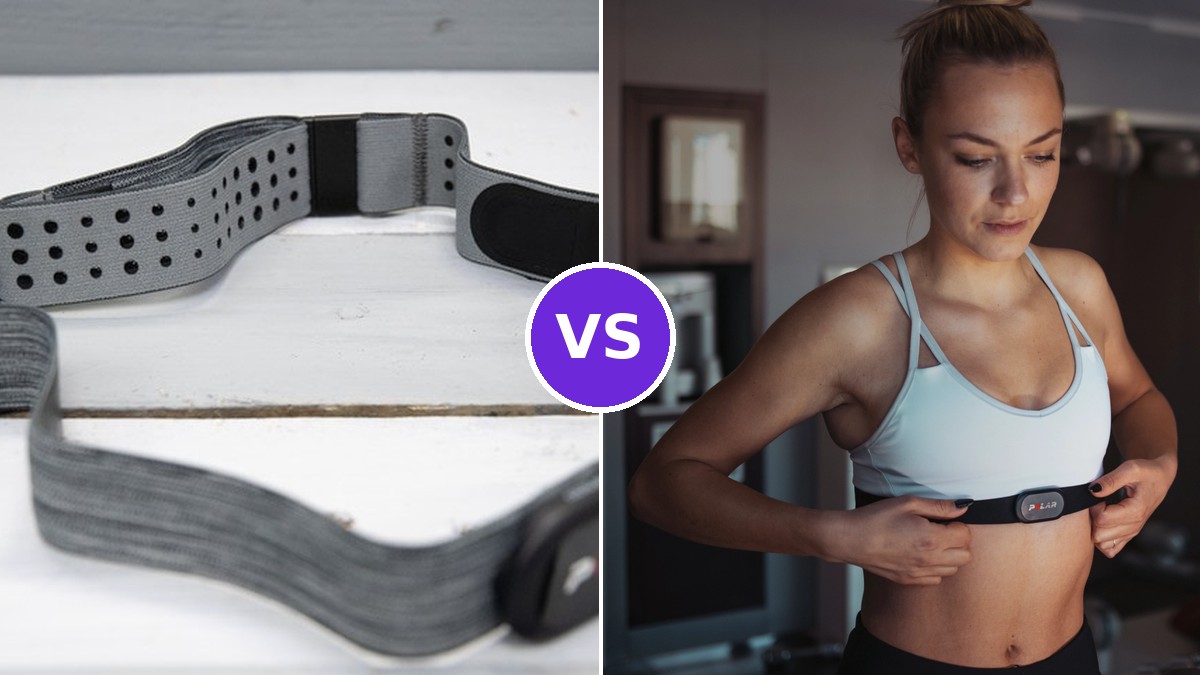
At a Glance: The Verdict
| Polar H10 | Polar H9 |
|---|---|
|
Best For: Serious athletes who want every edge in accuracy and data The gold standard in chest-strap heart rate monitoring. Built-in memory lets you train without your phone, the accelerometer tracks running cadence, and the premium Pro strap stays put during intense sessions. Worth the extra $30 if data is your religion. |
Best For: Budget-conscious exercisers who want reliable, accurate heart rate data Nearly identical heart rate accuracy at a significantly lower price. If you always train with your phone or watch nearby and don’t need running dynamics, the H9 delivers 95% of the H10 experience for two-thirds the cost. |
Quick Buy Path
Check today’s pricing before you go deeper.
If these are already your two finalists, compare current pricing now, then keep reading for the full verdict.
Introduction
Polar’s chest-strap heart rate monitors are widely regarded as the most accurate consumer HR sensors available, and the H10 and H9 sit at the top of that lineup. They share the same physical dimensions, battery life, and core ECG-based measurement technology — but a $30 price gap separates them, and the differences that justify it matter more for some athletes than others.
Key Differences
- Built-in memory: The H10 can store one full training session internally, so you can leave your phone behind. The H9 has no onboard storage and requires a connected device at all times.
- Accelerometer: The H10 includes an accelerometer that enables running cadence tracking and improved motion artifact filtering. The H9 relies purely on its heart rate sensor.
- Chest strap quality: The H10 ships with the Polar Pro chest strap, which uses improved electrodes and a more secure closure. The H9 comes with a standard Polar soft strap.
- Case material: The H10 uses a mix of ABS, glass-fiber reinforced ABS, polycarbonate, and stainless steel. The H9 uses a simpler plastic housing.
- Price: The H10 launches at $89.95 (street price around $105), while the H9 comes in at $59.95 — a meaningful $30 savings.
- Connectivity: Both support Bluetooth, ANT+, and Polar’s 5 kHz (GymLink) protocol for gym equipment compatibility. Identical here.
Deep Dive Comparison
Design & Comfort
On paper, these two sensors are twins: both weigh 60 grams, measure 65 mm across, and are water-rated to 30 meters. You’d struggle to tell the sensor pods apart at a glance. The real design difference is under the hood — and around the chest.
The H10’s sensor pod uses a multi-material construction (ABS, glass-fiber reinforced ABS, polycarbonate, and stainless steel) that feels marginally more robust. More importantly, it ships with the Polar Pro strap, which features silicone dots and improved electrode contact patches for a more secure fit during high-intensity movement. The H9’s standard soft strap is perfectly comfortable for most activities but can shift slightly during explosive movements like box jumps or sprint intervals.
Both straps are machine-washable, and replacement straps for either model are readily available — a detail that matters since the strap wears out long before the sensor does.
Battery Life
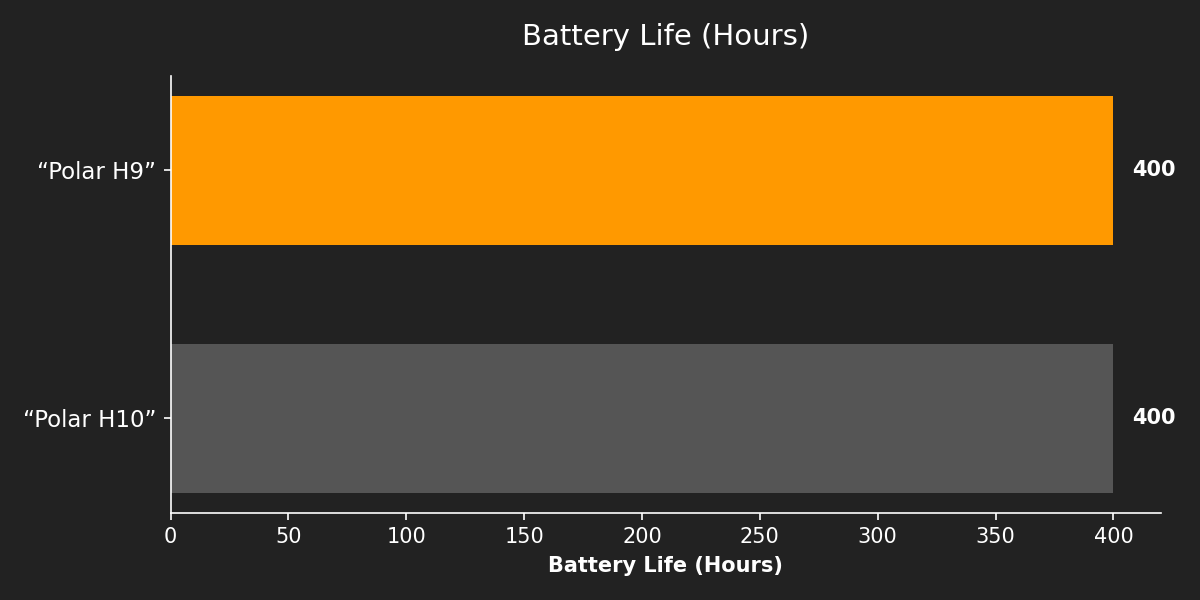
This is one area where these two are genuinely identical. Both the H10 and H9 use a standard CR2025 coin-cell battery and are rated for approximately 400 hours of active use. For most athletes training an hour a day, that translates to well over a year of use before needing a battery swap.
A late-2025 firmware update for both models also improved standby battery drain, further extending real-world longevity between replacements. The CR2025 is widely available and costs under $5, making battery replacements trivially cheap.
Health & Fitness Features
Both sensors use ECG-based chest-strap technology, which reads the heart’s electrical signals directly. This makes them significantly more accurate than wrist-based optical sensors, especially during high-intensity intervals where motion artifacts plague wrist monitors. In controlled testing, reviewers consistently find both the H10 and H9 within 1-2 BPM of medical-grade equipment.
Where the H10 pulls ahead is its built-in accelerometer. This enables:
- Running cadence and pace data when paired with compatible apps and watches
- Improved motion artifact rejection during erratic movements, giving the H10 a slight edge in accuracy during CrossFit-style workouts or contact sports
The H10’s internal memory is the other standout feature. It can store one complete training session (up to 25 hours of continuous recording) and sync the data to Polar Beat or Polar Flow afterward. This is invaluable for swimmers who can’t carry a phone, or runners who prefer to leave their device at home.
The H9 has no accelerometer and no memory. It needs a connected phone, watch, or compatible gym machine to record data in real time. For the majority of gym-goers and runners who already carry a phone or wear a smartwatch, this is a non-issue.
Smart Features
Neither the H10 nor the H9 has a display, speaker, microphone, NFC, or any smartwatch-like functionality. These are pure heart rate sensors — they measure, they transmit, and that’s it.
Both connect over Bluetooth and ANT+ simultaneously, meaning you can pair them with a phone app and a GPS watch at the same time. Both also support 5 kHz GymLink transmission, which is the standard used by compatible cardio machines (treadmills, ellipticals, bikes) at most commercial gyms.
The H10’s internal memory is the closest thing either sensor has to a “smart” feature, but it’s really a fitness feature — there’s no notification mirroring, no music control, nothing of that sort.
Price & Value
The Polar H10 launched at $89.95 and currently sells for around $105 at most retailers. The Polar H9 launched at $59.95 and typically stays close to that price. That $30-$45 gap is the central question of this comparison.
If you always train with a phone or watch, never swim without your device, and don’t need running cadence from the strap itself, the H9 gives you the same core accuracy for significantly less money. The savings could go toward a replacement strap down the line.
If you value phone-free training sessions, want running dynamics data, or simply want the best chest strap Polar makes with no compromises, the H10 justifies its premium. At around $105, it’s still far cheaper than most GPS watches.
Technical Specs
| Spec | Polar H10 | Polar H9 |
|---|---|---|
| Launch Price | $89.95 | $59.95 |
| Weight | 60 g | 60 g |
| Sensor Size | 65 mm | 65 mm |
| Case Material | ABS, ABS+GF, PC, Stainless Steel | Plastic |
| Water Rating | 30 m | 30 m |
| Sensors | ECG, Accelerometer | Heart Rate (ECG) |
| Built-in Memory | Yes (1 session) | No |
| Connectivity | Bluetooth, ANT+, 5 kHz | Bluetooth, ANT+, 5 kHz |
| Battery Life | ~400 hours | ~400 hours |
| Battery Type | CR2025 | CR2025 |
| Chest Strap | Polar Pro Strap | Polar Soft Strap |
The Verdict
Buy the Polar H10 if: You want the absolute best chest-strap HR monitor available. The built-in memory is a game-changer for swimmers and minimalist runners who don’t want to carry a phone. The accelerometer adds running cadence data and slightly improves accuracy during chaotic, high-intensity movements. If you’re a competitive athlete, a data obsessive, or someone who trains in environments where carrying a phone is impractical, the H10 earns every dollar of its premium.
Buy the Polar H9 if: You want elite-level heart rate accuracy without paying for features you won’t use. If you always have a phone or smartwatch with you during workouts, the H9’s lack of onboard memory is irrelevant. You’re getting the same ECG-grade measurement technology, the same battery life, and the same broad device compatibility — just without the accelerometer and Pro strap. At $59.95, it’s arguably the best value in fitness wearables, period.
The bottom line: Both sensors deliver accuracy that rivals clinical equipment. The H10 is the better sensor; the H9 is the better deal. For most people who already own a smartwatch or train with their phone, save the $30 and go with the H9.
🏆 Ready to Decide?
Check the latest deals to see which one fits your budget.
*We earn a commission if you make a purchase.
Specs and features may change. Always verify details on the manufacturer’s official site before purchasing.
