
At a Glance: The Verdict
| Apple Watch Ultra 2 | Apple Watch Series 10 |
|---|---|
|
Best For: Endurance athletes and outdoor adventurers The Apple Watch Ultra 2 is built for extremes. With a titanium case, 36-hour battery life, multi-band GPS, and 100-meter water resistance, it’s designed for trail runners, open-water swimmers, and hikers who push past the limits of a standard smartwatch. You pay a premium, but you get a tool that won’t quit before you do. |
Best For: Everyday fitness and daily wear The Apple Watch Series 10 delivers the core Apple Watch experience at half the price. It’s lighter, slimmer, and packs a slightly larger display — ideal for gym-goers, casual runners, and anyone who wants a capable fitness tracker that doesn’t feel like a dive computer on your wrist. |
Quick Buy Path
Check today’s pricing before you go deeper.
If these are already your two finalists, compare current pricing now, then keep reading for the full verdict.
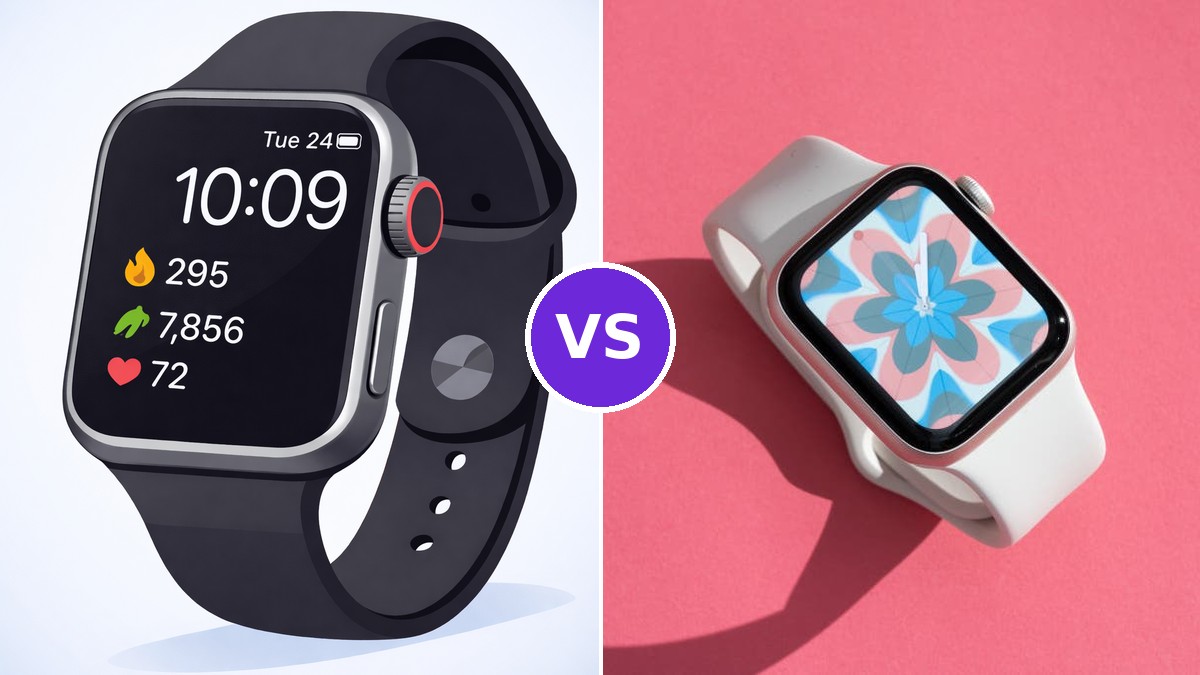
Apple dominates the smartwatch market, and these two models sit at opposite ends of its lineup. The Apple Watch Ultra 2 is the brand’s rugged flagship, built for serious athletes and outdoor pursuits. The Apple Watch Series 10 is the refined mainstream option, designed for everyday life and general fitness. Both run watchOS, both integrate seamlessly with your iPhone — but the differences in build, battery, and capability are significant. Here’s how they actually stack up.
Key Differences
- Battery life: The Ultra 2 lasts up to 36 hours in normal use compared to 18 hours on the Series 10 — effectively two days vs. one day between charges.
- GPS accuracy: The Ultra 2 uses multi-band GPS (L1 + L5 frequencies) for superior accuracy in canyons, dense forests, and urban environments. The Series 10 uses single-band GPS, which works well in open areas but can drift in challenging terrain.
- Water resistance: The Ultra 2 is rated to 100 meters and certified for recreational diving (EN 13319). The Series 10 is rated to 50 meters — fine for pool swimming, but not built for deep-water activities.
- Weight and comfort: At 36.4g, the Series 10 is 41% lighter than the 61.3g Ultra 2. For all-day wear and sleep tracking, that difference is noticeable.
- Price: The Series 10 launches at $399 — exactly half the Ultra 2’s $799 price tag.
- Case material: Titanium on the Ultra 2 vs. aluminum on the Series 10. Titanium is more scratch-resistant and durable in rough conditions.
- Storage: The Series 10 offers 64GB of on-device storage versus 32GB on the Ultra 2, giving you more room for offline music and podcasts.
Deep Dive Comparison
Design & Comfort
The Apple Watch Ultra 2 makes its intentions clear the moment you strap it on. The 49mm titanium case is imposing — this is a big watch at 61.3g. The flat sapphire crystal sits recessed within raised edges that protect the display during impacts. A programmable Action Button on the left side gives quick access to workouts, waypoints, or other functions. It’s unmistakably a sports tool.
The Apple Watch Series 10 takes the opposite approach. Its 46mm aluminum case weighs just 36.4g, making it one of the thinnest and lightest Apple Watches ever made. Despite the smaller case, its 1.96-inch display is actually slightly larger than the Ultra 2’s 1.92-inch screen — a testament to Apple’s work on shrinking bezels. For wearing to bed, to the office, or through a yoga class, the Series 10 disappears on your wrist in a way the Ultra 2 simply cannot.
If you have smaller wrists or prioritize comfort during sleep tracking, the Series 10 wins here easily. If you need a watch that can take a beating on a mountain bike trail or rocky scramble, the Ultra 2’s titanium build is worth every gram.
Battery Life
Battery life is one of the starkest differences between these two watches — and potentially the deciding factor for endurance athletes.
The Ultra 2 delivers up to 36 hours in normal smartwatch mode and up to 12 hours of continuous GPS tracking. That means you can run an ultra-marathon, sleep in the watch, and still have battery left the next morning. With Low Power Mode enabled, Apple claims up to 72 hours of total use.
The Series 10 offers 18 hours in normal use and roughly 7 hours of continuous GPS. That’s enough for a full day of wear and a long run, but you’re charging every night. A marathon runner who starts with a full battery will be fine, but back-to-back workout days without a charger will push it to the edge.
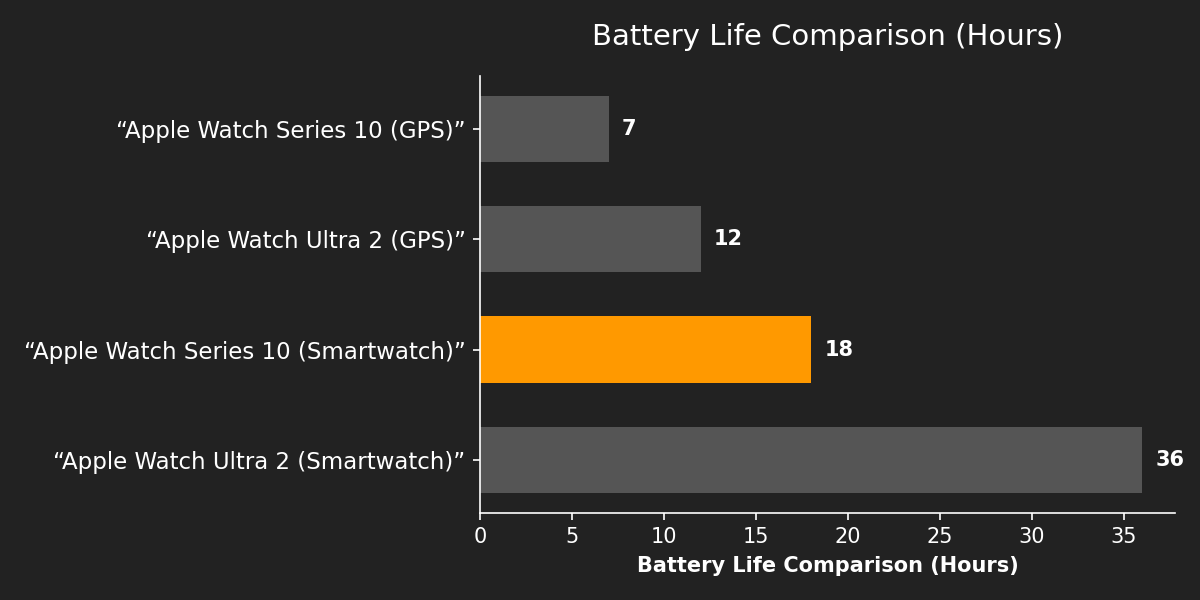
For weekend warriors who go off-grid for hiking or camping trips, the Ultra 2’s battery advantage is a genuine functional benefit — not just a convenience. For daily gym-goers who charge overnight, the Series 10’s battery is perfectly adequate.
Health & Fitness Features
Both watches share Apple’s core health platform: optical and electrical heart rate sensors, blood oxygen monitoring, ECG capability, fall detection, and crash detection. Both support temperature sensing for cycle tracking and retrospective ovulation estimates. In day-to-day health tracking, you’re getting the same experience on either watch.
The differences emerge in athletic and outdoor scenarios. The Ultra 2’s multi-band GPS is measurably more accurate in difficult environments. If you’re trail running through switchbacks under heavy tree cover, or navigating a city with tall buildings, the dual-frequency system locks onto your position faster and drifts less. The Series 10’s single-band GPS is reliable in open spaces but can lose accuracy in those same conditions.
The Ultra 2 also carries a depth gauge and water temperature sensor designed for diving and snorkeling. While the Series 10 now includes a depth gauge and water temperature sensor as well, the Ultra 2’s 100-meter water resistance and EN 13319 dive certification make it the only choice for anything beyond pool swimming.
The Ultra 2 features a built-in siren (86 dB) for emergency situations in the backcountry — a feature the Series 10 lacks entirely. For remote trail runners and hikers, this is a genuine safety tool.
Smart Features
On the software and smart features side, these watches are nearly identical. Both run the same version of watchOS. Both support Apple Pay via NFC, on-wrist calls with built-in mic and speaker, notifications, Siri, and the full App Store. Both offer Bluetooth 5.3 and LTE connectivity (on cellular models).
The Series 10 actually edges ahead in one area: storage. With 64GB versus the Ultra 2’s 32GB, the Series 10 holds more offline music, podcasts, and apps. If you like running without your phone and streaming from your wrist, the extra storage is a nice perk.
The Series 10 also features the newer LTPO3 display technology, which allows for a faster refresh rate during interactions while remaining efficient. The Ultra 2 uses LTPO2, which is still excellent but represents the previous generation of display tech.
Price & Value
The Apple Watch Ultra 2 launched at $799, while the Apple Watch Series 10 starts at $399. That’s a $400 gap — and it’s worth asking whether the Ultra 2’s advantages justify double the price for your specific use case.
If you regularly train for ultra-distance events, hike in remote areas, or participate in water sports beyond lap swimming, the Ultra 2’s titanium construction, multi-band GPS, extended battery, and 100-meter water resistance deliver genuine functional value. These aren’t luxury features — they’re tools that enable activities the Series 10 simply can’t support as well.
If your fitness routine involves gym sessions, road running, cycling, and casual swimming, the Series 10 gives you 95% of the health and fitness tracking capability at half the cost. You also get a lighter, more comfortable watch with a larger display and more storage. For the majority of Apple Watch buyers, the Series 10 is the smarter investment.
Technical Specs
| Spec | Apple Watch Ultra 2 | Apple Watch Series 10 |
|---|---|---|
| Launch Price | $799 | $399 |
| Case Size | 49mm | 46mm |
| Weight | 61.3g | 36.4g |
| Case Material | Titanium | Aluminum |
| Display | 1.92″ LTPO2 OLED (410 x 502) | 1.96″ LTPO3 OLED (416 x 496) |
| Water Resistance | 100 meters | 50 meters |
| Battery (Smartwatch) | 36 hours | 18 hours |
| Battery (GPS) | 12 hours | 7 hours |
| GPS | Multi-band (L1 + L5) | Single-band |
| Storage | 32GB | 64GB |
| Key Sensors | Blood O₂, ECG, Depth, Water Temp, Compass, Altimeter | ECG, Depth, Water Temp, Compass, Altimeter, Temperature |
| Connectivity | LTE, Wi-Fi, Bluetooth 5.3, NFC | LTE, Wi-Fi 4, Bluetooth 5.3, NFC |
The Verdict
Buy the Apple Watch Ultra 2 if: You train for ultra-distance events, spend significant time on trails or in the backcountry, or participate in water sports like open-water swimming, snorkeling, or recreational diving. The multi-band GPS will give you more accurate route data in challenging environments. The 36-hour battery means you won’t have to ration power during long training days or weekend adventures. And the titanium case will survive knocks and scrapes that would leave an aluminum watch looking rough. If your fitness life regularly takes you beyond paved roads and swimming pools, the Ultra 2 earns its $799 price tag.
Buy the Apple Watch Series 10 if: Your workouts happen at the gym, on the road, or in a pool — and you want a smartwatch that’s equally at home in a meeting or at dinner. At $399, it delivers the same health monitoring suite, a slightly larger and more advanced display, double the storage, and a weight so light you’ll forget it’s there. For the vast majority of fitness enthusiasts, the Series 10 is the right Apple Watch. It does everything most people need, and it does it at half the price.
🏆 Ready to Decide?
Check the latest deals to see which one fits your budget.
*We earn a commission if you make a purchase.
Specs and features may change. Always verify details on the manufacturer’s official site before purchasing.
