
At a Glance: The Verdict
| Fitbit Charge 6 | Garmin Forerunner 55 |
|---|---|
|
Best For: All-day health trackers who want NFC, ECG, and a slim band A 30g AMOLED band that handles heart-rate, SpO2, ECG, EDA stress, and tap-to-pay. Built for daily wellness, not long runs. |
Best For: Runners who need real GPS battery and a proper watch face 14 days of smartwatch life and 20 hours of GPS in a lightweight running watch. Garmin’s training brain in the cheapest body it sells. |
Quick Buy Path
Check today’s pricing before you go deeper.
If these are already your two finalists, compare current pricing now, then keep reading for the full verdict.
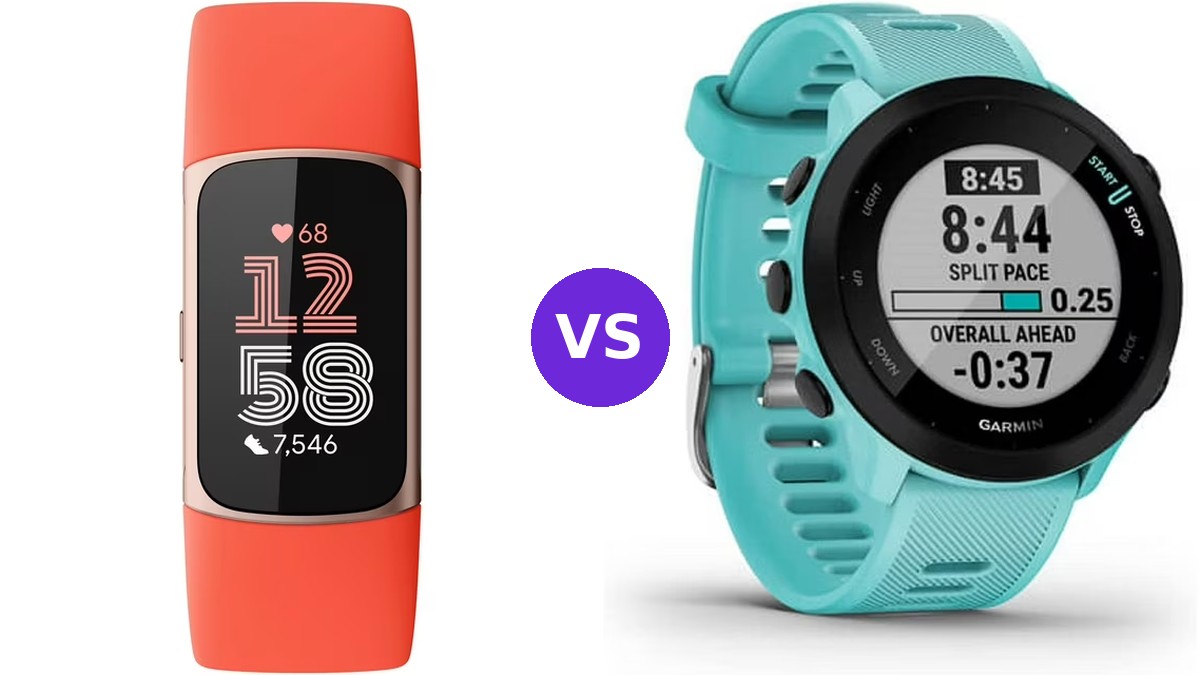
The Fitbit Charge 6 and the Garmin Forerunner 55 are both popular sub-$200 fitness trackers, but they’re built for different people. One is a health-first wristband. The other is a running watch with GPS endurance that embarrasses most flagships. Pick wrong and you’ll feel it within a week.
Key Differences
- Form factor: The Charge 6 is a slim 30g band with a 1.04-inch AMOLED touchscreen. The Forerunner 55 is a 37g round watch with a 1.04-inch transflective MIP display.
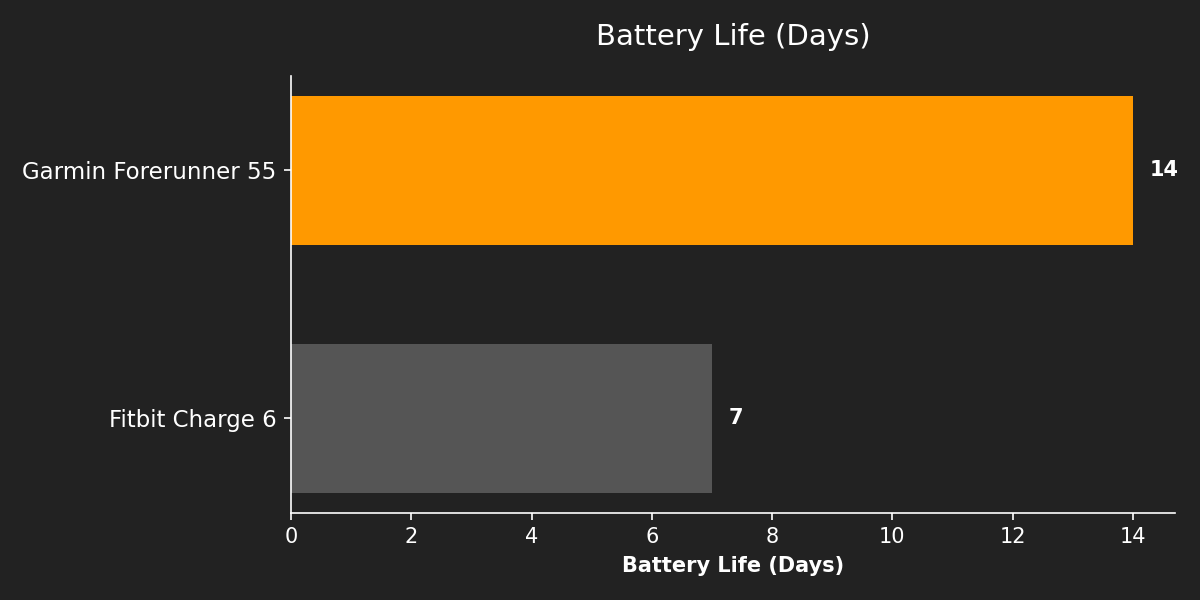
- Battery: Forerunner 55 lasts 14 days in smartwatch mode and 20 hours with GPS. Charge 6 manages 7 days and just 5 hours of GPS.
- Health sensors: Charge 6 adds ECG, EDA stress scans, SpO2, and a skin temperature sensor. Forerunner 55 sticks to optical heart rate and an accelerometer.
- GPS systems: Forerunner 55 pulls GPS, GLONASS, and Galileo. Charge 6 uses GPS + GLONASS.
- Payments: Charge 6 has NFC for tap-to-pay. Forerunner 55 does not.
- Connectivity: Forerunner 55 supports ANT+ for chest straps and bike sensors. Charge 6 is Bluetooth-only.
Deep Dive Comparison
Design & Comfort
The Charge 6 is the comfort winner if you hate watches. At 30 grams in aluminum, glass, and resin, it disappears under a sleeve and is friendlier for sleep tracking. The Forerunner 55 is a 37g fiber-reinforced polymer watch with a 42mm case — small for a Garmin, but still a watch on your wrist. If you want something you can wear in meetings, weight workouts, and bed without thinking, the Charge 6 is the lighter call.
Battery Life
This is where the Forerunner 55 lands a knockout. Garmin rates it at 14 days in smartwatch mode and 20 hours with GPS active. The Charge 6 claims 7 days of normal use and only 5 hours with GPS running. If you’re training for a half marathon, the Charge 6’s 5-hour GPS ceiling is a real problem. The Forerunner 55 will outlast a full marathon training block on a single charge and survive a 4-hour long run with battery to spare.
Health & Fitness Features
The Charge 6 is the deeper health tracker on paper. It includes optical heart rate, SpO2, an ambient light sensor, a device temperature sensor, and electrical sensors for ECG and EDA stress scans. That stack is rare under $200. The Forerunner 55 is the focused fitness watch — heart rate plus a multi-system GNSS receiver (GPS, GLONASS, Galileo) that locks faster and tracks more accurately on tree-lined paths. It also feeds into Garmin’s coaching: daily suggested workouts, recovery time, and PacePro pacing strategies. The Charge 6 will tell you more about your body. The Forerunner 55 will tell you more about your running.
Smart Features
Charge 6 wins this category cleanly. NFC tap-to-pay, Google Maps and YouTube Music controls, and a brighter AMOLED screen for notifications. Forerunner 55 has notifications and ANT+ chest strap support, but no NFC payments, no music storage, and a transflective MIP display that prioritizes daylight visibility over flash. Neither has a microphone or speaker.
Price & Value
The Charge 6 launched at $159.95 and the Forerunner 55 at $199.99. Street prices on both have softened, and the Forerunner 55 in particular goes on sale aggressively because it’s been around since June 2021. For runners, the Forerunner 55 is the better dollar-for-dollar buy at any price under $180. For everyone else, the Charge 6 is the more modern hardware with the better feature spread per dollar.
Technical Specs
| Spec | Fitbit Charge 6 | Garmin Forerunner 55 |
|---|---|---|
| Release Date | September 2023 | June 2021 |
| Launch Price | $159.95 | $199.99 |
| Weight | 30g | 37g |
| Case Material | Aluminum, glass, resin | Fiber-reinforced polymer |
| Display | 1.04-inch AMOLED, 184 x 276 | 1.04-inch transflective MIP, 208 x 208 |
| Water Rating | 5 ATM | 5 ATM |
| Battery (Smartwatch) | 168 hours (7 days) | 336 hours (14 days) |
| Battery (GPS) | 5 hours | 20 hours |
| GPS | Built-in GPS + GLONASS | Single-band GPS + GLONASS + Galileo |
| Sensors | Optical HR, SpO2, ECG, EDA, skin temp, ambient light, accelerometer | Optical HR, accelerometer |
| NFC Payments | Yes | No |
| Connectivity | Bluetooth, NFC | Bluetooth, ANT+ |
The Verdict
Buy the Garmin Forerunner 55 if you run. 20 hours of GPS, 14 days of smartwatch battery, multi-system GNSS, ANT+ chest strap support, and Garmin’s training tools make it the obvious pick for any runner training for a 5K through a marathon. The Charge 6’s 5-hour GPS ceiling is a dealbreaker the second your long runs cross the 90-minute mark.
Buy the Fitbit Charge 6 if you want a daily health band. ECG, EDA stress, SpO2, skin temperature, NFC tap-to-pay, and a bright AMOLED screen in a 30g package — that’s a stronger wellness story than anything Garmin sells at this price. It’s the better choice for sleep tracking, casual workouts, and anyone who wants tap-to-pay without strapping on a watch. Just don’t expect it to keep up on a half marathon.
🏆 Ready to Decide?
Check the latest deals to see which one fits your budget.
*We earn a commission if you make a purchase.
Specs and features may change. Always verify details on the manufacturer’s official site before purchasing.
