
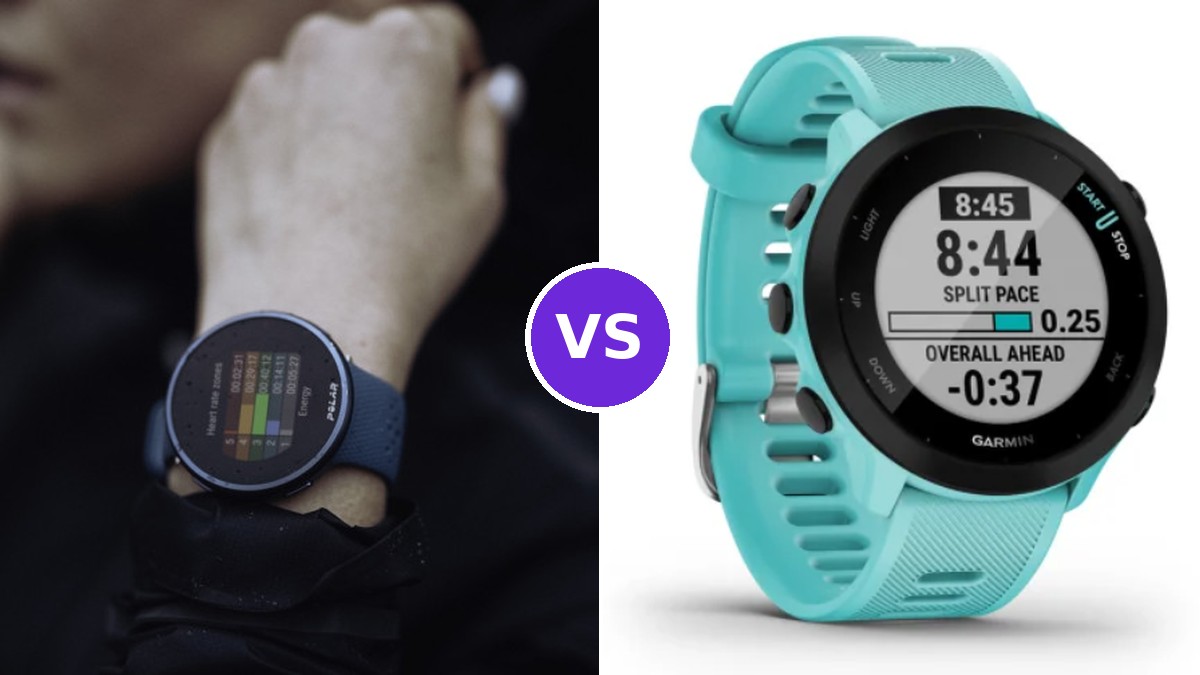
At a Glance: The Verdict
| Polar Pacer | Garmin Forerunner 55 |
|---|---|
|
Best For: Runners who want multi-band GPS accuracy The Pacer leans on dual-frequency GPS and Polar’s Precision Prime heart rate sensor to deliver sharper pace and route data in cities and tree cover. You trade battery life for location accuracy. |
Best For: Beginner and budget-minded runners The Forerunner 55 is the smarter buy for most people. Two-week battery, Garmin’s mature training tools, and a lower price make it the easier recommendation unless you need multi-band GPS. |
Quick Buy Path
Check today’s pricing before you go deeper.
If these are already your two finalists, compare current pricing now, then keep reading for the full verdict.
Both the Polar Pacer and the Garmin Forerunner 55 are entry-level GPS running watches built around the same goal: help you train smarter without draining your wallet. But they take very different paths to get there, and the gap between them is bigger than the price tags suggest.
Key Differences
- GPS hardware: The Pacer has multi-band GPS. The Forerunner 55 is single-band only.
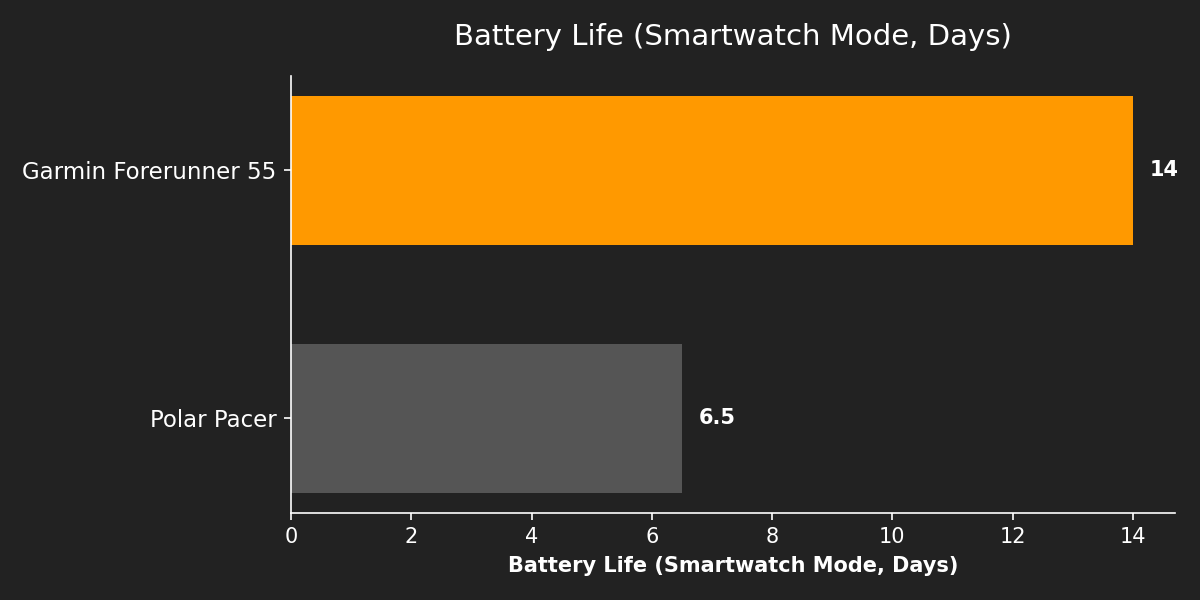
- Battery life: The Forerunner 55 lasts 14 days in smartwatch mode versus 6.5 days for the Pacer.
- GPS battery: The Pacer runs 32 hours with GPS on. The Forerunner 55 taps out at 20 hours.
- Case size: The Pacer is a 45mm case. The Forerunner 55 is a smaller, lighter 42mm build.
- Ecosystem: Garmin Connect is deeper and more polished. Polar Flow is leaner but offers strong training load and recovery tools.
- Price: The Forerunner 55 launched at $199.99. The Pacer launched at $220.
Deep Dive Comparison
Design & Comfort
The Forerunner 55 is the comfier watch on most wrists. At 37 grams and a 42mm case made of fiber-reinforced polymer, it disappears during long runs and fits smaller wrists better. The Pacer is 40 grams with a larger 45mm plastic case, though it’s protected by Gorilla Glass 3.0 on the lens, which should shrug off scratches better than the Garmin. Both are light enough to sleep in, but the Pacer feels bulkier if you have thinner wrists.
Battery Life
This is where the Forerunner 55 lands its biggest punch. Garmin rates it at 336 hours (14 days) in smartwatch mode, more than double the Pacer’s 156 hours (6.5 days). Flip on GPS, though, and the order reverses: the Pacer delivers 32 hours of continuous GPS tracking compared to 20 hours on the Forerunner 55. If you mostly do sub-hour workouts, Garmin’s two-week battery wins. If you’re training for ultras or weekend-long hikes, the Pacer’s GPS endurance matters more.
Health & Fitness Features
The Pacer’s multi-band GPS is the headline. In dense city blocks or under tree cover, it produces cleaner tracks and more reliable pace numbers than the single-band chip in the Forerunner 55. Polar’s Precision Prime GEN 3.5 optical heart rate sensor is also well-regarded, particularly for high-intensity intervals where many wrist sensors lose the plot. Garmin’s Elevate heart rate sensor is solid for steady-state running but can be noisy in hard efforts.
Both watches lean on GPS, GLONASS, and Galileo satellite systems. The Pacer adds QZSS coverage for Asia-Pacific users. Neither watch has SpO2, ECG, or skin temperature sensors, so if you want advanced recovery metrics, neither is your answer.
Smart Features
Neither watch does the flashy smartwatch stuff. No NFC payments. No microphone. No speaker. No onboard music storage beyond the 32MB used for firmware and workout data. Both will push smartphone notifications to your wrist and let you control music playback on your phone, and that’s about it. If you want to leave your phone at home and still pay for coffee, neither watch is the right tool.
Price & Value
The Forerunner 55 launched at $199.99 and often sells for less now that it’s a few years old. The Pacer launched at $220 and sits close to the same street price range. Dollar for dollar, the Forerunner 55 gives you longer battery life, a more mature app ecosystem, and better beginner coaching tools. The Pacer makes you pay a small premium for multi-band GPS and a better heart rate sensor. Which one is “better value” depends entirely on whether you care about those two upgrades.
Technical Specs
| Spec | Polar Pacer | Garmin Forerunner 55 |
|---|---|---|
| Release Date | April 2022 | June 2021 |
| Launch Price | $220 | $199 |
| Case Size | 45mm | 42mm |
| Weight | 40g | 37g |
| Case Material | Plastic with Gorilla Glass 3.0 | Fiber-reinforced polymer |
| Water Rating | WR50 | 5 ATM |
| Display | 1.2-inch MIP color, 240 x 240 | 1.04-inch MIP, 208 x 208 |
| Battery (Smartwatch) | 156 hours (6.5 days) | 336 hours (14 days) |
| Battery (GPS) | 32 hours | 20 hours |
| GPS Type | Multi-band | Single-band |
| Sensors | Optical HR, accelerometer, GPS, GLONASS, Galileo, QZSS | Optical HR, accelerometer, GPS, GLONASS, Galileo |
| NFC Payments | No | No |
| Connectivity | Bluetooth LE, USB-A proprietary | Bluetooth, ANT+ |
The Verdict
The Garmin Forerunner 55 is the right watch for most people. The 14-day smartwatch battery, lighter 37-gram build, and mature Garmin Connect app make it the easier daily driver, especially for first-time GPS watch buyers who are building a running habit and want something simple that just works.
Buy the Polar Pacer if you run in cities with tall buildings, heavy tree cover, or mountain valleys where single-band GPS struggles. The multi-band chip and Precision Prime heart rate sensor are genuine upgrades if you care about data accuracy more than battery life.
Buy the Garmin Forerunner 55 if you’re a beginner or casual runner, you want the longest battery life in this price range, you value ANT+ accessory support, or you plan to lean on structured training plans from Garmin Coach. For most shoppers cross-shopping these two, this is the one to grab.
🏆 Ready to Decide?
Check the latest deals to see which one fits your budget.
*We earn a commission if you make a purchase.
Specs and features may change. Always verify details on the manufacturer’s official site before purchasing.
