
At a Glance: The Verdict
| Garmin Forerunner 265 | Apple Watch Series 11 |
|---|---|
|
Best For: Dedicated runners and endurance athletes who need elite GPS and multi-day battery The Forerunner 265 delivers up to 20 hours of GPS tracking, multi-band satellite accuracy, and 13 days of smartwatch battery — all wrapped in a purpose-built training tool with deep running dynamics and recovery metrics. |
Best For: iPhone users who want a polished all-rounder with health monitoring and seamless app integration The Apple Watch Series 11 pairs a stunning 1.96-inch OLED display with cellular connectivity, a depth gauge, and tight iOS integration — ideal for everyday fitness tracking, quick workouts, and staying connected without your phone. |
Quick Buy Path
Check today’s pricing before you go deeper.
If these are already your two finalists, compare current pricing now, then keep reading for the full verdict.
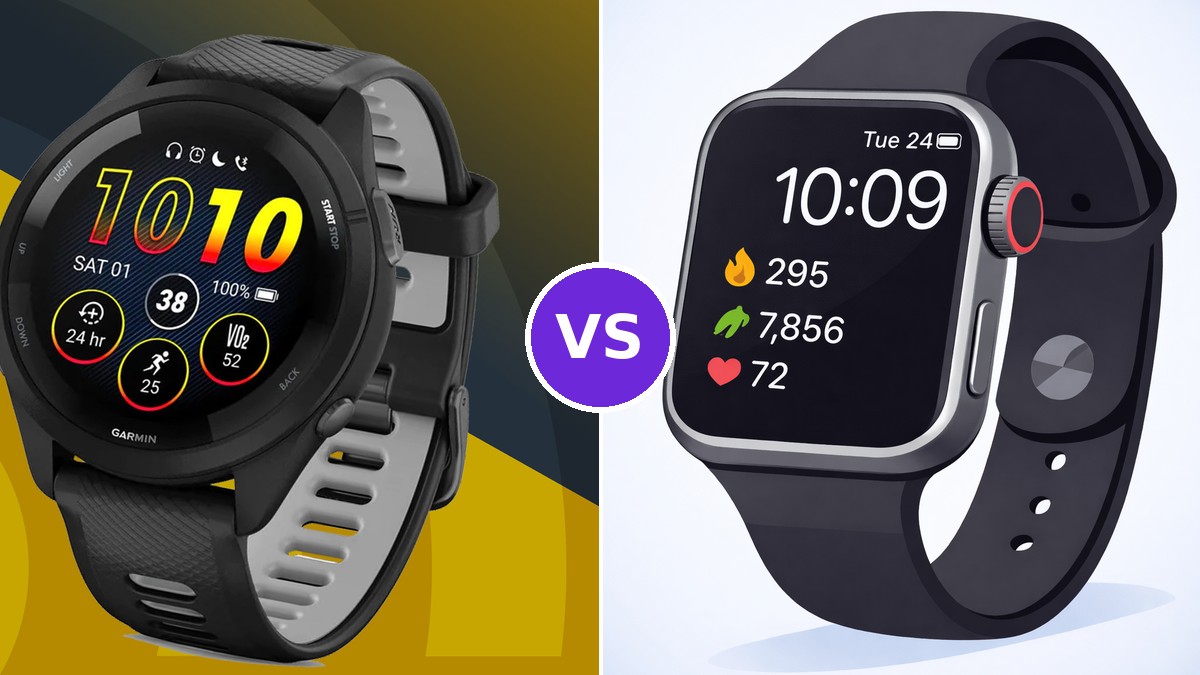
The Garmin Forerunner 265 and Apple Watch Series 11 sit at nearly the same price point, yet they target fundamentally different wrists. Garmin built the Forerunner 265 as a training-first tool with marathon-grade GPS and battery life measured in weeks, while Apple designed the Series 11 as a lifestyle smartwatch that also happens to track workouts. Choosing between them comes down to one question: do you need a coach on your wrist, or a computer?
Key Differences
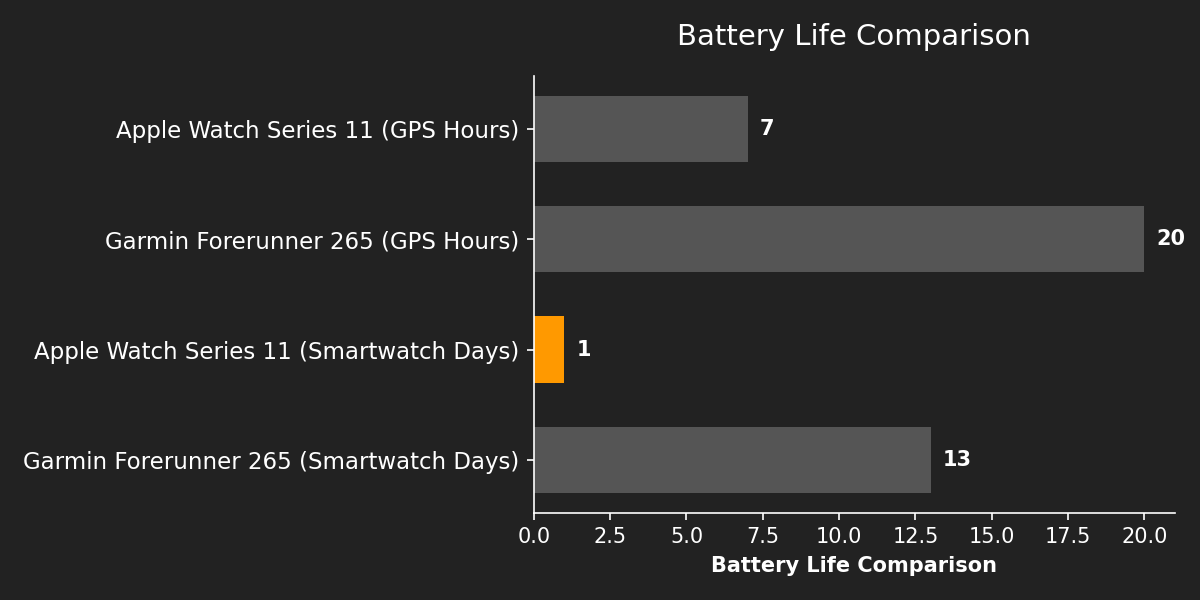
- Battery life gap is enormous: The Forerunner 265 lasts up to 13 days in smartwatch mode versus roughly 24 hours for the Apple Watch Series 11. In GPS mode, Garmin delivers 20 hours compared to Apple’s 8.
- GPS accuracy: Garmin uses multi-band GPS (GPS, GLONASS, Galileo with SatIQ), while the Series 11 relies on single-band GPS — a meaningful difference in dense urban areas and under tree cover.
- Cellular connectivity: The Apple Watch Series 11 offers LTE so you can leave your phone at home entirely. The Forerunner 265 has no cellular option.
- Display size: Apple’s 1.96-inch screen dwarfs Garmin’s 1.3-inch panel, making it far easier to read maps, messages, and apps.
- Mic and speaker: The Series 11 has both, enabling phone calls and Siri from your wrist. The Forerunner 265 has neither.
- Storage: Apple packs 64 GB versus Garmin’s 8 GB — relevant if you want a large offline music library or podcast catalog.
- Weight: At 37.8 g, the Apple Watch is about 10 g lighter than the 47 g Forerunner 265, though both are comfortable for all-day wear.
Deep Dive Comparison
Design & Comfort
The Forerunner 265 uses a fiber-reinforced polymer case at 46.1 mm across. It’s built to survive sweat, rain, and the occasional trail stumble. The physical buttons are a deliberate choice — they work reliably with wet or gloved hands mid-run. At 47 g, it’s noticeably present on the wrist but never heavy enough to bother during a long run.
The Apple Watch Series 11 opts for a 46 mm aluminum case that’s lighter at 37.8 g and more refined in appearance. Its touchscreen-first interface is intuitive for daily use but can frustrate during intense exercise when sweat interferes with swipes. The larger 1.96-inch LTPO3 OLED display is genuinely gorgeous and makes every interaction feel premium. Both watches carry water resistance suitable for swimming — Garmin at 5 ATM, Apple rated to 50 meters — plus Apple adds a depth gauge and water temperature sensor for casual dives.
Battery Life
This is where the comparison gets lopsided. The Forerunner 265’s AMOLED display sips power efficiently enough to deliver up to 13 days of smartwatch use and 20 hours of continuous GPS tracking. You can run an ultramarathon, forget to charge for a week, and still have juice left.
The Apple Watch Series 11 needs the charger every night. Its 24-hour smartwatch battery and 8-hour GPS window mean you’ll be planning charges around workouts. For a weekend warrior doing a Saturday 5K, that’s fine. For someone training for an Ironman, it’s a dealbreaker.
Health & Fitness Features
Both watches pack optical heart rate sensors, blood oxygen monitoring, and altimeters. The Forerunner 265 adds Garmin’s deep training ecosystem: Training Readiness scores, HRV Status, Race Predictor, PacePro pacing strategies, and running dynamics when paired with compatible accessories. Its multi-band GPS locks faster and holds accuracy better in challenging environments like city canyons and dense forest trails.
The Apple Watch Series 11 counters with an electrical heart sensor for ECG readings, a skin temperature sensor useful for cycle tracking and illness detection, and a depth gauge for water activities. Its workout detection and Apple Fitness+ integration make it easy to start and follow guided workouts. The health feature set is broader for general wellness, but Garmin goes deeper for serious athletic performance analysis.
Smart Features
The Series 11 is a full smartwatch in every sense. It runs apps, handles phone calls through its built-in mic and speaker, supports LTE for phone-free independence, streams Apple Music, and processes payments via Apple Pay. With 64 GB of storage, you can load thousands of songs, multiple podcast series, and dozens of apps without thinking twice.
The Forerunner 265 keeps things simpler. It handles notifications, supports Garmin Pay for contactless payments, stores music (up to 8 GB), and connects via Bluetooth, ANT+, and Wi-Fi. There’s no mic, no speaker, no cellular, and no third-party app store. It does what a runner needs and nothing more — which some users will see as a feature, not a limitation.
Price & Value
The Garmin Forerunner 265 launched at $450 and the Apple Watch Series 11 at $429 — remarkably close. But value calculations diverge once you factor in long-term costs. The Apple Watch may need a cellular plan add-on ($10/month with most carriers), and its one-day battery means the charger becomes a daily accessory. The Forerunner 265 has no recurring costs and its battery longevity means less wear on the charging components over time. Both represent strong value at their respective price points, but for a pure training investment, the Garmin stretches further.
Technical Specs
| Spec | Garmin Forerunner 265 | Apple Watch Series 11 |
|---|---|---|
| Release Date | March 2023 | September 2025 |
| Price | $450 | $429 |
| Case Size | 46.1 mm | 46 mm |
| Weight | 47 g | 37.8 g |
| Display | 1.3″ AMOLED (416 × 416) | 1.96″ LTPO3 OLED (416 × 496) |
| Battery (Smartwatch) | Up to 13 days | Up to 24 hours |
| Battery (GPS) | Up to 20 hours | Up to 8 hours |
| GPS | Multi-band (GPS, GLONASS, Galileo) | Single-band |
| Water Rating | 5 ATM | 50 m (with depth gauge) |
| Connectivity | Bluetooth, ANT+, Wi-Fi | LTE, Wi-Fi, Bluetooth 5.3, UWB, NFC |
| Storage | 8 GB | 64 GB |
| Mic & Speaker | No | Yes |
| NFC Payments | Garmin Pay | Apple Pay |
The Verdict
Buy the Garmin Forerunner 265 if you train with purpose. If you’re a runner, cyclist, or triathlete who wants multi-band GPS accuracy, two-plus weeks of battery life, and deep performance analytics like Training Readiness, HRV Status, and race predictions, this is your watch. It won’t take phone calls or run Instagram, but it will make you a better athlete.
Buy the Apple Watch Series 11 if you’re an iPhone user who wants one device for fitness tracking, health monitoring, phone calls, music streaming, and everyday convenience. Its larger display, cellular independence, ECG capability, and app ecosystem make it the most versatile wearable you can buy — as long as you’re willing to charge it every night.
For the dedicated athlete, the Forerunner 265 is the clear winner. For everyone else who wants a capable fitness tracker wrapped in a premium smartwatch, the Apple Watch Series 11 earns its place on your wrist.
🏆 Ready to Decide?
Check the latest deals to see which one fits your budget.
*We earn a commission if you make a purchase.
Specs and features may change. Always verify details on the manufacturer’s official site before purchasing.
