
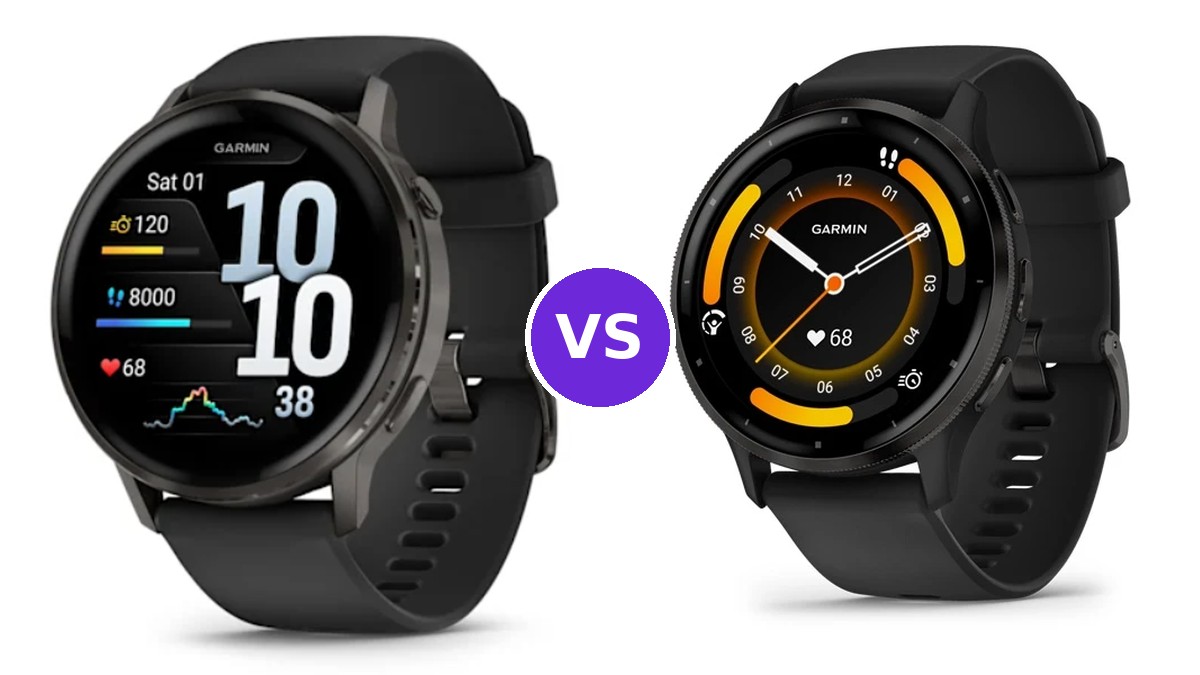
At a Glance: The Verdict
| Garmin Venu 4 | Garmin Venu 3 |
|---|---|
|
Best For: New buyers who want Garmin’s most complete lifestyle watch with premium build and advanced training tools The Garmin Venu 4 is a significant leap forward with a full stainless steel case, built-in flashlight, multi-band GPS, ECG, and a deep suite of performance metrics like Training Readiness and lactate threshold. It’s the default pick for anyone buying fresh — but at $549, it asks a premium for those upgrades. |
Best For: Venu 3 owners happy with their watch, or budget-conscious buyers who prioritize battery life over bleeding-edge features The Garmin Venu 3 still delivers a brilliant AMOLED display, solid health tracking, and up to 14 days of battery life — actually outlasting the newer Venu 4. If you already own one and mainly track steps, workouts, and sleep, there’s no urgent reason to upgrade. It’s also a smart buy at its now-discounted street price. |
Quick Buy Path
Check today’s pricing before you go deeper.
If these are already your two finalists, compare current pricing now, then keep reading for the full verdict.
The Garmin Venu 4 landed in September 2025 as a comprehensive overhaul of Garmin’s flagship lifestyle smartwatch. With a stainless steel build, multi-band GPS, built-in flashlight, and a deep bench of performance metrics borrowed from the Fenix and Forerunner lines, it’s easily the most capable Venu ever. But with a $100 price hike over the Venu 3, the real question for existing owners is whether those upgrades justify opening the wallet again.
For new buyers, the Venu 4 is the clear recommendation. This article focuses on what specifically changed, where the Venu 3 still holds its own, and whether upgrading makes sense for your situation.
⚡ Quick Buy Path
New buyer? Get the Garmin Venu 4 — it’s the better watch in nearly every measurable way.
Own a Venu 3? Keep reading. The upgrade math depends on whether you need multi-band GPS, ECG, and training analytics — or whether longer battery life and a lighter build still win for your routine.
Key Differences
- Build quality: The Venu 4 uses a full stainless steel and fiber-reinforced polymer case, giving it a noticeably more premium feel. The trade-off is weight — 38g vs the Venu 3’s featherlight 35g (both without band).
- Multi-band GPS: The Venu 4 upgrades to dual-frequency GNSS (L1 + L5) with SatIQ technology. The Venu 3 is limited to single-band GPS, which can struggle in urban canyons and dense tree cover.
- Built-in flashlight: A first for the Venu line, borrowed from Garmin’s outdoor watches. Useful for early-morning runs and nighttime safety.
- ECG capability: The Venu 4’s Elevate Gen 5 sensor adds electrocardiogram readings — a meaningful health upgrade the Venu 3 lacks.
- Training analytics: The Venu 4 adds Training Readiness, Training Load, Training Effect, lactate threshold, PacePro pacing, hill score, race predictor, and heat/altitude acclimation. These were previously reserved for Garmin’s Forerunner and Fenix lines.
- Display brightness: The Venu 4’s AMOLED hits 2,000 nits — roughly double the Venu 3 — making it far easier to read in direct sunlight.
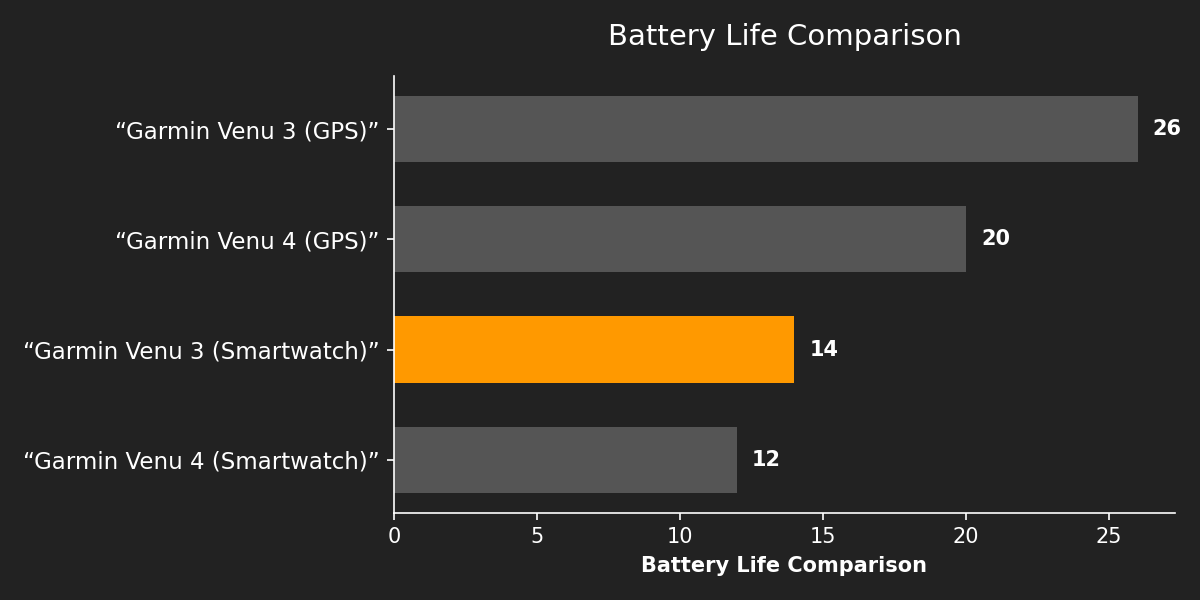
- Battery life favors the Venu 3: The older watch actually lasts longer — up to 14 days smartwatch / 26 hours GPS vs the Venu 4’s 12 days / 20 hours. The metal case and brighter display exact a cost.
- Price: $549 vs $449 at launch. The Venu 3 is now frequently available at further discounts, widening the gap.
Deep Dive Comparison
Design & Comfort
The Venu 4 is the first Venu to get a full stainless steel case, and the difference in hand feel is immediately apparent. It looks and feels like a premium watch in a way the Venu 3’s fiber-reinforced polymer body never quite managed. Garmin also added a built-in LED flashlight — a feature borrowed from the Fenix 8 and Enduro lines that’s surprisingly useful for dawn runners and late-night dog walks.
The catch is weight. At 38g (without band), the Venu 4 is slightly heavier than the Venu 3’s 35g. If you’re someone who notices their watch during sleep tracking or long runs, that’s not trivial. Both share the same 45mm case diameter and 1.4-inch AMOLED display at 454 x 454 resolution, and both maintain 5 ATM water resistance. The Venu 4’s display, however, peaks at 2,000 nits — roughly double the Venu 3 — which makes a real difference during outdoor workouts in bright sunlight.
Battery Life
Here’s where the Venu 3 actually wins. Garmin rates the Venu 3 at up to 14 days in smartwatch mode and 26 hours with GPS, versus 12 days and 20 hours for the Venu 4. Real-world testing by reviewers confirms the gap: the Venu 3 consistently delivers 10+ days even with always-on display enabled, while the Venu 4’s metal case, brighter screen, and multi-band GPS take a measurable toll.
For most users charging weekly, both watches are excellent. But if you’re traveling, backpacking, or simply hate charging, the Venu 3 gives you a meaningful buffer.
Health & Fitness Features
This is where the Venu 4 pulls decisively ahead. Both watches share core health tracking — optical heart rate, Pulse Ox, Body Battery, sleep tracking with sleep coach, stress monitoring, and women’s health features. But the Venu 4 adds a layer of serious athletic capability that the Venu 3 simply doesn’t have.
New on the Venu 4:
- ECG app — On-demand electrocardiogram readings for atrial fibrillation detection.
- Training Readiness — Combines sleep, recovery, and training load to tell you if today is a push day or a rest day.
- Training Load & Training Effect — Shows how your workouts distribute across aerobic and anaerobic zones over time.
- Lactate threshold estimation — Previously a Forerunner/Fenix exclusive.
- PacePro pacing strategies — GPS-powered pacing guidance for races and goal runs.
- Hill score & race predictor — Estimates your performance potential across distances.
- Heat & altitude acclimation — Tracks how your body adapts to environmental changes.
- Health Status dashboard — Aggregates HR, HRV, respiration, skin temperature, and Pulse Ox into a single trend view.
- Skin temperature sensor — The Venu 4 adds a thermometer sensor not present on the Venu 3.
The multi-band GPS is also a significant accuracy upgrade. Dual-frequency tracking (L1 + L5) across GPS, GLONASS, Galileo, and BeiDou gives the Venu 4 dramatically better position accuracy in challenging environments — think tall buildings, heavy tree cover, and canyon trails. The Venu 3’s single-band GPS is adequate for open roads but can wander in those conditions.
If you’re a casual fitness user who tracks walks and gym sessions, the Venu 3 covers your bases. If you run seriously, train for races, or want the most accurate GPS data, the Venu 4 is in a different league.
Smart Features
Both watches are well-matched on the smart side. They share Bluetooth, ANT+, and Wi-Fi connectivity, NFC for Garmin Pay, a microphone and speaker for phone calls, 8GB of onboard music storage, and support for Spotify, Amazon Music, and Deezer offline playback. Smart notifications, calendar alerts, and voice assistant integration are identical.
The Venu 4 runs Garmin’s updated OS platform (shared with the Fenix 8 and Forerunner 570/970), which brings a smoother interface and faster app performance. It also adds accessibility features including a spoken watch face and color blindness display modes — thoughtful additions that broaden the watch’s appeal.
Price & Value
The Venu 4 launched at $549 — a $100 premium over the Venu 3’s $449 launch price. Since the Venu 3 has been on the market for two years, it’s now regularly available at $350–$400, making the real-world price gap closer to $150–$200.
That changes the calculus. At $549, the Venu 4 competes with the Apple Watch Ultra and high-end Forerunners. At $350, the Venu 3 is arguably the best value AMOLED fitness smartwatch you can buy — you still get Garmin’s excellent ecosystem, multi-day battery life, and a feature set that covers 90% of what most people need.
Technical Specs
| Spec | Garmin Venu 4 | Garmin Venu 3 |
|---|---|---|
| Release Date | September 2025 | August 2023 |
| Price (Launch) | $549 | $449 |
| Case Size | 45mm | 45mm |
| Weight | 38g | 35g |
| Case Material | Stainless steel + FRP | FRP + stainless steel bezel |
| Display | 1.4″ AMOLED, 454×454, 2,000 nits | 1.4″ AMOLED, 454×454 |
| GPS | Multi-band GNSS (L1+L5) | Single-band GPS |
| Battery (Smartwatch) | Up to 12 days | Up to 14 days |
| Battery (GPS) | Up to 20 hours | Up to 26 hours |
| Water Rating | 5 ATM | 5 ATM |
| ECG | Yes | No |
| Flashlight | Yes | No |
| Training Readiness | Yes | No |
| Storage | 8GB | 8GB |
| NFC Payments | Garmin Pay | Garmin Pay |
The Verdict
For new buyers: Get the Garmin Venu 4. It’s the better watch, full stop. Multi-band GPS, ECG, the full training analytics suite, a premium steel build, and a sunlight-readable display make it the most complete lifestyle smartwatch Garmin has ever made. The $549 price is steep, but you’re getting hardware and software that previously required stepping up to a Forerunner 265 or Fenix 8.
For Venu 3 owners considering an upgrade: It depends on what you do with your watch. If you’re a serious runner or triathlete who wants Training Readiness, lactate threshold, PacePro, and accurate multi-band GPS, the Venu 4 is a meaningful upgrade that consolidates two Garmin watches into one. If you mainly use your Venu 3 for daily health tracking, step counting, sleep analysis, and weekend hikes — keep what you have. The Venu 3 still excels at all of that, lasts longer on a charge, weighs nearly half as much, and isn’t missing anything critical for that use case.
The budget play: The Venu 3 at its current street price of $350–$400 is arguably the best value in Garmin’s entire lineup. You get the same AMOLED display, the same core health suite, better battery life, and a lighter build. For 90% of fitness-focused users, it does everything they need — and the $150+ you save is real money.
Ready to Decide?
🏆 Buy the Garmin Venu 4 if you want the most capable Venu ever built — premium materials, multi-band GPS, ECG, and serious training tools in one package.
💰 Buy the Garmin Venu 3 if you prioritize battery life and value, or already own one and don’t need advanced training metrics.
🏆 Ready to Decide?
Check the latest deals to see which one fits your budget.
*We earn a commission if you make a purchase.
Specs and features may change. Always verify details on the manufacturer’s official site before purchasing.
