
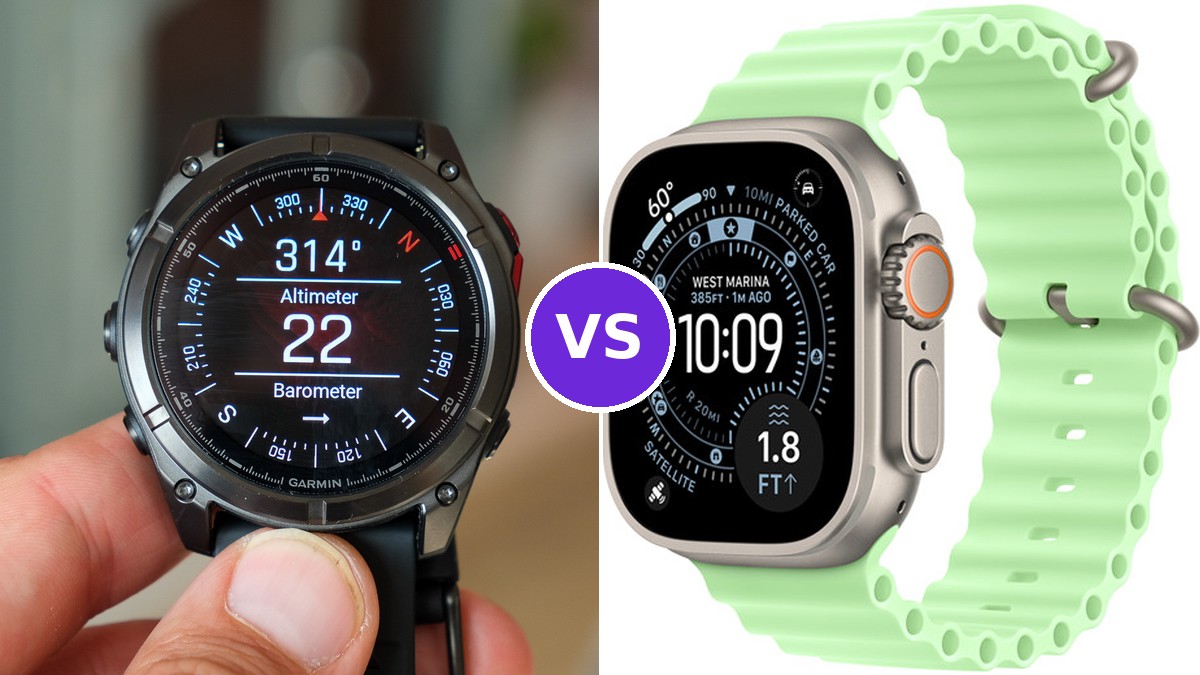
At a Glance: The Verdict
| Garmin Fenix 8 Pro | Apple Watch Ultra 3 |
|---|---|
|
Best For: Endurance athletes and backcountry adventurers who need multi-day battery and satellite messaging The Fenix 8 Pro delivers up to 15 days of smartwatch battery, built-in inReach satellite communication, and the deepest training analytics available on any wrist. It’s the watch you grab when you’re heading off-grid for days at a time. |
Best For: iPhone users who want a rugged, full-featured smartwatch with the best display in its class The Apple Watch Ultra 3 pairs a stunning 1.98-inch display with deep iOS integration, advanced health sensors, and a titanium build that can handle serious outdoor abuse — all at $400 less than the Fenix 8 Pro. |
The Garmin Fenix 8 Pro and Apple Watch Ultra 3 sit at the top of their respective ecosystems, and both are pitched at serious athletes. But they come from fundamentally different design philosophies — Garmin builds from the trail inward, while Apple builds from the phone outward. That distinction shapes everything from battery architecture to training tools, and it means the right choice depends heavily on how you train and what ecosystem you already own.
Key Differences
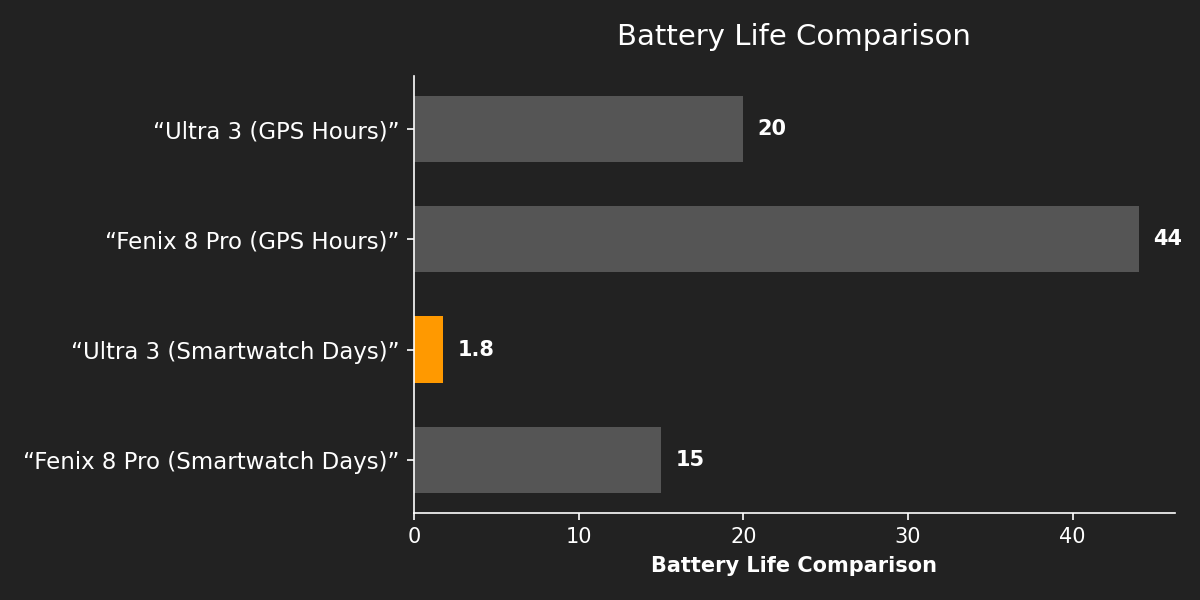
- Battery life isn’t close: The Fenix 8 Pro lasts up to 15 days in smartwatch mode and 44 hours with GPS. The Ultra 3 manages roughly 42 hours in smartwatch mode and about 20 hours with GPS — a fraction of the Garmin’s endurance.
- Satellite messaging is built into the Fenix 8 Pro: Garmin’s inReach technology lets you send and receive text messages via satellite anywhere on Earth. The Ultra 3 supports emergency SOS via satellite, but not two-way messaging.
- The Ultra 3 has the larger, sharper display: At 1.98 inches with LTPO3 OLED, the Ultra 3’s screen is significantly bigger and brighter than the Fenix 8 Pro’s 1.4-inch AMOLED panel.
- Ecosystem lock-in matters: The Ultra 3 requires an iPhone. The Fenix 8 Pro works with both iOS and Android, though the full Garmin Connect experience is equal on both platforms.
- Training analytics depth: The Fenix 8 Pro offers Training Readiness, Stamina tracking, Hill Score, Endurance Score, and multi-sport transition support that goes well beyond what Apple currently provides.
- Price gap is significant: The Fenix 8 Pro (47mm Sapphire AMOLED) launches at $1,199, while the Ultra 3 starts at $799 — a $400 difference.
Deep Dive Comparison
Design & Comfort
The Garmin Fenix 8 Pro uses a fiber-reinforced polymer case with a titanium rear cover and a sapphire crystal lens. At 77g and 47mm, it wears like a traditional chunky sport watch — substantial but well-balanced on larger wrists. Garmin’s QuickFit band system makes swapping straps effortless.
The Apple Watch Ultra 3 is built from Grade 5 titanium throughout, which gives it a more premium, unified feel. Despite the larger 49mm case, it’s actually lighter at 61.6g thanks to the titanium construction. The flat sapphire front crystal and raised edges protect the display well. Both watches handle water with confidence — the Fenix 8 Pro is rated to 10 ATM and the Ultra 3 to 100 meters — but only the Ultra 3 carries an actual EN13319 dive certification.
Battery Life
This is where the Fenix 8 Pro pulls decisively ahead. With up to 15 days (360 hours) of smartwatch battery life and 44 hours of continuous GPS tracking, it’s built for multi-day expeditions without a charger. The Apple Watch Ultra 3 offers roughly 42 hours in smartwatch mode and about 20 hours of GPS — respectable for an Apple Watch, but it still needs charging every one to two days under real-world athletic use.
For ultrarunners, thru-hikers, or anyone spending extended time away from power, this gap is the single biggest decision driver.
Health & Fitness Features
Both watches pack serious sensor arrays, but they emphasize different things. The Fenix 8 Pro features Garmin’s Gen 5 Elevate optical heart rate sensor, Pulse Ox monitoring, a barometric altimeter, thermometer, and depth sensor. Its training software is where it truly shines: Training Readiness scores, Body Battery energy monitoring, Stamina tracking in real time, Hill Score, Endurance Score, and deep running dynamics when paired with compatible accessories like the HRM-Pro Plus. The multi-band GPS with SatIQ technology delivers accurate tracks even under heavy tree cover.
The Apple Watch Ultra 3 counters with an electrical heart sensor (for ECG), optical heart rate (Gen 3), blood oxygen, and temperature sensing. Apple’s health ecosystem integrates tightly with the Health app for trend analysis and doctor sharing. The precision dual-frequency GPS (L1 + L5) delivers similarly accurate positioning. Where Apple falls short is in training load management — there’s no equivalent to Garmin’s Training Status, recovery advisor, or race predictor built into watchOS.
Smart Features
This round goes to Apple without much debate. The Ultra 3 runs the full watchOS experience with native apps for Messages, Mail, Maps, Podcasts, and thousands of third-party options. Phone calls work directly from the wrist via LTE. Siri integration, Apple Pay, and seamless handoff with your iPhone make daily smartwatch tasks effortless. With 64GB of storage, you can load a massive music library or podcast backlog.
The Fenix 8 Pro has improved its smart features considerably — it now has LTE connectivity, a microphone and speaker for calls, Garmin Pay, and 32GB of storage for music. But the app ecosystem is far smaller, notifications are more limited in interactivity, and the overall “smart” experience doesn’t match Apple’s polish. That said, Garmin’s Connect IQ store does offer useful sport-specific apps and data fields that Apple can’t replicate.
Price & Value
The Apple Watch Ultra 3 launches at $799, which is already a premium price by smartwatch standards. The Garmin Fenix 8 Pro 47mm Sapphire AMOLED edition starts at $1,199 — a full $400 more. That’s a meaningful gap, though the Fenix 8 Pro’s price reflects its sapphire lens, inReach satellite subscription capability, and multi-day battery architecture.
For buyers who primarily want a rugged smartwatch with strong fitness tracking, the Ultra 3 delivers excellent value. For dedicated athletes and adventurers who will use the advanced training tools and satellite features daily, the Fenix 8 Pro justifies its premium.
Technical Specs
| Spec | Garmin Fenix 8 Pro | Apple Watch Ultra 3 |
|---|---|---|
| Case Size | 47mm | 49mm |
| Weight | 77g | 61.6g |
| Case Material | Fiber-reinforced polymer / titanium | Grade 5 Titanium |
| Display | 1.4″ AMOLED (454 x 454) | 1.98″ LTPO3 OLED (422 x 514) |
| Water Rating | 10 ATM | 100m (ISO 22810) |
| Battery (Smartwatch) | Up to 15 days | Up to 42 hours |
| Battery (GPS) | Up to 44 hours | Up to 20 hours |
| GPS | Multi-band with SatIQ | Dual-frequency (L1 + L5) |
| Connectivity | BT, ANT+, Wi-Fi, LTE, Satellite | BT 5.3, Wi-Fi 4, LTE |
| Storage | 32GB | 64GB |
| NFC Payments | Yes (Garmin Pay) | Yes (Apple Pay) |
| Launch Price | $1,199 | $799 |
The Verdict
Buy the Garmin Fenix 8 Pro if you’re a dedicated endurance athlete — a trail runner, ultra-marathoner, triathlete, or backcountry hiker — who needs multi-day battery life without compromise. If you rely on detailed training load data, recovery metrics, and performance analytics to structure your training, the Fenix 8 Pro is unmatched. The built-in inReach satellite messaging is a genuine safety advantage for anyone who regularly ventures beyond cell coverage. And if you use an Android phone, this is the clear choice since the Ultra 3 isn’t an option.
Buy the Apple Watch Ultra 3 if you’re an active iPhone user who wants one device for both daily life and serious workouts. Its smartwatch experience is far superior for notifications, calls, apps, and everyday convenience. The larger display is easier to read mid-run, the titanium build is lighter and tougher, and at $799 it’s $400 less expensive. For athletes who charge nightly anyway and don’t need week-long battery or satellite texting, the Ultra 3 is the smarter buy.
The bottom line: The Fenix 8 Pro wins on endurance and training depth. The Ultra 3 wins on value, display, and daily smartwatch utility. Neither is the wrong choice — but they serve different priorities, and your training habits should drive the decision.
🏆 Ready to Decide?
Check the latest deals to see which one fits your budget.
*We earn a commission if you make a purchase.
Specs and features may change. Always verify details on the manufacturer’s official site before purchasing.
